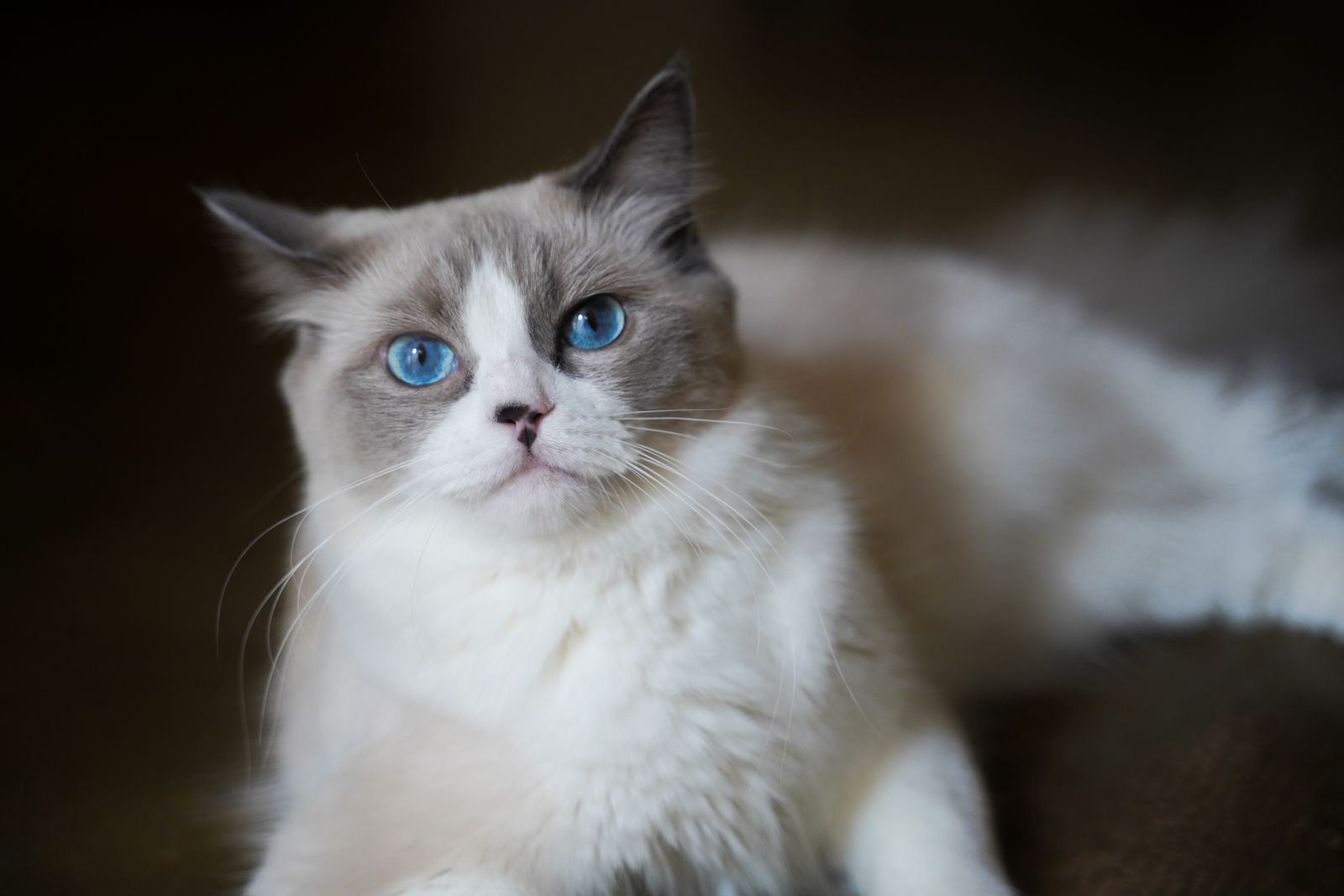
Ragdoll snapshot
The Cat Fanciers Association, known as the CFA, describes Ragdolls as loving without being demanding, as well as gentle, calm, and sociable. The CFA breed standard calls the Ragdoll a medium to large, moderately longhaired, blue eyed pointed cat. Pointed means the ears, face, legs, and tail carry darker color than the body. The standard describes a large and long body with heavy boning, a full chest, and a long tail with a full plume. It also describes a cat that follows its people. The CFA notes that a Ragdoll can be expected to greet you when you come home and stay close to your side, and that many sleep with their owners.
Two snapshot facts shape the insurance picture. The first is slow maturation. The CFA standard says Ragdolls are slow maturing, reaching full coat and color at about three years of age, and to allow for slow maturation in young adults. A young Ragdoll is therefore not a finished adult on the schedule owners may expect from a smaller cat. Screening, weight, and development need to be read across those early years, not only in the first kitten months. The second fact is trust. The CFA notes that it is rare for a Ragdoll to be aggressive or temperamental, and that the breed trusting nature means introductions to other animals need extra care. At the veterinary clinic, that same steadiness can be a mixed gift. A compliant cat is easier to examine, and a compliant cat may also show very little protest while something painful, such as a sore tooth or a full and blocked bladder, is getting worse.
| Size and build | Medium to large, with a large and long, broad and solid body, heavy boning, a full chest, and a rectangular shape. Females may be substantially smaller than males. |
|---|---|
| Coat | Moderately long, with abundant guard hairs and minimal woolly undercoat. The coat flows with the body, is shorter on the face, and lengthens toward a ruff and a long, plumed tail. |
| Eyes and color | Large, vivid blue oval eyes in every Ragdoll. All Ragdolls are pointed, in patterns that can include colorpoint, mitted, bicolor, and van white overlay patterns, and in point colors such as seal, blue, chocolate, and lilac. |
| Temperament | Gentle, calm, and sociable. Loving without being demanding, moderately active, playful and trainable, not very talkative, and closely attached to its people. |
| Maturation | Slow maturing. Full coat and color arrive at about three years of age, and young adults should be allowed for slow maturation. |
| Keeping notes | The CFA notes a love of food and a risk of gaining too much weight, so portion control and a healthy weight are part of ordinary Ragdoll care. |
Notice what this snapshot does not claim. It does not promise a set lifespan, a set adult weight, or a clean bill of health for the breed. The CFA itself pairs a generally healthy picture with a named hereditary warning. It says that, because of a diverse genetic background, Ragdolls are relatively healthy, and it names one hereditary health issue found in the breed, hypertrophic cardiomyopathy, noting that breeders now routinely test for it. That pairing is the honest starting point for this guide. A generally sturdy cat, one heart condition to screen for on purpose, a urinary emergency every owner should be able to recognize, and the ordinary cat conditions of kidneys, gut, and teeth that a long and quiet life can still bring.
Insurance terms in this guide are defined where they first appear. A deductible is the amount you pay out of pocket for covered care before reimbursement begins. Reimbursement is the share of an eligible bill the insurer pays back after the deductible. A pre-existing condition is a condition, or a sign of one, that was present before enrollment or during a waiting period. A waiting period is the set time after enrollment before illness cover begins. Hereditary means passed through the family line, and congenital means present at birth. Those definitions matter in every section that follows, because the Ragdoll claim stories in this guide turn less on exotic wording and more on dates, records, and whether a sign was written down before the policy started.
Health tendencies in Ragdolls
This section separates three kinds of risk, because honest separation is what makes a breed guide useful. First, there are breed linked risks, where a registry, a genetics laboratory, or a veterinary school names the Ragdoll itself. Hypertrophic cardiomyopathy belongs in that group, and polycystic kidney disease belongs in the related group of conditions the breed is screened for. Second, there are general cat risks that matter a great deal in this breed because of its sex, size, coat, or temperament. Urinary blockage in a male cat, bladder stones, gut disease, and dental pain belong there. Third, there are age related risks that arrive in many cats, and chronic kidney disease is the clearest example. A policy needs to handle all three groups, and the wording that protects one group does not always protect the others.
This section is general information about conditions a breed can be prone to, or that cats in general can develop. It is not veterinary advice and it is not a diagnosis of any cat. Signs listed here are possible signs owners may notice, and many of them have several causes. Only a veterinarian who examines your cat can say what a sign means. If your cat shows an emergency sign described on this page, seek veterinary care first and think about claims afterward.
Litter box and breathing emergency action card
Use this card at night, when the choice is between waiting and going. It covers the two emergencies this guide centers, a blocked urinary tract and breathing trouble that can accompany heart failure. It does not replace a veterinarian. It helps an owner sort what cannot wait until morning from what should still be booked promptly.
| What you see | What to do | Why it matters |
|---|---|---|
| Straining in the litter box with little or no urine coming out, repeated trips, crying while trying to urinate, or a cat that is becoming distressed | Go now. Travel to a veterinarian or emergency clinic immediately, day or night. | Cornell calls a urethral obstruction an absolute emergency. A blocked cat cannot empty the bladder, and the body balance of fluids and salts can become life threatening. |
| No fresh urine in the litter box, licking the genital area often, vomiting, hiding, weakness, or a cat that seems painful or unusually quiet after straining | Go now, and call ahead while you travel if you can do so safely. | These signs can accompany an obstruction as time passes. Waiting for a normal urine clump to appear is the dangerous delay in this story. |
| Labored or rapid breathing, open mouth breathing, or a cat that cannot settle and breathe comfortably | Go now. Keep the cat calm and handle it as little as possible on the way. | Cornell lists labored or rapid breathing, open mouthed breathing, and lethargy as signs that can appear when fluid builds in or around the lungs in heart disease. |
| Sudden pain or weakness in the back legs, or back legs that will not work | Go now. | Cornell explains that a blood clot linked to heart disease can block blood flow to the hind limbs, causing acute hind limb pain or, in extreme cases, paralysis. |
| Frequent small urinations, blood in the urine, or urinating outside the litter box, with normal amounts of urine still being passed | Call the veterinarian today and book promptly. | These are lower urinary tract signs with several possible causes, including bladder inflammation and stones. They need a diagnosis, and in a male cat they can move toward blockage. |
| Eating less, drinking or urinating more than usual, gradual weight loss, vomiting that repeats, or bad breath with drooling or dropping food | Book a routine visit soon, and mention every change when you book. | These slower signs can belong to kidney, gut, dental, thyroid, or other conditions. They are rarely solved by watching at home, and a dated record helps both care and any later claim. |
One rule sits above the whole card. Do not press on a straining cat belly, do not try to express the bladder, and do not give human pain medicine. Those steps can injure a blocked cat or poison a cat whose kidneys are already under strain. The home job is transport, a carrier, any notes about when signs started and when urine was last seen, and a phone call ahead if it can be made safely.
Hypertrophic cardiomyopathy (thickened heart muscle)
What it is
Hypertrophic cardiomyopathy, often shortened to HCM, is a condition in which the muscular walls of the heart thicken. Cornell University College of Veterinary Medicine, through its Feline Health Center, calls HCM the most common heart disease of cats, and explains that the left ventricle, the heart main pump chamber, thickens, holds less blood, and relaxes abnormally. Cornell lists the Ragdoll among the breeds in which the condition is more prevalent, and notes that mutations in several heart genes have been found in some cats with the disease, which suggests that genetics plays a role. This is the condition the CFA names as the hereditary health issue found in this breed.
The UC Davis Veterinary Genetics Laboratory adds the Ragdoll specific detail. In Ragdolls, a breed specific mutation known as R820W has been found in a heart gene called MYBPC3, and that mutation is associated with increased risk for HCM. The laboratory describes the pattern as autosomal dominant with incomplete penetrance. In plain language, a cat needs only one copy of the changed gene to carry the risk, and not every cat that carries it will show the disease in the same way. The laboratory reports that cats with two copies are at high risk of developing severe signs, usually between one and two years of age, and have a greater likelihood of early cardiac death, while cats with one copy are not likely to show signs and may live a normal lifespan. A DNA result is therefore a screening tool, not a verdict about the heart itself.
Signs owners may notice
- Often, none at all. Cornell is direct that many cats with HCM do not appear to be ill, which is why screening and routine examinations matter in this breed.
- Labored or rapid breathing, open mouthed breathing, and lethargy, which Cornell lists as signs of congestive heart failure when fluid accumulates in or around the lungs.
- Less interest in play, tiring sooner, hiding more, or a cat that seems flat and withdrawn compared with its usual people oriented self.
- A heart murmur or an irregular rhythm found by a veterinarian at a routine visit, even in a cat that looks well at home. A murmur is a sound, not a diagnosis, and it is one common doorway into heart testing.
- Sudden hind limb pain or paralysis, or collapse, which are emergency presentations rather than early warnings.
How vets usually evaluate and treat it
Cornell states that HCM is diagnosed by echocardiography, an ultrasound technology that creates an image of the heart and shows the thickened walls and reduced chamber volume. That sentence carries the insurance lesson of this card. A DNA test can show a mutation. A stethoscope can find a murmur. Neither one, on its own, diagnoses the thickened muscle. Cornell also notes that similar thickening can be caused by high blood pressure and by hyperthyroidism, an overactive thyroid, and that those diseases must be ruled out before HCM is diagnosed. A full evaluation can therefore include a physical examination, blood pressure measurement, blood testing including thyroid testing, chest radiographs, which are X-ray images, and electrocardiography, a recording of the heart electrical activity, depending on the findings.
Cornell notes that HCM has no known cure, and that a specialized care plan can help manage its signs. The goals it names are controlling heart rate, easing lung congestion in heart failure, and preventing the blood clots that can lead to thromboembolism, which is a clot blocking a vessel. Medication categories sit inside that plan, given by mouth to a stable cat or by injection in a more serious situation. For an owner, the practical shape is repeat examinations, repeat heart imaging at intervals a veterinarian sets, daily medication if it is prescribed, and a clear plan for what to do if breathing changes at home. Every one of those repeat steps is a claim question, which is why the clause box below matters as much as the diagnosis itself.
Polycystic kidney disease (inherited kidney cysts)
What it is
Polycystic kidney disease, often shortened to PKD, is an inherited condition in which fluid filled cysts form in the kidneys. The UC Davis Veterinary Genetics Laboratory describes the tested form, called PKD1, as a heritable form commonly seen in Persians and cats with Persian ancestry, and it lists the Ragdoll among the breeds for which PKD1 testing is appropriate. That wording should be read carefully and honestly. PKD is a screened condition in the Ragdoll testing conversation. It is not presented by UC Davis as a condition that defines the breed in the way HCM does, and this guide does not claim otherwise.
UC Davis explains that the early pattern is distinctive. Kidney cysts in this form present early, often before twelve months of age, are found in both kidneys, and are multiple, while kidney failure usually occurs at a later age. The inheritance is autosomal dominant, meaning one copy of the changed gene is enough for a cat to be affected. The laboratory explains that a cat with one copy will be affected by this heritable form, though the severity cannot be predicted, and that a cat with no copies will not have this heritable form and cannot pass that tested variant on. As with the heart test, the result answers one precise question about one known variant. It does not grade how a given cat kidneys will perform across a lifetime.
Signs owners may notice
- In the early cyst stage, usually no signs at home at all. The cysts are an imaging and testing finding long before they are a behavior change.
- Later, if kidney function declines, the signs overlap with chronic kidney disease. Drinking more, urinating more, reduced appetite, weight loss, and lower energy can all appear, and each of them has other causes as well.
- Enlarged kidneys or cysts found on an ultrasound examination done for screening or for another reason.
When it can be urgent
PKD itself usually develops slowly. Urgency comes from the company it can keep. A cat that stops eating, vomits repeatedly, becomes weak, produces little urine, or seems dehydrated needs prompt care, because those signs can mean kidney function or body fluid balance has worsened, whatever the underlying cause. A cat that is straining and passing no urine belongs in the emergency card above, not in a kidney monitoring plan.
How vets usually evaluate and treat it
Evaluation works on two levels. The genetic level is a DNA test for the known PKD1 variant, most useful in breeding decisions and in understanding a kitten background. The cat level is examination and imaging. Ultrasound can show cysts in the kidneys, and blood and urine testing show how well the kidneys are currently working. UC Davis notes that ultrasound screening and improved breeding practices have been used to reduce this condition in heavily affected lines. There is no step in the sources used for this guide that removes cysts or reverses the inherited pattern. Care therefore follows kidney function over time, with the monitoring, diet, hydration, and supportive categories described in the chronic kidney disease card below.
For a kitten buyer, the useful request is documents, not reassurance. Ask a breeder for the parents PKD1 results and their heart screening results together, because the two tests answer different questions and a clear result on one says nothing about the other. For a cat already at home, ask the veterinarian whether any kidney imaging or baseline blood and urine values are worth recording while the cat is well. A baseline is valuable later, because kidney claims often turn on when a value first changed.
Bladder stones and feline lower urinary tract disease
What it is
Feline lower urinary tract disease is a group of disorders, not one diagnosis. Cornell explains that lower urinary tract disease covers abnormalities of the bladder and the urethra, the tube that carries urine out of the body, and that its signs are often grouped as lower urinary tract signs. The common causes Cornell names include idiopathic cystitis, a painful bladder condition whose cause is not identified, urolithiasis, meaning urinary stones, and urethral obstruction, meaning a blockage of the urinary tract. A Ragdoll is not singled out by Cornell as a urinary breed. This is a general cat risk, and it earns its central place in this guide because a calm male cat can move from litter box discomfort to a complete blockage, and because Ragdoll size and temperament can make the early signs easy to read as a behavior quirk.
Bladder stones, called uroliths, are rock hard collections of minerals that form in the urinary tract. Cornell names the two most common stone types in cats as struvite, composed of magnesium, phosphorus, and ammonia, and calcium oxalate. The distinction is not academic. Cornell explains that a veterinarian may prescribe a special stone dissolving diet for struvite stones, and that surgery may be needed if that approach fails, while calcium oxalate stones cannot be dissolved with special diets and often need a more direct removal approach, such as flushing or surgery. Cornell also warns that cats that have formed stones are at increased risk of recurrence, and that a veterinarian may recommend medication or dietary changes to help prevent a return. Stone type, found by testing, therefore shapes both treatment and the recurrence plan an insurer will later be asked to pay toward.
Idiopathic cystitis deserves its own plain explanation, because many owners are told their cat has urinary signs and no infection, and hear that as no problem found. Cornell calls feline idiopathic cystitis the most common diagnosis in cats with lower urinary tract signs, and describes it as a diagnosis used when testing does not confirm another disease. Cornell notes that stress seems to be an important factor, that environmental enrichment and modification can reduce the severity and frequency of episodes, and that cats should have a safe and clean area in which to urinate as well as chances to climb, chase, and play. In a breed that settles closely around its people and its home routine, changes in household, routine, food schedule, or the number of animals can be part of the history a veterinarian needs, even though they never prove a cause on their own.
Signs owners may notice
- Difficult or painful urination, straining, or crying out while urinating.
- Increased frequency of urination, many trips to the litter box, or many small urine clumps instead of a normal amount.
- Blood in the urine, urinating outside the litter box, or frequent licking of the genital region. Cornell lists each of these among the most common signs of lower urinary tract disease.
- For stones in particular, the same signs in a cat that keeps returning to the box, because a stone can irritate the bladder or partly block the flow without stopping it completely at first.
- For a blocked cat, the pattern changes. Cornell notes that obstructed cats often show the same signs but pass little or no urine and become increasingly distressed, often crying out in pain as time passes.
How vets usually evaluate and treat it
Cornell describes the starting point as a physical examination and a urinalysis, which is a microscopic analysis of a urine sample. If that does not identify the cause, a veterinarian may recommend blood work, X-ray images, abdominal ultrasound, or a urine culture, which grows and identifies bacteria when infection is part of the question. Stones are usually diagnosed with X-ray images or ultrasound. That sequence matters for claims, because the itemized record will show several test categories before it shows a treatment, and each test is part of reaching the diagnosis rather than an optional extra.
Treatment of an obstruction usually involves catheterization, the passage of a narrow tube up the urethra to relieve the blockage, usually under sedation or anesthesia. Cornell explains that, after the obstruction is relieved, dehydration and electrolyte imbalance, meaning a disturbed balance of salts and fluids in the body, are treated with intravenous fluid therapy, that medication may be given for bacterial infection when present, and that drugs to help restore bladder function are sometimes required. Hospital time depends on severity and duration. Cornell also describes a surgery called perineal urethrostomy, which removes the narrow portion of the urethra and leaves a wider opening, as a last resort for cats that keep obstructing despite proper medical management, because it carries its own risks and side effects. For unobstructed bladder inflammation, care categories can include pain relief, consistent diet and feeding schedule, environmental change, and monitoring for recurrence, all directed by the veterinarian who examined the cat.
Chronic kidney disease (long term loss of kidney function)
What it is
Chronic kidney disease, often shortened to CKD, is the persistent loss of kidney function over time. Cornell describes healthy kidneys as filtering the blood, making urine, and helping to regulate blood pressure, and describes CKD as one of the most prevalent diseases in older cats, with age as the only known risk factor for its development in cats. That last point sets the honest frame for this card. CKD is not a Ragdoll breed condition in the way HCM is. It is the senior cat condition that a Ragdoll shares with cats in general, and a guide that skipped it would leave out the condition most likely to shape the later years of an insured cat life.
CKD is also the condition that connects several other cards. PKD can end in kidney failure at a later stage. A urinary obstruction can compromise the kidneys ability to remove toxins while it lasts. Dental and gut disease can reduce eating and drinking in a cat whose kidneys already have little reserve. None of that makes every kidney value a Ragdoll emergency. It makes baseline testing, dated records, and renewal wording unusually important in a breed whose owners may otherwise have very little in the medical file for years.
Signs owners may notice
- Drinking more water and producing larger or more frequent amounts of urine, as kidneys become less able to concentrate urine.
- Reduced appetite, gradual weight loss, lower energy, and a coat that looks less well kept than before.
- Nausea signs, such as lip licking, turning away from food, or vomiting, in a cat that still approaches the bowl.
- Bad breath, mouth sores, dehydration, or weakness in more advanced disease, each of which needs veterinary assessment rather than home interpretation.
- Sometimes no home sign at all in the early stage, with the first clue appearing in routine blood or urine testing at a senior visit.
When it can be urgent
CKD is usually a slow condition managed across months and years. It becomes urgent when the picture changes suddenly. A cat that stops eating or drinking, vomits repeatedly, becomes weak or unsteady, produces very little urine, or seems markedly worse over a short period needs same day care. A sudden change in a cat known to have kidney disease should never be filed away as just the kidney condition progressing, because dehydration, infection, obstruction, blood pressure problems, and other treatable causes can sit behind the change.
How vets usually evaluate and treat it
Cornell explains that veterinarians most often turn to blood tests and urine analysis to evaluate kidney function, looking at waste products and other components that healthy kidneys normally filter or regulate. It names blood urea nitrogen, creatinine, and symmetric dimethyl arginine as three important waste related measures in blood testing, and notes that a urine protein to creatinine ratio can help judge protein loss through the kidneys and the severity of disease. Cornell also notes that cats with CKD are at risk for high blood pressure and for anemia, a low red blood cell count, so blood pressure measurement and blood count testing can be part of a complete evaluation rather than extras.
Care is management, not reversal. Cornell points to prescription diets made for cats with kidney disease, in wet and dry forms and in a range of flavors and textures, and stresses working closely with a veterinarian to find an option the individual cat will eat. It states plainly that maintaining good hydration is essential, because dehydration can speed damage and worsen signs. Other therapy categories it names include phosphate binders, potassium supplementation, appetite support, and anti nausea medication, each used when it fits a particular cat results and signs. For an owner, the lived pattern is repeat testing on a schedule the veterinarian sets, diet adjustment, attention to water intake, and prompt visits when appetite or drinking changes. The insurance pattern matches it exactly. Small, repeated, medically necessary monitoring is the claim story, repeated at every renewal.
Gastrointestinal disease and inflammatory bowel disease
What it is
Gastrointestinal disease means disease of the stomach and intestines, the digestive tract that takes in food, absorbs nutrients, and moves waste out. Inflammatory bowel disease, often shortened to IBD, is one specific pattern inside that wider group. Cornell explains that in feline IBD, the gastrointestinal tract becomes chronically irritated and inflamed, as inflammatory cells enter the walls of the tract, thicken them, and disrupt the ability to digest and absorb food properly. Cornell notes that cats of any age can be affected, that the disease occurs most often in middle aged and older cats, and that its cause is unknown, with current evidence pointing to a complex interaction among the immune system, diet, bacterial populations in the intestines, and other environmental factors.
Honesty about breed link matters here too. The sources used for this guide do not name IBD as a Ragdoll hereditary condition, and this card does not claim that it is. It belongs in a Ragdoll guide for two practical reasons. First, vomiting and appetite change are easy to misread in a cat with a moderately long coat, because owners can reasonably blame hairballs for episodes that deserve a workup when they repeat. A hairball explanation fits an occasional episode. It fits much less well when vomiting, diarrhea, or weight loss becomes a pattern. Second, IBD is a diagnosis built by ruling other conditions out, which makes its workup long, staged, and especially sensitive to policy wording about diagnostics, specialist care, and chronic renewal.
Cornell explains the naming by location. If the stomach is inflamed, the condition is called gastritis. If the small intestine is inflamed, it is called enteritis. If the colon, the large intestine, is inflamed, it is called colitis. Cornell names lymphocytic plasmacytic enteritis as the most common form, involving two types of inflammatory white blood cells entering the small intestine. An owner does not need to memorize those terms. An owner does need to understand why a veterinarian will not name IBD from one loose stool, and why a biopsy, a small sample of tissue examined under a microscope, appears in the definitive diagnosis discussion below.
Signs owners may notice
- Vomiting that repeats across weeks, not only after eating quickly or bringing up a hairball.
- Weight loss, diarrhea, bloody stools, lethargy, and decreased appetite. Cornell lists each of these among the common signs of feline IBD.
- A cat that asks for food and then walks away, eats much smaller amounts, or becomes selective in a new and persistent way.
- More gas, a gurgling belly, or stools that vary in a pattern tied to no obvious food change.
When it can be urgent
Chronic gut signs are usually a prompt routine workup. They become urgent when a cat cannot keep water down, vomits repeatedly in a short period, has blood in vomit or stool with weakness, has a painful or swollen belly, may have swallowed string, ribbon, or another object, or stops eating entirely, above all in a heavier cat. A swallowed linear object, such as string, is an emergency in its own right and should never be pulled from the mouth or the rear end at home. Call or travel for veterinary care and let the clinic direct the next step.
How vets usually evaluate and treat it
Cornell is clear that diagnosing feline IBD requires an extensive workup, because many of its signs are also seen with other diseases. A veterinarian will usually build the picture in layers. History and physical examination come first, including weight history and a careful account of food, treats, hunting or scavenging, medicines, and household changes. Blood testing, fecal testing for parasites, and imaging can follow, to look for conditions involving the thyroid, kidneys, liver, pancreas, or the gut itself. Diet trials can be part of the process, because a response to a carefully chosen diet is useful information as well as a treatment step.
Cornell states that a definitive diagnosis of feline IBD requires an intestinal or gastric biopsy and evaluation of the tissue under a microscope. That one sentence explains the cost shape of this condition without naming any figure. Endoscopy, a camera procedure used to view and sample the tract, or surgery to obtain samples, plus laboratory analysis of the tissue, may all sit between the first vomiting visit and a named diagnosis. Treatment categories Cornell discusses include dietary modification and medical therapy chosen for the individual cat. Because IBD care can continue for life, with diet changes, medication adjustments, vitamin support when a veterinarian finds a deficiency, and rechecks when signs flare, the claim question is again duration. A policy that pays willingly for the first workup and then treats every flare as a new or excluded problem leaves the owner carrying the chronic part alone.
Dental disease (gums, periodontal disease, and tooth resorption)
What it is
Dental disease is disease of the teeth and gums. Cornell describes diseases of the teeth and gums as common in cats, and names the three most common dental diseases as gingivitis, periodontitis, and tooth resorption. Gingivitis is inflammation of the gums where they meet the teeth, seen as swelling, redness, discomfort, and, in severe cases, bleeding. Periodontitis is what can follow if gingivitis is not controlled. It affects the deeper tissues that hold a tooth in place and, once established, cannot simply be reversed. Tooth resorption is a breakdown of tooth structure that Cornell describes as first appearing as a pinkish defect in the tooth at the line where the tooth meets the gums.
This is a general cat condition, not a Ragdoll hereditary condition, and it belongs in this guide because mouth pain is the condition a calm cat is best at hiding. A Ragdoll that eats more slowly, drops kibble, chews on one side, grooms less, or withdraws from the close contact it usually seeks may be protecting a sore mouth. None of those changes proves dental disease. All of them deserve an oral examination before they are explained away as age, mood, or a dislike of a new food. In a breed whose owners value close daily contact, a change in that contact is data.
Signs owners may notice
- Bad breath that persists, red or swollen gums, or bleeding where the gums meet the teeth.
- Drooling, pawing at the mouth, dropping food, chewing on one side, or preferring soft food over food the cat used to eat happily.
- Reduced appetite, weight loss, less grooming, or a cat that resists having its face or mouth touched.
- A pinkish defect or a broken looking area on a tooth at the gum line, broken teeth, or teeth that look discolored or loose.
- Sometimes no clear home sign, with disease found under the gum line at a veterinary dental examination.
When it can be urgent
Most dental disease is a prompt routine visit, and it should not be left for an annual check if pain signs are present. Same day care fits a cat that cannot eat, drools with blood, has facial swelling, has a jaw injury, or seems to be in marked pain. A cat that stops eating needs prompt attention for reasons beyond the mouth as well, because poor intake can worsen kidney and liver problems in a vulnerable cat. When in doubt, call and describe the eating change plainly rather than waiting for the mouth to declare itself.
How vets usually evaluate and treat it
A complete dental evaluation goes beyond what a cooperative cat shows while awake. Cornell explains that a complete evaluation of a cat with periodontitis involves probing the gums and examining X-ray images of the head and jaw, which require anesthesia. That is why a dental procedure quote and a dental claim can include anesthesia, monitoring, imaging, cleaning, and treatment of individual teeth as separate parts of one medically connected event. Cornell notes that treatment for periodontitis involves removing plaque and mineral buildup by scaling and polishing the teeth while trying to save teeth where possible. For tooth resorption, Cornell associated guidance describes extraction of affected teeth as the effective treatment when the condition is confirmed, because a resorbing tooth cannot be restored to a sound tooth.
Prevention still matters alongside insurance. Cornell identifies regular removal of plaque buildup by tooth brushing as the best way to prevent gingivitis. Brushing works best when it is introduced gradually, with pet specific toothpaste, and stopped before it becomes a fight that ends the habit. Dental diets, chews, and water or food additives are a wide and uneven market, and a veterinarian who has seen the individual cat mouth is the right source for which, if any, of them fits. Insurance wording should be read with the same care. In pet policies, routine cleaning, dental illness, dental injury, and treatment under anesthesia are often handled under different rules, and assuming that the word dental on a summary page settles the question is a common and expensive mistake.
Policy decisions that matter for a Ragdoll
For a Ragdoll, a policy has to pass two very different tests. On one night, it has to work as emergency cover, when a blocked male cat is unblocked under anesthesia and monitored in a hospital and nobody at the clinic is discussing clauses. Across the following years, it has to work as chronic cover, when heart imaging repeats, kidney values are tracked, urinary episodes return, or a gut workup moves in stages toward a biopsy. A plan can look generous on a single large event and still fail the second test. Read these rows as a pair of tests, emergency and duration, and require the wording to pass both.
| Policy feature | Why it matters for a Ragdoll | Stronger wording looks like | Watch out for |
|---|---|---|---|
| Hereditary condition coverage | Hypertrophic cardiomyopathy is named for this breed by its registry and its genetics laboratory, and polycystic kidney disease sits in its screening conversation. | Hereditary and congenital conditions are covered on the same terms as other illnesses, with no breed specific carve out for this breed heart or kidney conditions. | Hereditary exclusions, breed specific exclusions, or a clear genetic test result used to exclude a condition before any illness appears, without that rule being stated plainly. |
| Cardiac diagnostics and screening follow up | HCM is diagnosed by echocardiography, and similar thickening must be separated from high blood pressure and thyroid disease. | Echocardiography, cardiology referral, blood pressure checks, thyroid and other blood testing, chest imaging, and electrocardiography are covered categories for a covered heart condition. | A policy that covers heart medication but limits the imaging and specialist work that establishes and monitors the diagnosis. |
| Emergency urinary cover | A urethral obstruction is an absolute emergency in Cornell wording, and its care bundles anesthesia, catheterization, fluids, and hospital monitoring into one night. | Emergency examination, unblocking, anesthesia, intravenous fluids, hospital monitoring, and follow up urine testing are covered for a covered urinary condition, at an emergency clinic as well as a regular clinic. | Emergency surcharges or out of hours care carved out, preapproval steps that cannot be met at night, or follow up monitoring treated as unrelated to the emergency. |
| Recurring urinary condition counting | Bladder inflammation, stones, and blockage can be chapters of one urinary story, and cats that form stones face an increased recurrence risk. | A clear written rule for when repeat urinary episodes are one condition and when they are new, applied consistently at claim time. | Vague recurrence wording that lets each episode be counted in whichever way pays least, or a rule that resets the deductible and the condition history at every flare. |
| Chronic condition renewal terms | Kidney disease, heart disease, and inflammatory bowel disease are managed across renewals once diagnosed, with repeat testing as part of ordinary care. | A condition covered in one policy term stays covered in later terms while enrollment continues, and its monitoring tests stay reimbursable. | Wording that caps a named condition, ends its cover at renewal, or reclassifies it as pre-existing in a new term. |
| Diagnostics coverage in general | Almost every Ragdoll card in this guide is workup led. Kidney values, urine tests, heart imaging, gut biopsy, and dental imaging all precede or direct treatment. | Lab work, imaging, specialist examinations, endoscopy, biopsy, and tissue analysis are covered categories when they investigate a covered condition. | Diagnostics capped separately, imaging that needs preapproval without a workable emergency exception, or tissue analysis treated as optional when it is the definitive test. |
| Dental illness terms | Gingivitis, periodontitis, and tooth resorption are common cat diseases, and their treatment can involve anesthesia, imaging, and extraction in one procedure. | Dental illness is covered as illness, with anesthesia, dental imaging, scaling, and extraction included when they treat a covered dental condition. | The word dental used to mean accident injury only, routine cleaning presented as dental cover, or early tartar notes used to exclude later dental illness broadly. |
| Prescription diet treatment | Stone dissolving, urinary prevention, and kidney management can all involve a veterinarian prescribed diet as a core part of treatment, not as ordinary feeding. | The policy states plainly whether prescription diets are covered, for which conditions, and for how long, so the owner can plan with real wording. | Assuming a prescribed diet is covered because the condition is covered, or the opposite, rejecting a sound plan only because diet cover is absent without weighing the rest of its wording. |
A deductible, defined earlier as what you pay before reimbursement begins, deserves a Ragdoll specific look. An annual deductible is met once in a policy year. A per condition deductible can be met again for each separate condition. A Ragdoll year can plausibly contain a urinary episode, dental treatment, and kidney monitoring in the same twelve months, all unrelated to each other. Under an annual design, those eligible bills share one deductible. Under a per condition design, the counting restarts. Neither design is automatically better, because premiums differ, but the comparison should be made with this breed pattern of several moderate, unrelated claims in view, not only with one imagined catastrophe.
Life stages: kitten, adult, and senior
Kitten and young adult
The kitten stage is when the record is cleanest, the waiting periods can run quietly, and the breeder documents matter most. Ask for the parents heart screening and PKD1 results before you fall for a kitten photograph, and keep whatever documents you receive with the veterinary record. The CFA slow maturation point changes how this stage should be read. A Ragdoll is still maturing across its first years, reaching full coat and color at about three years of age, so the young adult stage is longer than owners of faster maturing cats may expect. UC Davis reports that Ragdolls with two copies of the heart mutation are at high risk of severe signs usually between one and two years of age. That does not mean a clear kitten is safe by a birthday, or that a carried mutation is a diagnosis. It means heart conversations belong in the young adult visits, not only in old age, and that a murmur, a breathing change, or a collapse episode in a young Ragdoll deserves the full seriousness described in the heart card.
Weight habits also start here. The CFA notes the breed love of food and the need to monitor portions so a Ragdoll keeps a healthy weight. Extra weight raises urinary and anesthesia concerns in general cat care and makes breathing and heart assessment harder to read. Portion control, play that uses the breed moderate activity and trainability, and a litter box routine that makes urine output easy to notice are quiet forms of prevention. An owner who knows what a normal day of urine clumps looks like for their own cat is far better placed to spot the day the clumps shrink or vanish.
Adult
Adulthood is when the urinary story most often declares itself, and when screening findings can turn into diagnoses. Cornell describes lower urinary tract signs as most frequently seen in middle aged, overweight cats that get little exercise, use an indoor litter box, and drink less water, with male cats at increased risk and stress as a contributing factor. That profile fits many indoor Ragdolls closely enough that every adult owner should learn the emergency card by heart. Adult life is also when a heart murmur may first be recorded, when a first kidney baseline becomes valuable, and when dental disease begins to build under the gum line where nobody at home can see it.
The insurance work of this stage is record keeping. Keep screening results, imaging reports, urine and blood results, and a simple dated note of episodes at home, including litter box changes, vomiting patterns, appetite changes, and breathing changes. File claims as they happen rather than saving them up. Check at each renewal that any condition the cat now has is still described as covered. If renewal wording weakens, that discovery should happen at renewal, while choices still exist, and not at the next emergency visit.
Senior
A senior Ragdoll is still a Ragdoll. The attachment to people, the calm manner, and the wish to stay close do not retire, which makes gradual withdrawal, reduced grooming, or a cat choosing distance worth more attention, not less. Chronic kidney disease becomes a leading concern in this stage, and Cornell advises regular monitoring for it in senior cats because age is its known risk factor. Heart disease, dental pain, gut disease, thyroid disease, and high blood pressure can overlap in the same cat, and their signs overlap too. Weight loss in a senior Ragdoll should start a workup, not a shrug, because several treatable conditions share that single sign.
Review the policy in this stage for age based changes, premium increases, and any reduction in cover at advanced ages. Ask how prescription diets, monitoring visits, and dental procedures under anesthesia are handled for an older cat with a known kidney or heart condition, because those combinations are exactly where exclusions and preapproval rules tend to hide. A plan that quietly thins out when a cat reaches the years in which kidney and dental care become routine fails the purpose it was bought for, however strong its kitten year wording looked.
A claim, step by step: a blocked male Ragdoll
The example below is hypothetical. It is not a real cat, a real claim, or a guarantee of how any insurer will decide. It follows an adult male Ragdoll through a night of straining in the litter box, an emergency unblocking, hospital monitoring, follow up urine testing, and recurrence planning, because that full arc shows how emergency cover, diagnostics, hospital care, and recurrence wording meet in one Ragdoll claim. Pet insurance generally reimburses after you pay the vet, as explained in how pet insurance works.
The evening of straining, and the decision that starts everything
Late in the evening, the cat visits the litter box again and again. He strains, cries once, licks himself, and leaves either no urine or a spot far smaller than usual. His owner checks the box and finds no normal fresh urine clump. That pattern matches the emergency card at the top of the health section, so the owner does not wait until morning and does not assume constipation. The cat travels to an emergency clinic that night, and the owner notes the time the straining was first seen and the last time a normal amount of urine was confirmed. Those two times will matter to the veterinarian immediately, and to the claim record later.
Emergency examination and the blocked bladder finding
At the clinic, the veterinary team examines the cat, feels a firm and painful bladder that cannot empty, and treats the case as a urethral obstruction. Cornell describes this as a blockage of the urethra, the tube carrying urine out of the bladder, and as an absolute emergency. Blood testing and other rapid assessment can be part of the first hour, because a blocked cat can develop disturbed fluid and electrolyte balance, and the kidneys ability to clear toxins is compromised while urine cannot leave the body. The owner consents to emergency care first. Paperwork for the insurer follows care, which is the correct order on this night even though the bill will be significant in shape, with examination, testing, anesthesia, procedure, fluids, and hospital care as its parts.
Unblocking, catheter care, and hospital monitoring
The obstruction is relieved by catheterization, the passage of a narrow tube up the urethra, under sedation or anesthesia, following the treatment path Cornell describes. A urinary catheter may remain in place while the cat is hospitalized, so urine output can be measured and the bladder can recover. Intravenous fluids treat dehydration and help correct the body fluid and salt balance. The team monitors urine production, comfort, appetite, and repeat blood values. A plug of minerals, cells, and mucus like material is one common cause Cornell names for obstruction, and a stone is another, so what was found, flushed out, or saved for analysis becomes part of the record the owner should keep.
Checking the waiting period and the earlier record
On paper, the insurer will line this night up against the policy dates and the earlier record. In this hypothetical, the policy began when the cat was young, the illness waiting period ended long ago, and there is no earlier note of straining, blood in the urine, bladder inflammation, crystals, or a urinary diet. That clean timeline makes the first urinary claim straightforward in structure. Change one detail, and the same night becomes harder. A single earlier visit for urinating outside the box, recorded before enrollment and never worked up, is the kind of note an insurer may read as the first sign of the same urinary condition. That is why the checklist at the end of this guide treats early litter box changes as record events, not as household trivia.
Discharge, follow up urine testing, and the recurrence plan
When urine flows freely and blood values and comfort allow it, the cat goes home with a plan. Follow up usually includes a recheck visit and repeat urine testing, called urinalysis, to look at urine concentration, blood, crystals, and signs of infection, with a urine culture if the veterinarian wants to grow and identify bacteria. Imaging may be used to look for bladder stones that could obstruct again. The veterinarian may discuss diet, water intake, litter box access, stress reduction, and what kind of food consistency to keep, because Cornell notes that changes in food and routine can be part of recurrence in bladder inflammation, and that cats with stones face increased recurrence risk. The owner keeps every discharge instruction, because the recurrence plan is both a care document and a claim document.
Submitting the claim, and how reimbursement is counted
The claim is filed with the itemized emergency invoice, the hospital records, the test results, and the discharge plan, with the date and time of first straining stated clearly. Each eligible charge then moves through the mechanics described in what pet insurance costs and why. Charges count against the deductible first. The policy reimbursement rate applies to eligible charges after that. Totals are tracked against the annual limit, if the policy has one. On a night built from many connected parts, the classification questions are practical. Are anesthesia and monitoring treated as part of the urinary condition? Is the follow up urinalysis part of the same claim story or a new one? Are out of hours emergency charges eligible on the same terms as daytime care? The answers live in the policy wording the owner read, or did not read, before the night happened.
The months after, and where repeat claims are denied
Urinary disease can recur, and the months after a blockage are where recurrence wording earns its keep. A later episode of bladder inflammation, a stone found on imaging, or a second obstruction will each be read against the first claim. Under clear recurrence wording, the owner knows whether the new episode shares the original deductible counting and condition history. Denial pressure points in this breed story are an insurer treating the first straining visit as pre-existing because of an earlier vague litter box note, hospital monitoring separated from the emergency that required it, a prescription urinary diet refused without the diet rule being quoted, and repeat episodes counted in a way the summary page never described. Each of those is a clause question, and each can be asked in writing before a cat ever strains at midnight.
What drives a Ragdoll premium
No responsible guide will name a price for your cat, because the quote depends on the cat, the address, and the settings chosen. What can be explained is the shape of Ragdoll pricing and the choices that move it. The full mechanics are in what pet insurance costs and why.
Breed risk profile. Insurers see a medium to large, long lived style of cat whose named hereditary risk is a heart condition diagnosed with specialist imaging, and whose most urgent common risk is a urinary blockage treated as an emergency with hospital care. That profile mixes scheduled screening costs with unscheduled emergency costs. It is a different shape from a breed whose main risk is one planned surgery, and it rewards a policy whose diagnostics and emergency wording are both strong.
Sex and urinary history. Male cats face the obstruction risk that female cats largely do not, because of the longer and narrower urethra Cornell describes. An insurer may or may not price that difference directly, and this guide does not claim a rule for any company. What an owner controls is recognition and record quality. A male Ragdoll whose first litter box change is documented, worked up, and claimed cleanly is in a stronger position than one whose early episodes were treated informally and appear in no record at all until the emergency night.
Size. A Ragdoll is a substantial cat with heavy boning. Medication amounts, anesthesia, imaging, and hospital care are all influenced by body size in general veterinary practice, and a larger cat sits at the heavier end of the cat range. That relative scale is part of breed pricing, and it is one reason a very low annual limit can be used up faster in this breed than an owner of a small cat might expect, even without naming any figure.
Age curve and slow maturation. Premiums generally rise with age, and the conditions that dominate the senior Ragdoll years, kidney monitoring, dental procedures, and heart follow up, are recurring rather than single events. The total cost of insuring a Ragdoll is therefore a long horizon calculation, shaped by the slow early maturation at one end of life and the monitoring heavy senior years at the other. A cheaper policy that caps chronic monitoring can cost more across those years than a stronger policy, because the caps apply again at every recheck.
Location and plan settings. Vet prices in your area set the bill sizes the insurer expects, and emergency clinic prices in particular vary by place and by hour. Your deductible, reimbursement rate, and annual limit choices trade premium against claim returns. For this breed, deductible type deserves the same attention as deductible size, because an annual deductible and a per condition deductible produce very different results across a urinary year, a dental year, and a kidney monitoring year that happen to overlap.
Pre-purchase checklist for a Ragdoll policy
- Confirm hereditary conditions are covered for this breed, including hypertrophic cardiomyopathy, and ask how polycystic kidney disease screening results are treated.
- Check that echocardiography, cardiology referral, blood pressure measurement, and thyroid testing are covered, because the heart diagnosis depends on them together.
- Read the emergency urinary pathway end to end: examination, unblocking, anesthesia, fluids, hospital monitoring, and follow up urine testing.
- Ask how repeat urinary episodes are counted, and whether bladder inflammation, stones, and a later blockage are treated as one condition story or as separate ones.
- Confirm a covered chronic condition stays covered at renewal, with its monitoring blood and urine tests still reimbursable.
- Ask what dental illness cover includes, in writing: anesthesia, dental imaging, scaling, and extraction for gingivitis, periodontitis, and tooth resorption.
- Check the gastrointestinal workup as a whole, including ultrasound, endoscopy, biopsy, and tissue analysis, not only medication.
- Ask whether prescription diets for urinary, stone, or kidney management are covered, excluded as food, or covered for a stated purpose only.
- Enroll as a kitten, before a heart murmur, a urinary episode, a kidney value, a dental note, or a vomiting pattern enters the medical record, and file the breeder screening documents with that record.
Questions to ask an insurer, in writing
- Is hypertrophic cardiomyopathy covered for a Ragdoll, and are echocardiography and cardiology referral covered when a murmur is found?
- How do you treat a clear or positive genetic test result for the Ragdoll heart mutation or for PKD1 when no illness has been diagnosed yet?
- If my male cat is unblocked at an emergency clinic at night, are the examination, anesthesia, fluids, hospital monitoring, and follow up urine tests all eligible under the same urinary claim?
- How do you count repeat urinary episodes: one recurring condition, separate conditions, or a new condition at each renewal?
- Once kidney disease is diagnosed and covered, will its monitoring blood tests, urine tests, and blood pressure checks remain reimbursable year after year?
- Is dental illness covered for a cat, including anesthesia, dental imaging, and extraction for tooth resorption, or is dental cover limited to accidental injury?
Questions Ragdoll owners ask
Does pet insurance cover hypertrophic cardiomyopathy in Ragdolls?
An accident and illness policy can cover hypertrophic cardiomyopathy when hereditary conditions are included, the illness waiting period has passed, and no heart murmur, breathing sign, or cardiac finding was recorded before enrollment. Check the whole pathway, not only medication. Echocardiography, which is the ultrasound test that diagnoses this condition, blood pressure checks, chest imaging, and cardiology referral all need to be covered categories.
My Ragdoll had a clear DNA test for the heart mutation. Does that rule out heart disease?
No. The UC Davis Veterinary Genetics Laboratory test looks for one known Ragdoll mutation in a heart gene. A clear result means that cat does not carry that tested mutation. It does not rule out heart disease from other causes, and Cornell notes that similar heart thickening can also come from high blood pressure and an overactive thyroid. A veterinarian still diagnoses the heart itself, usually with echocardiography, and a genetic result should be read with veterinary guidance.
My male Ragdoll is straining in the litter box and little urine is coming out. What do I do?
Go to a veterinarian or an emergency clinic now, day or night, and do not wait to see if it passes. Cornell describes a urethral obstruction, meaning a blocked tube carrying urine out of the bladder, as an absolute emergency requiring immediate treatment. A cat that strains, cries, makes repeated trips, and passes little or no urine may be blocked. Call ahead while you travel if you can do so safely, and do not press on the belly or try to unblock the cat at home.
Are bladder stones and urinary blockages covered for Ragdolls?
They can be, as illness conditions, when urinary conditions are not excluded and the first signs were not present before enrollment or during the waiting period. The details matter. Ask in writing how emergency unblocking, hospital monitoring, urine testing, imaging, stone surgery, and repeat episodes are handled, and whether a prescription urinary diet is covered or treated as food and excluded. Policies differ sharply on recurrence, so the answer needs to be in the policy wording, not in a sales summary.
Will kidney disease stay covered after my policy renews?
It should, under a policy that keeps covered chronic conditions covered at renewal. Kidney disease, once diagnosed, is usually monitored and managed for the rest of a cat life, with repeat blood and urine tests, blood pressure checks, and diet changes over time. Avoid wording that treats a condition as new, capped, or pre-existing at each renewal, and check that monitoring tests for an ongoing covered condition are covered too, not only treatment on the day of diagnosis.
When is the best time to enroll a Ragdoll?
As a kitten, before a heart murmur, a urinary episode, a kidney value, a dental note, or a vomiting pattern enters the medical record. Ragdolls mature slowly, so a young cat can look fully grown while still developing, and early enrollment clears the waiting periods while the record is cleanest. Ask the breeder for the parents heart and kidney screening results as well, because enrollment does not replace screening. It sits alongside it.
Sources and further reading
- Cat Fanciers Association, Ragdoll breed page and breed standard for the calm and sociable temperament, the blue eyed pointed description, size and build, coat, slow maturation to full coat and color at about three years, the love of food, and hypertrophic cardiomyopathy named as the hereditary issue found in the breed.
- Cornell Feline Health Center, Hypertrophic cardiomyopathy for thickened heart walls, the Ragdoll among the breeds where the condition is more prevalent, signs including labored breathing and clots to the hind limbs, diagnosis by echocardiography, and ruling out high blood pressure and hyperthyroidism.
- UC Davis Veterinary Genetics Laboratory, Hypertrophic cardiomyopathy in Ragdolls for the breed specific MYBPC3 mutation known as R820W, its dominant inheritance with incomplete penetrance, and the differing risk picture for cats with one copy and with two copies.
- UC Davis Veterinary Genetics Laboratory, Polycystic kidney disease (PKD1) for inherited kidney cysts, early and bilateral cyst presentation, later kidney failure, dominant inheritance, and the Ragdoll listed among the breeds for which PKD1 testing is appropriate.
- Cornell Feline Health Center, Feline lower urinary tract disease for lower urinary tract signs, idiopathic cystitis, struvite and calcium oxalate stones, urethral obstruction as an absolute emergency, catheterization, fluids, hospital care, and recurrence.
- Cornell Feline Health Center, Chronic kidney disease for the persistent loss of kidney function, age as the known risk factor, blood and urine evaluation including blood urea nitrogen, creatinine, and symmetric dimethyl arginine, blood pressure and anemia risks, kidney diets, and hydration.
- Cornell Feline Health Center, Inflammatory bowel disease for chronic irritation and inflammation of the gastrointestinal tract, its signs, its unknown cause, the extensive rule out workup, and biopsy as the definitive diagnosis step.
- Cornell Feline Health Center, Feline dental disease for gingivitis, periodontitis, and tooth resorption as the three most common dental diseases in cats, gum probing and imaging under anesthesia, scaling and polishing, and plaque removal by brushing as prevention.
Sources checked on November 5, 2026. CoverageForPets is operated by its publisher as a general information site. This guide was researched from the sources above and is not veterinary, insurance, or personal advice for any individual cat.