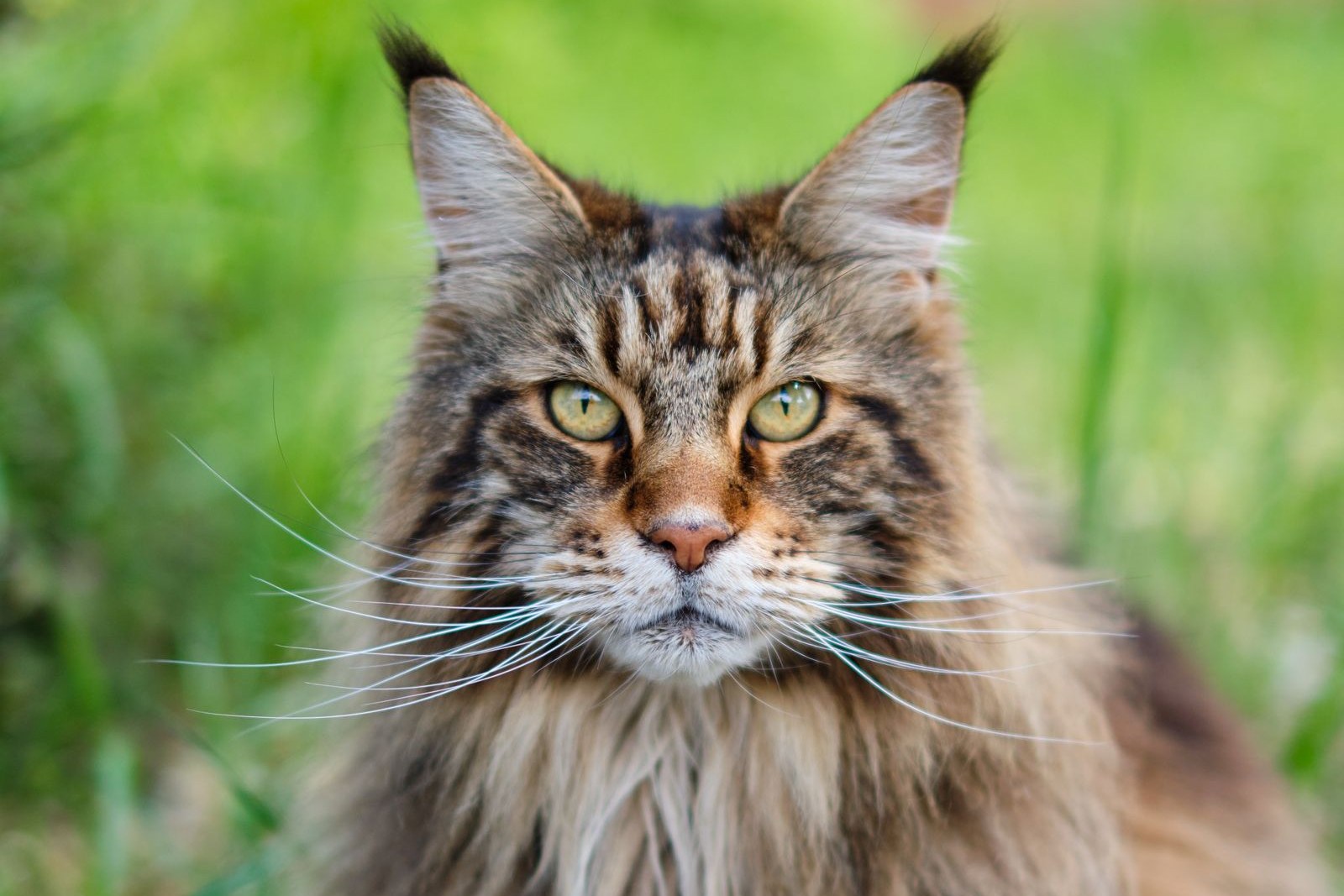
Maine Coon snapshot
The International Cat Association, known as TICA, describes the Maine Coon as a breed native to Maine in the northeastern United States, developed as a working cat in a harsh climate. Its breed standard calls the disposition essentially amiable, and it describes a large cat with substantial boning, a broad chest, and a long, hard muscled, rectangular body. The Cat Fanciers' Association, known as the CFA, sets out the breed's coat and colors in its own standard, including the heavy, shaggy coat and the long, plumed tail that most people picture first.
| Size | Large. One of the largest cat breeds, with substantial boning and a broad chest. Females are generally smaller than males. |
|---|---|
| Maturity | Slow to mature. The TICA standard says the breed reaches full maturity at four to five years of age, far later than most cats. |
| Body | Long, muscular, and rectangular, with large, well tufted paws and a tail as long as the body, with long, flowing fur. |
| Coat | An all weather coat with a silky texture. It is shorter on the shoulders and lengthens down the back and sides, with a frontal ruff, shag on the belly, and longer fur on the back legs. |
| Temperament | Essentially amiable, in the words of the TICA standard. A breed that developed alongside people as a working cat, and one that usually stays close to household life. |
| Eyes | Large and expressive. Eye color can be shades of green, gold, green gold, or copper, with blue or odd eyes possible in white cats and cats with white. |
Two snapshot facts shape the insurance picture. The first is the slow maturity. A Maine Coon is still growing into its frame well past the age when most cats are finished, so a policy bought for a kitten has to make sense for a much larger adult cat, and size based questions, such as how medication, anesthesia, and imaging are handled for a big cat, are not fine print in this breed. The second fact is that the breed's best known risks sit at two ends of life. Some inherited conditions declare themselves in kittens. The heart condition can appear later, in a cat that screened normally when young. A good Maine Coon policy has to work across that whole span, not only in the first year.
One more thing belongs in the snapshot, because owners meet it in breeder paperwork. Maine Coons from breeders often arrive with health screening records for their parents, such as DNA results and heart scan reports. Those records are genuinely useful, and later sections of this guide explain how to read them. They describe the parents and one point in time. They are not a health record for your individual cat, and an insurer will judge claims on your cat's own medical record, not on a parent's clear test.
Health tendencies in Maine Coons
The conditions below are the ones with a documented link to this breed at a primary veterinary or academic source, plus one mouth condition that is not breed specific but matters to Maine Coon owners because dental coverage varies so much. These are tendencies, not predictions about an individual cat. Many Maine Coons will never develop most of them. The point of naming them is not worry. It is that each one tests a different line of policy wording, and this breed tests more lines than most.
This section is general information about conditions a breed can be prone to. It is not veterinary advice and it is not a diagnosis of any cat. Signs listed here are possible signs owners may notice, and many of them have several causes. Only a veterinarian who examines your cat can say what a sign means.
A note on a condition you will see on many other Maine Coon pages: polycystic kidney disease, in which fluid filled cysts grow inside the kidneys. The Cornell Feline Health Center describes that inherited disorder as occurring most frequently in Persian cats, and as evident primarily in Persians and occasionally in a few other breeds, such as Himalayans and British Shorthairs. Cornell does not name the Maine Coon for it. Because no primary source we checked supports it as a Maine Coon tendency, this guide does not list it as one. If your own cat is ever found to have kidney cysts on a scan, that finding still matters for that cat's care and claims, whatever breed lists say.
Hypertrophic cardiomyopathy (HCM)
What it is
A disease of the heart muscle in which the muscular walls of the heart thicken, most importantly the left ventricle, the heart's main pumping chamber. The Cornell Feline Health Center calls hypertrophic cardiomyopathy the most common heart disease of cats, and lists the Maine Coon among the breeds where it is more prevalent. Cornell explains that the thickened wall leaves less room inside the chamber and relaxes poorly, so the heart works less efficiently, and that the disease is generally progressive, meaning it commonly worsens over time. There is a known inherited piece in this breed. The UC Davis Veterinary Genetics Laboratory explains that a mutation called A31P in a heart muscle gene, MYBPC3, has been found to be associated with increased risk for the disease in Maine Coons.
Signs owners may notice
- Often, nothing at all. Cornell notes that many cats with this disease do not appear to be ill, which is why screening and routine exams carry so much weight in this breed.
- Labored or rapid breathing, open mouth breathing, and unusual tiredness, which Cornell lists as signs of congestive heart failure, the stage where fluid builds up in or around the lungs.
- A murmur or an abnormal rhythm heard by the vet at a routine exam, in a cat that seems completely well at home. This is a finding, not a home sign, and it is one of the most common doors into diagnosis.
- Sudden pain or weakness in the back legs, which can signal a blood clot that has traveled from the heart and blocked blood flow to the hind limbs.
How vets usually evaluate and treat it
The diagnosis is made by echocardiography, called an echocardiogram or echo for short. That is an ultrasound scan that creates an image of the heart, and in a cat with this disease it shows the thickened walls and the smaller chamber. Cornell stresses that similar thickening can also be caused by high blood pressure and by an overactive thyroid, and that those conditions must be ruled out before the diagnosis is made, so blood pressure measurement and bloodwork are often part of the same workup. Chest X-rays and an electrocardiogram, a recording of the heart's electrical activity, may also be recommended. Cornell is clear that the disease has no known cure. Care is a specialized plan built around controlling heart rate, easing lung congestion if heart failure develops, and reducing the chance of blood clots, with medication given by mouth to stable cats.
One mutation is not the whole heart: DNA results and echocardiograms compared
This is the single most misunderstood part of Maine Coon health paperwork, and it has a direct insurance angle, so it gets its own table. Owners often arrive with a DNA result and believe the heart question is settled. It is not, and the two tests below answer different questions.
| Question | DNA test for the known Maine Coon mutation | Echocardiogram (heart ultrasound) |
|---|---|---|
| What it actually looks at | Whether the cat carries the one known mutation, called A31P, that UC Davis tests for in this breed. | The heart itself: wall thickness, chamber size, and how the heart is moving and filling on the day of the scan. |
| What a clear or normal result means | The cat does not carry that one mutation. UC Davis is explicit that the mutation is not the sole cause of this disease in Maine Coons, so a clear result does not rule the disease out. | No thickening consistent with the disease was seen on that day. It is a snapshot of the heart at that age, not a promise about later years. |
| What a positive or abnormal result means | The cat carries a risk factor. Cornell advises that genetic screening results should be interpreted carefully with a veterinary professional, since not all cats with these mutations will develop the condition. | Thickening was measured. The vet then rules out look alike causes, such as high blood pressure and an overactive thyroid, before naming the disease. |
| Does it need repeating? | No. A DNA result does not change over a cat's life. It only ever answers the one mutation question. | Yes, when a vet recommends it. A slow maturing breed keeps developing for years, and a heart that scans normally while young can change later. That is the core reason repeat screening exists. |
| How an insurer is likely to see it | Background risk information. It is not a diagnosis, and a clear result is not evidence that a later heart claim should be denied or approved. | The diagnostic record itself. The scan report, its date, and what it showed are the documents a heart claim will turn on. |
The practical takeaway is simple. Keep both kinds of paper. A breeder's DNA records tell you about inherited risk in the line. Your own cat's echocardiogram reports, with dates, tell the story an insurer will actually read. When the two seem to disagree, for example a clear DNA result and a later abnormal scan, the scan is describing the real heart in front of the vet, and it is the scan that drives care and claims.
Hip dysplasia and joint disease
What it is
A developmental problem of the hip joint, the ball and socket joint that connects the thigh bone to the pelvis. Cornell's Feline Health Center explains that in a normal cat the top of the thigh bone fits snugly into the socket and glides as the cat moves, while in a cat with hip dysplasia the ball and socket are misaligned and loose, so the bones rub painfully against each other. Over time that rubbing wears the smooth cartilage that protects the joint, leading to osteoarthritis, also called degenerative joint disease. Cornell names the Maine Coon directly here: it calls hip dysplasia the most frequently occurring developmental joint defect, and it says Maine Coons, due to their naturally stocky bodies, are more susceptible to hip dysplasia than other breeds.
Signs owners may notice
- Slowing down that is easy to blame on age or temperament: less play, less jumping, and more time spent resting.
- Seeking out warm, comfortable sleeping spots, hiding more, or becoming reclusive, which Cornell describes as a common way cats conceal joint pain.
- Trouble hopping in and out of the litter box, avoiding stairs, or no longer grooming the back half of the body properly.
- Stiffness, a subtle reduction in activity, and later a changed gait, which Cornell lists as the typical progression of joint disease.
When it can be urgent
Hip disease itself develops slowly. A cat that suddenly cannot bear weight, cries when a leg is touched, or stops using a litter box altogether may have an injury or a much more severe joint problem, and that change deserves prompt care rather than watchful waiting.
How vets usually evaluate and treat it
Cornell describes diagnosis as a complete medical history and physical exam, followed by an orthopedic exam and X-rays of the joints. The X-rays are what confirm how the ball and socket fit and how much arthritis has developed. Treatment in cats is most often palliative, a word that means focused on relieving discomfort rather than curing the joint. Cornell says that approach relies largely on pain medication and attentive home care, with the goal of a reasonably good quality of life. Keeping extra weight off matters, because Cornell notes that overweight cats exert excessive pressure on weight bearing joints. Surgical procedures exist for severe cases, but they are the exception in cats, not the routine path.
Spinal muscular atrophy (SMA)
What it is
An inherited condition of the nerves and muscles that is seen in Maine Coon cats. The UC Davis Veterinary Genetics Laboratory describes it as a loss of motor neurons, the nerve cells that carry movement signals, in the lower spinal cord, with wasting of the muscles in the hind limbs. The result is progressive instability, an unsteady gait, and changes in posture. UC Davis explains that the condition is inherited as an autosomal recessive trait, a term that means a kitten must inherit the mutation from both parents to be affected, while a kitten with one copy is a healthy carrier. UC Davis also notes two facts that shape how owners should think about it: the condition is neither painful nor fatal, and affected cats can live a comfortable life indoors.
Signs owners may notice
- An unsteady, wobbly way of walking in a young kitten, especially in the back legs.
- Posture that looks different from littermates, with the hind end sitting or standing less steadily.
- Thinning of the muscles of the hind limbs as the kitten grows, and tiring or giving up on play and climbing sooner than expected.
When it can be urgent
This condition itself is slow and is not an emergency. UC Davis places the first signs at about three to four months of age, so wobbliness in a kitten of that age is a prompt vet appointment. Sudden inability to walk, dragging legs after a fall, or signs of pain point to something else, such as an injury, and need same day care.
How vets usually evaluate and treat it
Evaluation starts with the history and a hands on neurological and muscle exam, and the vet will want to rule out other causes of a wobbly kitten, such as injury or infection. The specific DNA test described by UC Davis identifies the mutation associated with this condition in Maine Coons, and it can identify affected kittens and carriers. There is no drug treatment described for reversing the condition at the sources used for this guide. Care is supportive: an indoor life, a home set up the cat can navigate safely, and vet guided support for mobility and comfort as the cat grows.
Pyruvate kinase deficiency (PK deficiency)
What it is
An inherited blood condition. Pyruvate kinase is an enzyme, a protein that helps red blood cells make the energy they need to survive. The UC Davis Veterinary Genetics Laboratory explains that when there is not enough activity of this enzyme, red blood cells become unstable and are lost too quickly, producing a hemolytic anemia. Anemia means the blood carries fewer red cells than the body needs. UC Davis lists the Maine Coon among the breeds found to be at higher risk, and recommends genetic screening for the mutation in those breeds. Like spinal muscular atrophy, it is autosomal recessive, so a cat with one copy is a carrier and a cat with two copies is affected.
Signs owners may notice
- Severe tiredness and weakness that come and go, because UC Davis describes the anemia in this condition as intermittent, with a variable age of onset.
- Weight loss and a reduced appetite during an anemia episode.
- Jaundice, a yellowing that owners may notice in the skin inside the ears, the whites of the eyes, or the gums.
- A swollen or enlarged belly, which UC Davis lists among the possible signs of this anemia.
When it can be urgent
A cat that is very weak, will not eat, breathes fast at rest, or has pale or yellow gums during a suspected anemia episode needs prompt, same day care. Anemia reduces the oxygen the blood can carry, and a fast worsening episode is not a wait and see situation.
How vets usually evaluate and treat it
Evaluation usually centers on blood tests that confirm whether the cat is anemic, how severe the anemia is, and whether the body is replacing red cells, alongside an exam and a search for other causes of anemia. A DNA test can identify whether the cat carries the mutation, which explains the cause, but UC Davis notes that for a cat with two copies the severity of symptoms cannot be predicted, so the blood results and the cat in front of the vet guide care. Treatment categories are monitoring over time, supportive care during anemia episodes, and emergency care in severe episodes, all directed by the treating vet.
Gingivostomatitis (severe mouth inflammation)
What it is
A debilitating dental disease marked by severe, long lasting inflammation of the gums and the mucosa, the moist lining of the mouth. Cornell's Feline Health Center explains that the immune system becomes overly reactive to plaque, the thin coating of bacteria that builds up on teeth, and that the inflammation can spread well beyond one tooth to the back of the mouth and under the tongue. One honesty note matters here. Cornell says it does not see a strong predisposition for this disease among the various breeds, so this guide does not present it as an inherited Maine Coon condition. It is on this page because it is one of the most painful mouth conditions a cat can develop, its treatment can be extensive, and dental wording is where policies differ most sharply.
Signs owners may notice
- Swollen, ulcerated, or bleeding gums, and signs of extreme mouth pain.
- A cat that seems eager to eat but then cannot, or that loses interest in food and loses weight.
- Excessive drooling, sometimes with blood in the saliva, bad breath, and pawing at the mouth.
When it can be urgent
A cat that cannot eat because of mouth pain needs prompt care, not a long wait. Cornell warns that if the condition remains untreated it can become so painful that a cat is unable to take in food at all. A cat that has stopped eating entirely should be seen quickly, whatever the cause turns out to be.
How vets usually evaluate and treat it
A vet examination looks at the whole mouth. Cornell describes lesions under the tongue and on the lips, in the back and on the roof of the mouth, and around teeth, especially the back teeth, and notes that a tissue biopsy is sometimes needed for a conclusive diagnosis. A full look inside a painful mouth, and any dental X-rays, usually require sedation or anesthesia. Cornell describes two broad treatment paths, used alone or together: medical management, with drugs that calm the immune response and control bacteria in the mouth, and surgical management, which is likely to involve removal of teeth, in serious cases all of them. Owners are often surprised that cats can thrive after full mouth extraction, and Cornell explains why: removing the teeth removes the surfaces where the plaque that drives the reaction collects.
Entropion (eyelid rolling inward)
What it is
An inversion of the eyelid, in which the lid edge rolls inward so that the eyelashes and the hair beside the eye rub against the surface of the eye itself. A peer reviewed ophthalmology article published through the Canadian Veterinary Medical Association explains that entropion in cats can be primary, meaning developmental in origin, or secondary to scarring, to eyelid spasm from an irritated eye, or to age related changes. The Maine Coon link is specific: the article states that intact male Maine Coon cats are predisposed to primary entropion because of their pronounced facial jowls. It can affect one eye or both, and a cat that has it in one eye may later develop it in the other.
Signs owners may notice
- Chronic tearing or watering from one or both eyes, and watery discharge.
- Squinting, holding an eye partly closed, or other signs of eye discomfort, with redness around the surface of the eye.
- Rubbing or pawing at the eye, and in longer standing cases a cloudy or damaged looking surface to the eye.
How vets usually evaluate and treat it
Eye evaluation usually includes a full examination of the eye and eyelid position, a tear production test, measurement of pressure inside the eye, and a stain test that shows damage to the cornea. A drop of topical anesthetic can help the vet judge how much of the rolling is spasm from irritation, because if the rolling disappears once the surface pain is numbed, the underlying irritation needs treating before surgery is planned. The article is direct that treatment of established entropion requires surgical correction. The most common procedure reshapes the eyelid skin so the lid sits in its normal position, temporary stitches can hold a lid outward while irritation settles, and an eye protective collar and tear support are typical aftercare.
Policy decisions that matter for a Maine Coon
For most cats, a policy is judged on one bad night. For a Maine Coon, it is judged on a long timeline: a kitten whose inherited risks can appear within months, a giant adult who is still maturing years later, and a heart that may need scanning, medication, and monitoring for the rest of its life. Read these rows with that whole timeline in mind.
| Policy feature | Why it matters for a Maine Coon | Stronger wording looks like | Watch out for |
|---|---|---|---|
| Hereditary condition coverage | The breed list runs on inheritance: hypertrophic cardiomyopathy, hip dysplasia, spinal muscular atrophy, and pyruvate kinase deficiency. | Hereditary and congenital conditions are covered on the same terms as other illnesses. | Hereditary exclusions, or breed specific exclusions that quietly name this breed's conditions. |
| Cardiology diagnostics | A murmur becomes a referral, and a referral becomes an echocardiogram, before any treatment begins. | Specialist exams and echocardiography are covered categories for a covered heart concern. | Wording that covers heart medication but leaves the scan that diagnoses the disease outside the covered categories. |
| Repeat monitoring at renewal | Heart disease in this breed is progressive and has no known cure, so monitoring scans, blood tests, and medication continue for life. | A condition covered in one term stays covered in later terms, including its monitoring, while enrollment continues. | Renewal wording that caps a chronic condition, ends it at renewal, or reclassifies it as pre-existing. |
| Screening versus diagnosis | A routine heart scan in a healthy cat with no finding is a different claim event from a scan ordered because a murmur was heard. | The policy states clearly how scans ordered after a clinical finding are treated. | All heart scans treated as elective screening and denied, even when a vet ordered one to investigate a murmur. |
| Dental illness terms | Gingivostomatitis care can involve anesthesia, dental imaging, medication, and removal of teeth. | Dental illness is included, with anesthesia and extractions for a painful mouth condition covered. | Dental disease excluded entirely, dental cover limited to injury only, or a cleaning history requirement you have already failed. |
| Orthopedic and bilateral terms | Hips come in pairs, and eye problems can also appear on the second side later. | Each side is judged on its own record, with clear terms for the second side. | A bilateral clause that treats the second hip or eye as pre-existing once the first is diagnosed. |
| Kitten timing and waiting periods | Spinal muscular atrophy signs can appear at about three to four months of age, before many owners have even chosen a policy. | Illness and orthopedic waiting periods are short, stated plainly, and already finished before early signs are likely. | A long waiting period that overlaps the exact age window when this breed's kitten conditions appear. |
| Deductible type | Repeat heart scans, blood monitoring, and rechecks produce steady claims across a year, every year. | An annual deductible that is met once, after which eligible claims across conditions are reimbursed. | A per-condition deductible that restarts the counting for the heart, the hips, the mouth, and the blood separately. |
Life stages: kitten, adult, and senior
Kitten
The kitten stage is when the record is cleanest and when this breed's early inherited conditions can appear. Spinal muscular atrophy signs can show at about three to four months of age. A heart murmur may be heard at an early exam. Eyelid problems can be noted while a kitten is still growing into those famous jowls. Enrolling before those notes exist is the single most valuable move a Maine Coon owner makes. Ask the breeder for the parents' DNA results and heart scan reports, and read them using the comparison table above: they tell you about risk in the line, not about your kitten's own heart. Keep every kitten visit record, because in this breed the earliest notes are the ones later claims get measured against.
Adult
Adulthood is long in a Maine Coon, because the cat is still maturing until four to five years of age. A young adult that looks finished is still filling out its frame, and its heart screening story may still be unwritten. This is the stage where a routine exam turns up a murmur in a cat that seems perfectly well, and where hips begin to matter in a heavy cat that is slowing down in ways that are easy to miss. The insurance work of this stage is habits: file claims as they happen, keep every scan report with its date, track breathing at home if the vet asks you to, and at each renewal confirm that any condition the cat now has is still described as covered.
Senior
A senior Maine Coon carries the accumulated version of the breed list: a heart that may have been monitored for years, arthritic hips in a big frame, a mouth that needs watching, and eyes that should never be left squinting. Review the policy for age based changes, premium increases, and any reduction in coverage at advanced ages. Check whether the monitoring rhythm built up over the cat's adult life, the repeat heart scans and blood tests, is still reimbursable on the same terms. A plan that quietly thins out exactly when a long monitored cat needs it most fails the purpose it was bought for.
A claim, step by step: a murmur that becomes a heart diagnosis
The example below is hypothetical. It is not a real cat, a real claim, or a guarantee of how any insurer will decide. It follows an adult Maine Coon from a murmur heard at a routine exam, through a cardiology referral and an echocardiogram, to a diagnosis of hypertrophic cardiomyopathy, medication, and repeat monitoring through renewal, because that full arc is what Maine Coon heart coverage has to handle. Pet insurance generally reimburses after you pay the vet, as explained in how pet insurance works.
A murmur at a routine exam
At an annual wellness visit, the vet listens to the chest of a Maine Coon that seems completely well and hears a heart murmur, an extra sound made by turbulent blood flow. The vet records the date, describes the murmur, and recommends follow up rather than panic, because a murmur is a finding, not a diagnosis. The owner keeps the full visit record. That single page, showing when the murmur was first heard relative to the policy dates, becomes the anchor document for everything that follows.
The rule out workup at the general practice
Before anyone names a heart disease, the vet checks the look alike causes. Blood pressure is measured, and bloodwork includes a check of thyroid function, because Cornell explains that high blood pressure and an overactive thyroid can also thicken the heart wall and must be ruled out first. The results come back normal. The owner pays the clinic, keeps the itemized invoice and the complete results, and now has a record that shows the general practice did its part of the investigation in the right order.
Checking the waiting period and the record
On paper, the insurer will line the murmur date up against the policy dates. In this example the policy was started when the cat was a kitten, the illness waiting period ended long ago, and no earlier record mentions a murmur, an abnormal rhythm, breathing changes, or a heart concern of any kind. That clean timeline makes this a straightforward claim. Contrast it with the harder version of the same story, where a kitten exam note says a soft murmur was heard and would be rechecked, and nobody rechecked it. That one old line is the kind of record that turns a later heart claim into an argument about pre-existing signs.
Referral to cardiology and the echocardiogram
The general vet refers the cat to a veterinary cardiologist, a heart specialist. The cardiologist performs an echocardiogram, the ultrasound scan of the heart. The scan shows thickening of the wall of the left ventricle, the main pumping chamber, with a smaller chamber volume. The owner pays the specialist directly and collects the scan report itself, not only the invoice, because the measurements and findings in that report are the diagnostic core of the claim. If the policy requires preapproval for specialist referrals, that step is handled before this visit, not discovered after it.
The diagnosis and the first claim
With the look alike causes ruled out and the scan showing the characteristic thickening, the diagnosis recorded is hypertrophic cardiomyopathy. The claim is filed with the general practice records, the blood pressure and bloodwork results, the referral note, the cardiology report, and the invoices, with the murmur date stated clearly. Daily heart medication begins, prescribed by the cardiologist. The owner starts a simple home log of resting breathing and energy, which becomes genuinely useful evidence at every later monitoring claim and every medication review.
Medication, monitoring, and how reimbursement works
Ongoing care settles into a rhythm: medication at home, recheck visits, bloodwork when the cardiologist wants it, and repeat echocardiograms at intervals the cardiologist sets, because this disease is progressive and a scan is a snapshot, not a verdict for life. Each eligible bill moves through the same mechanics described in what pet insurance costs and why. Charges count against the deductible first, the policy's reimbursement rate applies to eligible charges after that, and totals are tracked against the annual limit. With an annual deductible already met by the workup, the later monitoring bills in that year are no longer reduced by it. With a per-condition design, the counting works differently, which is why deductible type was flagged in the policy table above.
Renewal, repeat claims, and where they get denied
At renewal, the decisive question is whether the heart condition is still a covered condition or has been reclassified. Under wording that keeps covered chronic conditions covered, the medication refills, rechecks, and the next echocardiogram are filed the same way, referencing the original diagnosis date and the scan history. The denial pressure points in this breed story are a murmur in the record from before enrollment, a scan denied as elective screening when it was ordered to investigate a finding, a referral denied because a preapproval step was missed, and renewal wording that caps or ends a named chronic condition. Each of those is a clause question, and each can be asked in writing before you buy, not after the cardiologist visit.
What drives a Maine Coon premium
No responsible guide will name a price for your cat, because the quote depends on the cat, the address, and the settings chosen. What can be explained is the shape of Maine Coon pricing and the choices that move it. The full mechanics are in what pet insurance costs and why.
Breed risk profile. Insurers see a very large cat whose best known risk is a progressive heart disease that involves specialists and repeat scanning, and whose frame adds a real hip tendency. That profile prices differently from a small, short lived, low intervention cat. The heart is the wildcard even inside the profile, because two cats with the same breed label can have very different scan histories, and the profile is priced before any individual cat's story is known.
Size. A Maine Coon is a big patient. Medication doses, anesthesia, and imaging all scale with the animal on the table, and a large cat's bills for the same procedure tend to run larger than a small cat's. That relative scale is built into breed pricing. It is also why the monitoring rhythm matters so much in this breed: repeat scans and rechecks for a big cat add up over years, and a policy that reimburses them reliably is worth more than the same policy would be for a cat with no monitoring needs.
Age curve and slow maturity. Premiums generally rise with age, and this breed spends years still maturing before it even reaches its adult frame. The total cost of insuring a Maine Coon is therefore a long horizon calculation, stretching from an early window when kitten conditions can appear, through a long adult stage when the heart can change, into senior years with hips and heart together. A slightly cheaper policy with chronic condition caps can cost more over that span than a stronger policy, because the caps bite at every renewal of a lifelong heart condition.
Location and plan settings. Vet prices in your area set the bill sizes the insurer expects, and specialist cardiology availability varies widely by region, which affects both price and how care actually unfolds. Your deductible, reimbursement rate, and annual limit choices trade premium against claim returns. For this breed, deductible type deserves the same attention as deductible size, because an annual deductible and a per-condition deductible produce very different results across heart monitoring, hip care, and a mouth claim in the same year.
Pre-purchase checklist for a Maine Coon policy
- Confirm hereditary conditions are covered, including hypertrophic cardiomyopathy, hip dysplasia, spinal muscular atrophy, and pyruvate kinase deficiency.
- Check that a cardiology referral and an echocardiogram ordered after a murmur are covered as diagnosis, not dismissed as elective screening.
- Confirm repeat echocardiograms, bloodwork, and medication for a covered heart condition stay reimbursable at every renewal.
- Read the murmur wording in the pre-existing definitions, and think about what is already in your kitten's early exam records.
- Confirm dental illness coverage in plain terms, including anesthesia, dental imaging, and tooth removal for gingivostomatitis.
- Read the bilateral clause for hips and eyes, and the orthopedic waiting period that applies to hip claims.
- Ask how intermittent conditions, such as the anemia of pyruvate kinase deficiency, are counted across episodes.
- Choose between an annual and a per-condition deductible using this breed's pattern of steady monitoring claims.
- Enroll as a kitten, before a murmur, a wobbly gait note, a hip note, or a mouth finding enters the medical record.
Questions to ask an insurer, in writing
- Once hypertrophic cardiomyopathy is diagnosed and covered, will it and its monitoring stay covered at every renewal while I stay enrolled?
- Is an echocardiogram ordered because a vet heard a murmur treated as covered diagnosis, or as excluded screening?
- My kitten's DNA test for the known Maine Coon heart mutation was clear. Does that change anything about heart coverage or claims?
- Is dental illness covered, including anesthesia and tooth removal for gingivostomatitis, and what dental history do you require?
- If one hip or one eye needs treatment, how is the other side treated under your bilateral rule?
- How do you count an intermittent inherited condition, such as pyruvate kinase deficiency, when signs improve and later return?
Questions Maine Coon owners ask
Does pet insurance cover hypertrophic cardiomyopathy in Maine Coons?
An accident and illness policy can cover hypertrophic cardiomyopathy when hereditary conditions are included, the illness waiting period has passed, and no murmur, abnormal rhythm, or heart concern was recorded before enrollment. Check that the cardiology referral and the echocardiogram itself are covered categories, and that repeat echocardiograms and heart medication for a covered condition stay covered at renewal, because monitoring is part of living with this disease.
My Maine Coon's DNA test was clear for the known heart mutation. Is heart coverage still worth checking?
Yes. The UC Davis Veterinary Genetics Laboratory explains that its Maine Coon test detects one known mutation, called A31P, and that this mutation is not the only cause of hypertrophic cardiomyopathy in the breed. A clear DNA result is useful information about one risk. It is not a picture of the heart, and it is not a promise that heart disease will never develop, so the echocardiogram and hereditary coverage questions still matter.
The vet heard a murmur but my cat seems fine. What should I save for a claim?
Save the full visit record showing the date the murmur was first heard and exactly what the vet recommended next. Keep blood pressure and bloodwork results, the cardiology referral note, and the echocardiogram report, not only the invoices. Note at home whether you see faster or labored breathing, open mouth breathing, or new tiredness, and when you saw it. That timeline helps the vet judge urgency, and it helps the insurer place the first finding inside the policy period.
Will hypertrophic cardiomyopathy stay covered after my policy renews?
It should, under a policy that keeps covered chronic conditions covered at renewal. Hypertrophic cardiomyopathy has no known cure and is usually managed for life with medication and repeat heart monitoring, so renewal wording decides whether the policy keeps helping after the first year. Avoid wording that treats a covered condition as new, capped, or pre-existing at each renewal, and confirm that monitoring visits for an ongoing covered heart condition are covered too.
Are dental problems like gingivostomatitis covered for Maine Coons?
Not automatically, and dental wording is one of the widest gaps between policies. Some accident and illness plans exclude dental disease entirely, some cover only dental injury, and some include dental illness with conditions attached. Gingivostomatitis treatment can involve medication, dental surgery under anesthesia, and removal of teeth, so ask in writing whether dental illness, anesthesia, and extractions for a painful mouth condition are covered for your cat, and what dental records or cleaning history the policy requires.
When is the best time to enroll a Maine Coon?
As a kitten, before a murmur, a heart scan finding, a hip note, or a mouth problem enters the medical record. Maine Coons mature slowly and keep growing for years, and some of their inherited conditions show up early, while heart disease can appear later even after a normal early screen. Enrolling young clears the waiting periods while the record is clean, and it makes the hereditary coverage and chronic renewal wording worth reading from day one.
Sources and further reading
- The International Cat Association, Maine Coon breed group standard for the breed's origin, amiable disposition, large rectangular body, and full maturity at four to five years of age.
- Cat Fanciers' Association, Maine Coon Cat breed standard for coat, colors, and eye colors in this breed.
- Cornell Feline Health Center, Hypertrophic cardiomyopathy for heart muscle thickening, the breeds where it is more prevalent including the Maine Coon, its signs, diagnosis by echocardiography, and treatment goals.
- UC Davis Veterinary Genetics Laboratory, Hypertrophic cardiomyopathy in Maine Coons for the A31P mutation in the MYBPC3 gene, why it is not the sole cause of the disease in this breed, and how test results should be read.
- Cornell Feline Health Center, Is your cat slowing down? for degenerative joint disease, hip dysplasia and its misaligned ball and socket joint, why Maine Coons are more susceptible, the subtle signs of joint pain, and X-ray diagnosis.
- UC Davis Veterinary Genetics Laboratory, Spinal muscular atrophy in Maine Coon cats for the loss of motor neurons, unsteady gait and hind limb muscle wasting, first signs at about three to four months, and recessive inheritance.
- UC Davis Veterinary Genetics Laboratory, Erythrocyte pyruvate kinase deficiency for the inherited hemolytic anemia, its intermittent course and variable signs, and the Maine Coon among the breeds at higher risk.
- Cornell Feline Health Center, Gingivostomatitis for severe inflammation of the gums and mouth lining, its signs of oral pain, drooling, and weight loss, and medical and surgical management including tooth removal.
- Sandmeyer and Osinchuk, Diagnostic ophthalmology, Canadian Veterinary Journal, via PubMed Central for entropion as an inward rolling eyelid, the predisposition of intact male Maine Coons, and surgical correction.
- Cornell Feline Health Center, Polycystic kidney disease for why that inherited kidney disorder is described primarily in Persian cats, which is why this guide does not list it as a Maine Coon tendency.