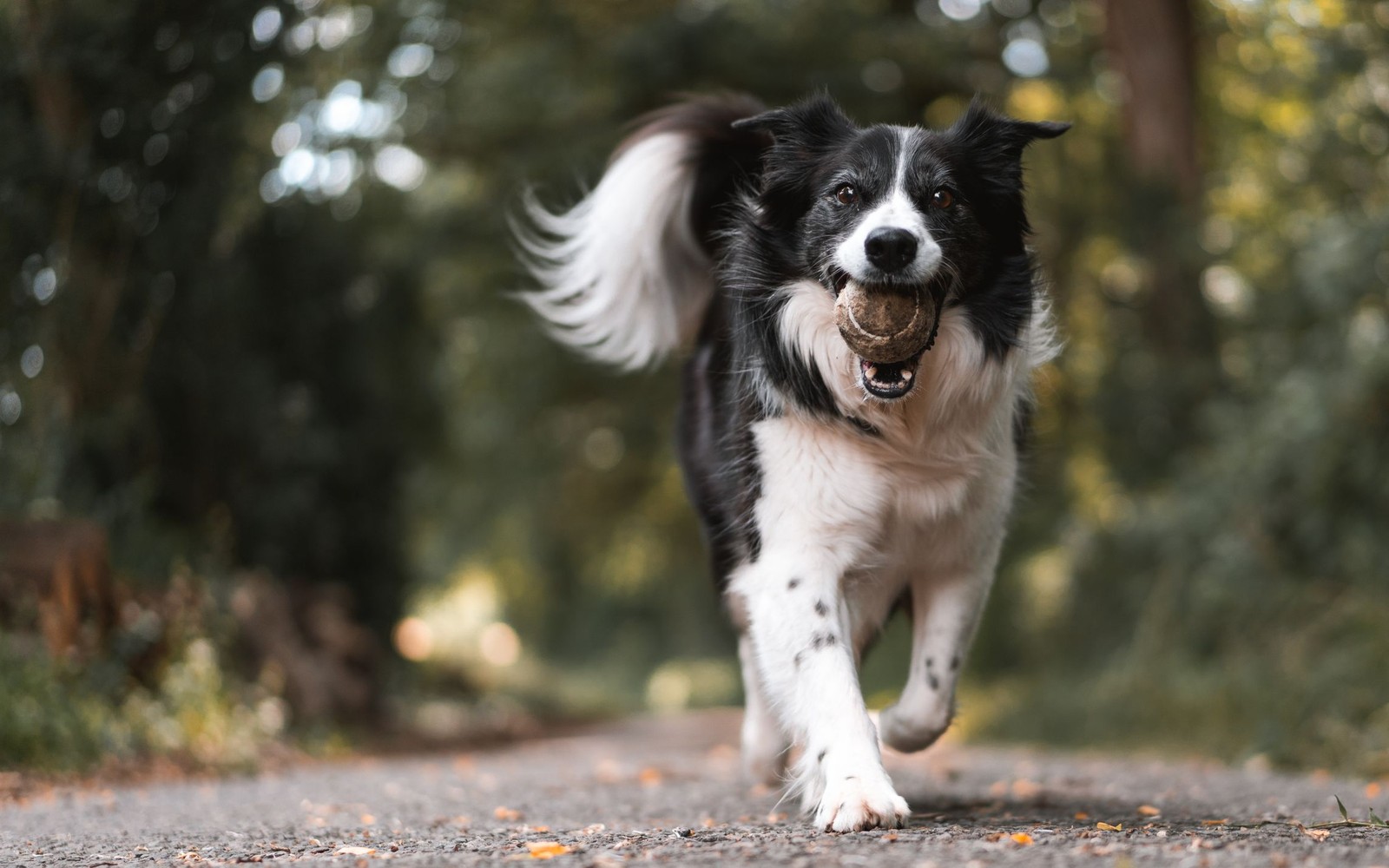
Border Collie snapshot
The American Kennel Club describes an affectionate, smart, and energetic herding dog, remarkably bright and a workaholic, with a herding tendency that can extend to animals and to people. The AKC notes that the breed does best with older, well behaved children. A dog bred to move stock by eye and by movement will also try to organise a household that runs around it. The coat comes in two varieties, rough and smooth, and both are double coats, a softer undercoat under a coarser outer coat. The AKC placed the Border Collie at No. 30 in its Most Popular Dog Breeds of 2024 list, based on registration statistics.
| Height | 19 to 22 inches at the shoulder for males, and 18 to 21 inches for females. |
|---|---|
| Weight | 30 to 55 pounds. |
| Lifespan | 12 to 15 years, as listed by the AKC. |
| Coat | A double coat in two varieties, rough and smooth. The rough variety is medium length with feathering, which means longer hair on the legs, chest, and tail. The smooth variety is shorter and coarser. |
| Temperament | Affectionate, smart, and energetic. A remarkably bright workaholic with a strong herding tendency, which can include herding animals and people. |
| Group | Herding Group. A working sheepdog breed, built to gather and move stock over distance and rough ground. |
| Energy and exercise | High. This breed needs real daily work for the body and for the mind, not a short walk alone. Under exercised Border Collies tend to invent jobs, and the jobs they invent at home are rarely the ones an owner would choose. |
Two snapshot facts shape the insurance decision, and both follow from the work this dog was bred to do. The first is energy. A high energy herding dog runs hard, turns hard, works in heat and in cold, and stays focused long after a less driven dog would stop. That is the setting named again and again in this guide. Strenuous exercise is the trigger for Border Collie Collapse, and heat and excitement add to exercise risk. Energy is not a flaw in this breed. It is the breed. The insurance job is to make sure the policy wording matches a dog whose normal, healthy life includes the exact situations where its breed risks appear.
The second fact is the lifespan. At 12 to 15 years, a Border Collie lives a long life, and it stays active deep into that life. A seizure condition that starts in a young adult dog can need medicine and monitoring for a decade. An eye condition found early can need specialist checks for years. A hip that is managed rather than operated on is managed across many renewals. A policy for this breed is judged over a long middle, not a short one, so wording about chronic conditions, renewals, and repeat episodes matters more than the headline benefit list does. The breed's own health program tells you where breeders look first. The Border Collie Society of America, shortened to BCSA, strongly recommends screening for hip dysplasia and inherited eye problems, with hip evaluation after 24 months of age and eye examinations by a board certified veterinary ophthalmologist annually until age 7, and results recorded with the Orthopedic Foundation for Animals, shortened to OFA, and the Canine Health Information Center, shortened to CHIC. That record is the backbone of the screening section below.
Health tendencies in Border Collies
Cornell, UC Davis, the University of Minnesota, the University of Missouri, the breed club, and the Merck Veterinary Manual point to a Border Collie list that only partly overlaps the other herding breeds on this site. It pairs old working dog risks, hips and eyes, with a seizure condition that has no DNA test, a collapse condition that has no DNA test, and three inherited conditions that a DNA panel can settle in a puppy. Two more DNA topics, MDR1 drug sensitivity and Imerslund-Grasbeck Syndrome, sit in the screening section rather than in the cards below, because they are records that change drug and feeding decisions rather than diseases an owner watches for. These are tendencies, not predictions. Each one has a clause attached to it, and the clause is easier to check before a claim than during one.
This section is general information about conditions a breed can be prone to. It is not veterinary advice and it is not a diagnosis of any dog. Signs listed here are possible signs owners may notice, and many of them have several causes. Only a veterinarian who examines your dog can say what a sign means.
Idiopathic epilepsy
What it is
Epilepsy is a condition of recurrent seizures. A seizure is a burst of abnormal electrical activity in the brain that changes awareness, movement, or behaviour for a short time. Idiopathic means no identifiable underlying cause is found. Cornell's Riney Canine Health Center defines idiopathic epilepsy in exactly those terms, and states that it is more common in purebred dogs including Border Collies. Cornell places typical onset between 6 months and 6 years of age, with a median onset of 2.5 years. Median means the middle value in the group studied, so half began earlier and half began later. Cornell's separate guidance on managing seizures lists the Border Collie among the breeds known to experience difficult seizures, alongside the German Shepherd, the Irish Setter, the Golden Retriever, the Siberian Husky, the Keeshond, and the Saint Bernard. Difficult here means seizures that can be harder to bring under control, which is why dates, duration, and frequency matter to the vet as well as to any later claim.
Signs owners may notice
- A full body episode with loss of awareness, stiffening, paddling or convulsions, drooling, or loss of bladder or bowel control.
- A smaller focal episode, which means signs in one part of the body or one part of awareness, such as staring, trembling, lip licking, fly biting at the air, or one leg moving on its own.
- A quiet and confused period after an episode, in which the dog seems tired, clingy, wobbly, or not itself.
- Episodes that come in a pattern, after rest, during sleep, around excitement, or at a similar time of day.
- A second episode weeks or months after a first one that was easy to explain away at the time.
How vets usually evaluate and treat it
Idiopathic epilepsy is a diagnosis of exclusion. Exclusion means the diagnosis is reached by ruling other causes out, not by one test that proves it. A workup can therefore include a physical and neurological examination, blood testing, and, where the vet judges it needed, referral to a veterinary neurologist and advanced imaging to look at the brain itself. Each step removes a possible cause from the list, such as a metabolic problem, which means a problem in the body chemistry, a toxin, an infection, or a structural problem in the brain. Cornell notes that anti-seizure drugs, shortened to AEDs, are used to manage seizures. Cornell's managing seizures guidance adds a practical point owners often miss. A seizure log helps the vet decide when to start anticonvulsant therapy, which is medicine against seizures. A dated log of episodes, duration, and recovery is therefore a medical tool, not paperwork. The triage section below gives the exact log this guide recommends.
Collie Eye Anomaly (CEA, or choroidal hypoplasia)
What it is
Collie Eye Anomaly, shortened to CEA and also called choroidal hypoplasia, is a heritable disorder of the eye. Heritable means it is passed through breeding. UC Davis Veterinary Genetics Laboratory describes it as a disorder that can result in abnormal development of the inner structures of the eye, and notes that the same genetic variant is associated with CEA in multiple breeds. The choroid is a layer inside the eye that carries blood supply for the retina, the layer that senses light. Hypoplasia means underdevelopment. The range inside this condition is wide. Some dogs show no obvious signs and keep normal vision. In severe presentations, affected dogs may also show retinal detachment, which means the retina separates from its normal position, bleeding inside the eye, impaired vision, or blindness. A DNA result that finds the variant is not a statement that this dog cannot see, and a dog that sees well at home has not thereby cleared the condition.
Signs owners may notice
- Often, no sign at all at home. Mild CEA is commonly found on a specialist eye examination rather than noticed by an owner.
- In more severe cases, bumping into objects, hesitation in new places or in dim light, or trouble finding a dropped toy.
- A change in how the eye looks, or one eye behaving differently from the other.
- Signs that appear in a young dog and do not change much, rather than signs that build late in life.
When it can be urgent
CEA itself is usually a record and monitor condition, not an emergency. Sudden vision loss, a painful or red eye, or a dog that suddenly cannot navigate a familiar room needs same day care, because those signs can have other causes that are urgent even when CEA is already in the file.
How vets usually evaluate and treat it
Evaluation rests on two different records that answer two different questions. The DNA test, described by UC Davis, settles whether the known CEA variant is present in this dog. The eye examination, by a board certified veterinary ophthalmologist, describes the eyes themselves on that date. The BCSA screening program uses the second record, an eye examination annually until age 7, because an examination is a dated snapshot of the actual eye. There is no medicine that rebuilds an underdeveloped inner eye structure, so care for affected dogs is usually monitoring, honest breeding decisions, and prompt attention to complications such as retinal detachment or bleeding if they occur. Keep both records. The DNA result explains the inheritance, and the dated eye forms explain the dog.
Hip dysplasia
What it is
Hip dysplasia is a developmental looseness and malformation of the hip joint. Developmental means the joint forms and grows in a way that leaves it loose and poorly matched, rather than being damaged by one injury. Over time, a loose and poorly matched joint can lead to arthritis, which is inflammation and wear inside a joint. The Merck Veterinary Manual describes hip dysplasia in dogs in terms of radiographic evaluation and categories of care that run from weight and activity management and medical management to surgical options in severe cases. Radiographic means shown on X-rays. This is a screened condition in this breed, not a surprise. The BCSA strongly recommends screening for hip dysplasia, with a hip evaluation from OFA, AVCO, or PennHIP after 24 months of age. PennHIP is a hip evaluation method that measures joint looseness. A final hip record is therefore an adult record by design, because the scheme waits until the dog is grown.
Signs owners may notice
- Stiffness after rest, or a dog that is slow to rise and then warms out of it.
- Bunny hopping at a run, which means both back legs move together instead of in turn.
- Reluctance to jump, climb, or keep up on a long working day that the dog used to finish easily.
- Swaying in the back end, loss of muscle over the hips, or tiring earlier than expected.
- In a driven Border Collie, a quieter sign. The dog still works, but recovers more slowly and is stiff the next morning.
When it can be urgent
Hip dysplasia signs are usually book an appointment signs. A leg that will not bear weight after a fall or a twist, a cry of pain, or sudden swelling is a different sign and needs prompt care, because an injury can sit on top of an old joint problem and the two need separating in the record.
How vets usually evaluate and treat it
Evaluation uses a physical examination and radiographs, which are X-rays taken in a standard position and scored under a formal scheme. The Merck Veterinary Manual sets out the care categories. Weight and activity management come first, because extra weight loads a loose joint on every step and a herding dog covers a lot of steps. Medical management follows, aimed at pain and inflammation. Surgical options are discussed in severe cases. Keep the score from every formal evaluation, and keep the date. A hip score recorded at any point is exactly the kind of early record an insurer will later line up against a hip claim, and a complete dated file is a better answer than a memory of what a breeder said the score was.
Trapped Neutrophil Syndrome (TNS)
What it is
Trapped Neutrophil Syndrome, shortened to TNS, is an inherited neutropenia in Border Collies. Neutropenia means too few neutrophils. A neutrophil is a white blood cell that forms a first line of defence against infection, and in this condition those cells are produced but trapped, so they do not reach the blood in normal numbers. UC Davis Veterinary Genetics Laboratory describes TNS as an inherited neutropenia that compromises the immune system, leading to chronic infection in affected dogs. Compromises here means weakens. This is therefore an immune condition that usually declares itself in young dogs through infections that keep coming back, rather than through a visible injury or a gait change. Unlike epilepsy and collapse, this condition is on the DNA side of the breed record. UC Davis includes it in the Border Collie Health Panel, so a laboratory result can settle whether the known variant behind TNS is present in this dog.
Signs owners may notice
- Infections that recur, take longer than expected to clear, or return soon after treatment ends.
- A puppy or young dog that is repeatedly unwell while littermates or housemates stay well.
- Fever, low energy, or poor recovery that keeps being treated one episode at a time.
- A vet noting low white cell counts on blood work taken during those episodes.
When it can be urgent
A dog with a weakened immune system and a high fever, refusal to eat, marked weakness, or an infection that is clearly worsening needs same day care. In a dog whose file already holds a TNS result, do not wait for an infection to prove itself over several days.
How vets usually evaluate and treat it
Evaluation usually combines the clinical pattern, which means the history of repeated infections, with blood work that shows the neutrophil count, and a DNA result that settles the inherited side of the question. Blood work alone shows a low count on a day. The DNA result explains whether this breed condition is the reason behind it. Care is aimed at the infections themselves and at supporting a dog whose defence against infection is reduced, with prompt treatment and careful monitoring between episodes. Keep every infection visit in one timeline. A pattern that is obvious across two years of records can look like bad luck when each visit is read on its own.
Neuronal Ceroid Lipofuscinosis (NCL, CLN5)
What it is
Neuronal Ceroid Lipofuscinosis, shortened to NCL, is a group of inherited storage diseases. Storage disease means material that should be broken down inside cells builds up instead, and in this group the buildup affects nerve cells. The University of Missouri College of Veterinary Medicine Canine Genetics Laboratory lists Neuronal Ceroid Lipofuscinosis CLN5 as occurring in the Border Collie and the Australian Cattle Dog, and lists DNA testing by disease and breed. CLN5 names the gene form in this breed. This card is written carefully on purpose. The laboratory record settles the DNA question for this named form. It does not turn this guide into a prognosis for an individual dog, and owners should read any result with their vet, who can place it against the dog in front of them. What matters for insurance is the same point that matters in the epilepsy card, reached from the opposite direction. Here a DNA test exists. There, it does not. A Border Collie file can therefore hold a settled result for NCL and an open history for seizures at the same time, and the two must never be read as one clearance.
Signs owners may notice
- Behaviour change in a young adult dog, such as new anxiety, restlessness, or loss of learned habits.
- Unsteady or uncoordinated movement that was not there before, or a gait that slowly worsens.
- Vision change, hesitation in dim light, or bumping into objects.
- Signs that progress over time rather than appearing once and resolving fully.
How vets usually evaluate and treat it
Evaluation starts with a physical and neurological examination. Neurological means to do with the nervous system, the brain, the spinal cord, and the nerves. Because the signs overlap with epilepsy, eye disease, infection, and other brain conditions, a workup can involve blood testing, referral to a veterinary neurologist, and advanced imaging. The DNA result belongs in that file as background evidence. It is not a substitute for examining a sick dog, in either direction. Where an inherited storage disease is the diagnosis a vet reaches, care is supportive, aimed at safety, comfort, and honest planning. That shape of care, specialist led and open ended, is why the coverage questions below matter even though the condition itself cannot be prevented.
Border Collie Collapse (BCC)
What it is
Border Collie Collapse, shortened to BCC, is an episodic nervous system disorder triggered by strenuous exercise. Episodic means it comes in episodes, with a normal dog between them. The University of Minnesota College of Veterinary Medicine Canine Genetics Lab describes it in those terms, and lists the other names it travels under, exercise induced hyperthermia, stress seizures, and the wobbles. Those older names are part of the problem this card exists to solve, because two of them point an owner, and a claim reviewer, toward the wrong condition. The Minnesota lab states that affected dogs are normal at rest. Typical episodes begin 5 to 15 minutes after the onset of exercise, and the dog is then abnormal for 5 to 30 minutes before recovering completely, with no residual lameness or stiffness. Residual means left behind afterwards. The lab also states that excitement, heat, and the intensity of exercise are contributing factors, and that the genetic basis is unknown and believed complex. There is therefore no single DNA test that settles BCC. History is the record.
Signs owners may notice
- Disorientation or loss of focus in a dog that was working normally minutes earlier.
- Swaying, staggering, and falling during or just after hard exercise.
- Exaggerated lifting of each limb and a choppy gait, quite different from the dog's normal movement.
- Scuffing of the feet and crossing of the legs when turning.
- Full recovery after rest, with the dog moving normally again and showing no lameness or stiffness afterwards.
How vets usually evaluate and treat it
Evaluation rests on the history in unusual detail, because the dog in the consulting room is usually normal. The Minnesota description gives the vet the pattern to test the history against. When did the episode begin relative to the start of exercise. What did each leg do. Did the dog stay aware. How long until the dog was fully normal again, and was anything left behind. A video of an episode is often the single most useful item an owner can bring, which is why this guide treats filming, when it is safe, as part of care. Care is centred on management. Recognising the trigger, stopping exercise at the first signs, avoiding the combination of intensity, excitement, and heat that sets an episode off, and keeping a dated log. Keep the word collapse in the record when collapse is what the vet found, and keep seizure out of it unless a seizure is what the vet found. That wording choice is the wording a claim will later be judged on.
The breeder screening file and the DNA panel map
No other breed guide on this site needs this section in this exact form, because no other breed on the site pairs a long DNA panel with two major conditions that no DNA test can settle. A Border Collie puppy can come with two kinds of evidence, and each kind proves a different thing. One kind is a hip score and an eye examination form, dated records of the actual dog. The other kind is a laboratory DNA panel, results about named genetic variants, most of them settled before a puppy shows any sign of anything. Owners often treat the file as a single pass or fail stamp. It is not. It is a set of separate records with separate dates and separate limits, and an insurer will treat them separately too.
The Border Collie Society of America health statement, issued in October 2016 and hosted by the AKC, sets the breed's clinical record. The BCSA strongly recommends screening for hip dysplasia and inherited eye problems. Hip evaluation comes from OFA, AVCO, or PennHIP after 24 months of age. The eye examination is performed by a board certified veterinary ophthalmologist, annually until age 7. Dogs are identified by microchip, and results are recorded at OFA and with CHIC. Read those ages as part of the record itself. A hip file for a young parent that stops before 24 months is not a final hip record under this program. An eye file that was complete in a young dog and never repeated is a stale file by age 7, not a lifetime clearance. The DNA panel below answers different questions again, and it does not expire in the same way, because a dog's DNA does not change. That difference, DNA settles once and examinations date, is the idea this whole section hangs on.
| Record | What to ask for | What it proves | What it does not prove |
|---|---|---|---|
| Hip evaluation | The hip evaluation result and date for each parent, from OFA, AVCO, or PennHIP, made after 24 months of age as the BCSA statement sets out. | That this dog's hips were X-rayed and scored under a formal scheme as an adult, and what the score was. | It does not prove a puppy's hips. A parent's score is evidence about breeding stock, and a puppy's own hips are judged on the puppy's own adult evaluation. |
| Eye examination | The dated eye examination forms from a board certified veterinary ophthalmologist, repeated annually until age 7 as the BCSA statement sets out. | That a specialist examined this dog's eyes on each of those dates and recorded what was found, or found nothing, on each day. | It does not prove the eyes stay clear. An eye examination is a snapshot, not a lifetime clearance, and it answers a different question from the CEA DNA result in the next table. |
| DNA panel | The laboratory panel result for each parent, and for the puppy if it was tested, naming each condition and its result, with the dog's name and the test date. UC Davis notes that a DNA sample is cheek and gum cells, and to wait until puppies are at least 3 weeks old before testing. | Whether each named variant in the panel was found in this dog, in the laboratory's own terms for that condition. | It does not speak to epilepsy, hip dysplasia, or Border Collie Collapse at all. The second table in this section lists what settles those instead. |
| Permanent identification | The microchip number recorded with the screening file, matching the dog in front of you, as the BCSA statement expects. | That the records in the file belong to this dog, and not to another dog with a similar name. | It proves nothing about health. Its job is to tie every other record to the right dog. |
The DNA panel map: what DNA can settle, and what it cannot
UC Davis Veterinary Genetics Laboratory offers a Border Collie Health Panel that bundles several genetic tests relevant to Border Collie health. The University of Missouri Canine Genetics Laboratory lists DNA tests by disease and breed on the same principle. A panel is a bundle, not a verdict. Each row inside it answers one narrow question about one named variant. The table below is the map this guide is built around. Read the first group as settled paper. Read the second group as open history.
| Condition or status | What the record is | Plain language meaning |
|---|---|---|
| Collie Eye Anomaly (CEA) | DNA test can settle it. | The test settles whether the known variant linked to CEA and choroidal hypoplasia is present in this dog. It does not by itself describe how this dog sees today. The dated eye examination does that. |
| Trapped Neutrophil Syndrome (TNS) | DNA test can settle it. | The test settles whether the known variant behind this inherited neutropenia is present. Neutropenia means too few neutrophils, the white blood cells that fight infection, so an affected dog's immune system is weakened and chronic infection follows. |
| Neuronal Ceroid Lipofuscinosis (NCL, CLN5) | DNA test can settle it. | The test settles whether the CLN5 form listed for the Border Collie by the University of Missouri laboratory is present in this dog. CLN5 names the gene form. The result is background evidence, not a substitute for examining a dog with signs. |
| Imerslund-Grasbeck Syndrome (IGS) | DNA test can settle it. | The test settles whether the known variant behind IGS is present. IGS is a disorder found in Beagles and Border Collies in which vitamin B12 is unable to be absorbed through the gut, in UC Davis's words. Vitamin B12 is a nutrient the body needs to make blood cells and to keep nerves working, so a dog that cannot absorb it needs the problem found rather than guessed at. |
| MDR1 drug sensitivity status | DNA test can settle it. | The test settles this dog's MDR1 status, which decides how a set of named drugs must be handled for this dog. The next subsection explains the pump, the drugs, and the one safe case owners most often get wrong. |
| Idiopathic epilepsy | No DNA test can settle it. | What settles it instead is the seizure history and the family history, worked through as a diagnosis of exclusion. Cornell's definition controls here. Recurrent seizures, other causes ruled out, and a dated log of episodes, duration, and recovery. |
| Hip dysplasia | No DNA test can settle it. | What settles it instead is hip radiographs. X-rays taken in a standard position after 24 months of age and scored under a formal scheme, as the BCSA statement sets out. |
| Border Collie Collapse | No DNA test can settle it. | What settles it instead is the episode history, ideally with video. The University of Minnesota states that the genetic basis is unknown and believed complex. Timing, gait, awareness, and recovery, recorded episode by episode, are the evidence. |
MDR1, in plain words: the pump, the problem drugs, and the safe case
MDR1 is a gene, also named ABCB1. Washington State University's Veterinary Clinical Pharmacology Laboratory, shortened to VCPL, explains that the gene encodes P-glycoprotein. Encodes means the gene carries the instructions for making it. P-glycoprotein is a pump. It pumps many drugs and toxins out of the brain. A dog with the mutant form of the gene cannot pump some drugs out normally, and may show abnormal neurologic signs after those drugs. Neurologic signs here means signs from the nervous system, such as deep sedation, wobbliness, or worse. WSU lists the mutation in Border Collies among other herding breeds, and states the rule that governs the whole topic. The only way to know an individual dog's status is to test the dog. Breed alone does not settle it, in either direction.
The problem drugs documented by WSU VCPL need reading at a general level, with one distinction kept sharp. Ivermectin is the case owners meet first, because it is used in heartworm prevention. WSU states that the heartworm prevention dose is safe in dogs with the mutation, while higher doses, of the kind used for mange, can cause neurologic toxicity. Toxicity means poisoning effects. Selamectin, milbemycin, and moxidectin are handled the same way in the WSU guidance, as safe at heartworm prevention label doses. Loperamide, a drug used against diarrhoea, is to be avoided in dogs with the mutation. Acepromazine, a sedative, produces deeper and longer sedation. The rule is therefore not that a dog with the mutation can never have any of these drugs. Dose and drug choice become vet decisions made with the result in front of them. Test before drug decisions where possible, tell every vet who treats the dog, including emergency clinics, and record the result in the file.
Imerslund-Grasbeck Syndrome, in plain words
IGS earns a short subsection of its own because its name explains nothing and its mechanism explains everything. UC Davis describes IGS as a disorder found in Beagles and Border Collies where vitamin B12 is unable to be absorbed through the gut. A dog can therefore eat a normal diet and still run short of B12, because the failure is in absorption, not in the food. Absorption means taking a nutrient from the gut into the body. A DNA test exists for IGS and sits in the panel map above. That is the settled part. What a result means for feeding, supplementation, and monitoring in an individual dog is a vet conversation, and this guide does not turn a laboratory result into a feeding plan. Keep the result with the MDR1 result and the rest of the panel, described in the laboratory's own terms.
Three habits make this file useful rather than decorative. First, check that each record names the dog, the date, and the result, and that the microchip matches the dog, because a verbal summary is not a record. Second, note the gaps honestly, and name which kind each one is. A missing eye form is a stale snapshot. A missing panel row is an unsettled variant. A missing episode history is not a gap a laboratory can fill later. Third, keep the whole file with the policy from the first day, so a question about dates is answered in one folder.
One caution belongs here. A screening result is a medical record, and a result recorded before a policy starts can be read by an insurer as evidence about the dog's history. That is not a reason to avoid testing. Untested dogs get the same conditions, with worse records and later care. It is a reason to enroll early, and to ask the classification questions in the checklist below in writing.
Seizure, collapse, or heat? An episode table
No sibling guide on this site has this table, because no other breed on the site asks an owner to separate three episodes that can all happen on the same working day, in the same dog. A Border Collie that goes down during hard work has three main readings, and they are not interchangeable. It may be a seizure, a brain event. It may be Border Collie Collapse, an exercise triggered nervous system episode with full recovery. Or it may be ordinary overheating, a heat problem any hard working dog can meet. Owners confuse the three because all three can involve wobbliness and falling, and vets and claim reviewers then inherit whichever word the owner used first. This table is general information built only from the Cornell and University of Minnesota facts logged for this guide, plus careful general wording on heat. It is not a diagnosis. Signs like these can have other causes, and only a veterinarian who examines your dog can say what is going on. When in doubt, treat the episode as one level more urgent than the table suggests, and call your vet.
| Situation | What it usually looks like | What to do next |
|---|---|---|
| A seizure | Loss of awareness, with convulsions, stiffening or paddling, or smaller focal signs such as staring, trembling, or one part of the body moving on its own. Cornell ties typical idiopathic epilepsy onset to between 6 months and 6 years of age. A quiet, confused period often follows. | Time it, keep the dog safe, and judge by the emergency rule. Cornell states that a seizure over 5 minutes, or multiple seizures within 24 hours, is a medical emergency needing transport. Any first seizure needs a vet visit and a workup, because idiopathic epilepsy is a diagnosis of exclusion. Film the episode only if you can do so safely and without delaying care. |
| A collapse episode (Border Collie Collapse) | Begins 5 to 15 minutes into strenuous exercise. The dog stays aware but looks disoriented and loses focus, sways, staggers, and may fall, lifts each limb in an exaggerated way with a choppy gait, and scuffs and crosses the legs when turning. The dog is abnormal for 5 to 30 minutes, then recovers fully with rest, with no residual lameness or stiffness. | Stop the exercise at once. Move the dog to shade, cool the dog, and let the dog rest while you time the recovery. Record the episode with the protocol below. Book a vet visit and take the record and any video with you, and use the word collapse in your account if collapse is what happened. |
| Overheating and heat stress | Heavy panting that does not settle after exercise stops, drooling, and weakness in heat, in a dog that has been working hard in warm weather. Excitement, heat, and the intensity of exercise are also contributing factors in collapse episodes, so heat can sit alongside either of the other two situations rather than replacing them. | Stop, cool, and seek care promptly. Stop the work, move the dog out of the heat, cool the dog, and contact a vet promptly when panting does not settle, drooling continues, or weakness is present. Do not push on to finish the work, and do not read a heat explanation into an episode that matched the seizure or collapse pattern above. Note the weather in the episode log either way. |
The episode video and log protocol
The habit that ties this table to both good care and a fair claim is a dated episode record, made the same way every time. Film if it is safe to film. Timing and safety come first, and a video taken while a dog is in danger helps no one. When filming is safe, a short clip that shows awareness, gait, and what each leg is doing is worth more to a vet than a long description written a week later. Then write the log while the details are still fresh. Cornell's managing seizures guidance makes the medical case for this log. A seizure log helps decide when to start anticonvulsant therapy. The same log, kept for collapse episodes, is what separates a collapse history from a seizure history in the file.
| Item | What to record |
|---|---|
| Video | Film the episode if you can do so safely. Show the whole dog, the face and eyes for awareness, and all four legs for gait. Keep filming into the first part of recovery if it is safe, then stop and help the dog. |
| Timing | Time the start and the end of the episode. Note how many minutes into exercise it began, how long the dog was abnormal, and how long full recovery took after rest. |
| Setting | Note the exercise, how intense it was, how long it had been going, the weather and heat, and how excited the dog was before and during the work. |
| The body | Note what each leg did, whether the gait was choppy or crossing, whether the dog stayed aware, whether awareness was lost, and whether there were convulsions or focal signs. |
| Recovery | Note what recovery looked like, whether it was complete, and whether any lameness, stiffness, confusion, or tiredness was left behind afterwards. |
| Action | Note what you did next, including cooling, rest, the name of any clinic contacted or visited, and what the vet recorded. Save the video with its date in the same folder as the log and the screening file. |
Keep one log for every episode, whatever you believe it was. Write the description in plain words and let the vet name the condition. A log that says the dog fell minutes into work, stayed aware, lifted its legs high, and was normal again after rest is a record a vet can use and an insurer can read fairly. A log that only says the dog had a fit is neither. Both histories exist in this breed, seizures and collapse. Yours should say which one your dog has, episode by dated episode.
Policy decisions that matter for a Border Collie
For a Border Collie, read a policy from the exclusions inward, not from the benefits outward. Does the wording that carves things out carve out this breed's seizures, eyes, hips, immune condition, nerve condition, and collapse episodes? Work down this table in order, because the first rows can make the later rows irrelevant.
| Policy feature | Why it matters for a Border Collie | Stronger wording looks like | Watch out for |
|---|---|---|---|
| Hereditary condition coverage | Epilepsy, CEA, hip dysplasia, TNS, and NCL are inherited or developmental. This row decides more Border Collie claims than any other. | Hereditary conditions are covered on the same terms as other illnesses, with no breed carve out. | Hereditary exclusions, low separate limits, or coverage that starts only after a long special wait. |
| Neurology and seizure wording | Idiopathic epilepsy is a diagnosis of exclusion, is more common in this breed on Cornell's account, and this breed is listed among breeds known to experience difficult seizures. | Seizure care, specialist neurology referral, advanced imaging, and long term anti-seizure medicine are covered services. | Neurologic exclusions, imaging covered only after a diagnosis the imaging itself is needed to reach, or seizure care limited to a first episode. |
| Collapse classification | Border Collie Collapse is an exercise triggered nervous system episode with no DNA test. Its classification decides whether an episode history helps or harms later claims. | The policy names how exercise collapse is classified, and treats a collapse history and a seizure history as separate histories. | Wording that folds every episode into one seizure history, or that reads a collapse note as a pre-existing seizure condition. |
| Eye wording | CEA ranges from no visible sign to retinal detachment and blindness in severe presentations, and the breed program runs specialist eye examinations annually until age 7. | Hereditary eye conditions, specialist eye examinations, and treatment of eye complications are covered services. | Eye exclusions for this breed, or cover that ends at the first eye when the second eye is affected later. |
| Orthopedic waiting period and the bilateral rule | Hips come in pairs, the final hip record is an adult record made after 24 months, and care runs from management to surgery in severe cases. | Each side is judged on its own record, with clear terms for the second side and for scores recorded early. | An orthopedic waiting period that resets the clock, or wording that treats the second hip as pre-existing after the first is diagnosed. |
| Chronic condition renewal wording | Seizure medicine, infection monitoring in a TNS dog, hip management, and eye monitoring all run across renewals. None of them ends when the policy year does. | A covered chronic condition stays covered at renewal, and repeat episodes are counted under a clear rule. | Each episode treated as a new condition with a new deductible, or cover that thins out after the first year. |
| DNA result classification | This breed's file holds laboratory results for CEA, TNS, NCL, IGS, and MDR1 status, recorded before any sign exists in many puppies. | The policy states how a dated DNA result for a named variant is classified, separately from a diagnosis made by a vet. | Definitions that turn any laboratory result, including a drug sensitivity status with no disease attached, into a pre-existing condition. |
| Waiting periods and pre-existing definitions | Border Collie records start early and casually, as a panel result, an eye form, a wobble on a run, or one unexplained episode that nobody named at the time. | Short, listed waiting periods, and a pre-existing definition tied to signs a vet recorded and explained. | Long illness or orthopedic waiting periods, and definitions that turn any early note, however vague, into a permanent exclusion. |
Life stages: puppy, adult, and senior
Puppy
The puppy stage builds the file. Ask the breeder for the screening record set out above, for both parents and, where the breeder has them, for the puppy itself. A DNA panel can exist early, because UC Davis notes that a sample is cheek and gum cells and that puppies should be at least 3 weeks old before testing. A final hip score cannot exist yet, because the BCSA program sets hip evaluation after 24 months of age. A puppy file with a panel and no hip score is therefore complete for its age, not missing a piece. Start the episode log in the first months too, even with nothing to record, so the first odd episode is recorded the same way as every later one. Enrolling in the first weeks at home, before the puppy's own record adds a seizure note, a collapse note, or an eye finding, is the single most valuable move a Border Collie owner makes. The waiting periods every policy carries then run while the puppy is at its healthiest.
Adult
Adulthood is when the breed's list usually declares itself. Cornell places typical idiopathic epilepsy onset between 6 months and 6 years of age, with a median onset of 2.5 years, which makes young adult life the window in which a first seizure most often arrives. Collapse belongs to this stage too, because it needs a dog working at full adult intensity before its trigger is met. The adult hip evaluation falls in this stage, after 24 months, and the eye examinations run annually until age 7, so the screening file is still growing while working life is at its peak. Do not let any episode become background noise. A wobble that resolves is still an episode. A single seizure still starts a history. Get each one examined and written down properly, and check at each renewal that the conditions the dog now carries are still described as covered. If you change insurers in adulthood, the new policy will judge the dog on the record that already exists.
Heat and intensity deserve their own habits in this breed. This dog will not reliably stop itself, and its drive can carry it past the early signs in the triage table, which makes the owner's stop decision part of the dog's care. Stop the work at the first sign, rest the dog, and write the log, noting the weather, the intensity, and how excited the dog was, because the Minnesota laboratory names all three as contributing factors in collapse. A dog with a known pattern also needs its MDR1 status in every new vet's hands before drug decisions, including at emergency clinics.
Senior
A Border Collie senior is a dog managing a long list at once, usually while still asking for work. A seizure condition that began in young adult life may be in its second decade of medicine and monitoring. Hips that were managed rather than operated on need weight and activity judged kindly and honestly. Eyes that were examined annually until age 7 still deserve prompt attention when vision changes, because a new sign in an old dog is a new sign, not just age. Keep the home logs going, episodes, mobility, appetite, vision, and sleep, because change over time is what a vet, and any claim review, needs to see. Ask the vet at each senior visit which findings are new and which are continuations, and make sure the record says so.
A claim, step by step: a first seizure workup
The example below is hypothetical. It is not a real dog, a real claim, or a guarantee of how any insurer will decide. It follows an adult Border Collie through a first seizure and the workup that rules other causes out, because that full arc is what Border Collie seizure coverage has to handle. Pet insurance generally reimburses after you pay the vet, as explained in how pet insurance works. If a claim is accepted, the insurer applies the deductible and the reimbursement share described in the policy wording. Deductible means the part the owner pays first. This walkthrough names no amounts, on purpose. The steps and the records are the lesson.
The episode, and the notes that start the file
On a quiet evening at home, a three year old Border Collie stiffens, falls to its side, and convulses. The owner times the episode, keeps the dog away from the stairs, and films the last part of it once the dog is safe. The episode stops on its own in under the emergency threshold Cornell names, and the dog is quiet and confused afterwards. The owner writes the log that night. Date, start and end time, what the body did, loss of awareness, the confused period afterwards, and what the dog had been doing that day. That timeline matters, because the insurer will later compare it with the policy start date, the waiting periods, and the screening file.
The workup that rules other causes out
The vet examines the dog, including a neurological examination, and runs blood testing as a first step in ruling other causes out. Because idiopathic epilepsy is a diagnosis of exclusion, each normal result is part of the diagnosis rather than a detour from it. The vet discusses referral to a veterinary neurologist and whether advanced imaging is needed for this dog at this stage. The record names each cause ruled out in plain terms. That list is the sentence the claim will later turn on, because it is what separates an idiopathic reading from a seizure with a cause the policy may treat differently.
Checking the neurology wording before the plan settles
Before long term medicine begins, the owner checks three things in writing. Whether hereditary conditions are covered for a Border Collie under this plan, or sit inside a hereditary exclusion. Whether specialist neurology referral and advanced imaging are covered services. And whether long term anti-seizure medicine and the monitoring that goes with it stay covered at renewal. A short written answer from the insurer at this stage is worth more than a long argument after a year of bills exists.
The management plan and the log as a medical tool
Where medicine is started, Cornell's guidance gives the owner a continuing job. The seizure log helps decide when to start anticonvulsant therapy, and it keeps helping afterwards, because frequency, duration, and recovery across months are how a vet judges whether a plan is working. The owner pays the clinic directly at each visit and keeps the itemised invoices, the full records, the referral letters, and every log update together, because a seizure claim is usually several documents across several months rather than one large one.
Submitting the claim
The claim is filed with the invoices and the complete records, including the first visit where the seizure was recorded, the blood results, the list of causes ruled out, and the screening file. If the insurer asks for earlier records, sending them promptly and completely is better than sending selected pages, because a gap in the timeline invites the worst reading of it. The claim is checked against what pet insurance costs and why for how deductibles, reimbursement rates, and annual limits apply to an accepted claim, and against what pet insurance covers for the covered services the workup used.
Where Border Collie seizure claims get denied
The pressure points are timing and wording. A seizure note dated before coverage or during a waiting period. A hereditary exclusion the owner had not found. An episode record that used the word seizure for what the vet later judged to be collapse, or the word collapse for what was judged to be a seizure, so the history and the diagnosis fight each other. A workup judged incomplete, where the causes an insurer expects to see ruled out were never recorded. And a medicine claim separated from the episode that started it and judged on its own. Each risk is reduced by enrolling early, reading the hereditary and neurology clauses before the dog needs them, timing and logging the first episode, and keeping the full record, screening file and episode log included.
The claim file, on one page
Everything this walkthrough used, gathered in one place. An owner who keeps this file from the first episode forward never has to rebuild a timeline under pressure, and a reviewer reading it meets a complete record instead of a gap.
| Record | Why it matters |
|---|---|
| The episode log, with dates, start and end times, and recovery notes | It fixes when signs began, which is the fact pre-existing and waiting period questions turn on. |
| Video of an episode, where filming was safe | It lets the vet, and later the reviewer, see whether the episode reads as a seizure or as a collapse. |
| The full vet record for the workup, including the list of causes ruled out | Idiopathic epilepsy is a diagnosis of exclusion. The ruled out list is the diagnosis. |
| The screening file, including DNA results and hip and eye records | It shows what was known about the dog, and when it was known. |
| Itemised invoices and referral letters | Reimbursement is calculated from itemised records, and referral letters connect specialist care to the episode that started it. |
| The insurer answers received in writing | A written answer given before a claim is the wording the claim can be held to. |
What drives a Border Collie premium
No responsible guide will name a price for your dog, because the quote depends on the dog, the address, and the settings chosen. What can be explained is why a Border Collie is priced the way it is, and which choices move the number. The full mechanics are in what pet insurance costs and why, and the comparison method is in how to compare plans.
Breed risk profile. Insurers see a breed whose core conditions are inherited at the same time as they are active. Seizures, eyes, hips, an immune condition, a nerve condition, and exercise collapse do not depend much on luck, and several of them involve specialists, imaging, or long term medicine. Judge any Border Collie quote against the policy table above, not against the headline benefit list.
Working dog, specialist bills. A Border Collie is a medium dog, and medication doses and handling follow its size. Specialist time does not shrink with the dog. A neurologist's workup for a first seizure, an ophthalmologist's examination series, or advanced imaging costs what it costs because of the specialist and the equipment, not the weight of the patient. A breed that can need two different specialists in the same year prices differently from a breed that rarely leaves its general vet.
Age curve and lifespan. Premiums generally rise with age. A breed that lives 12 to 15 years spends a long middle in the years when seizure management, hip care, and eye monitoring repeat, and then reaches a senior stage where several of them run at once. A policy that is weak on hereditary, chronic condition, and renewal wording is weak for most of this dog's life, not just at the end of it.
Location and plan settings. Vet prices in your area set the bill sizes the insurer expects, and specialist and emergency care vary widely by market. For this breed, picture one seizure workup with its monitoring plus a year of hip management in the same policy year when you size the limit, because that combination is a plausible Border Collie year, not a freak one.
Pre-purchase checklist for a Border Collie policy
- Read the breed condition exclusions first, and check the Border Collie core list against them one condition at a time.
- Confirm hereditary conditions are covered, including idiopathic epilepsy, CEA, hip dysplasia, TNS, and NCL.
- Ask how a DNA panel result, an eye examination form, and a hip score recorded before enrollment would each be treated at claim time.
- Ask how an exercise collapse episode is classified, and whether a collapse history and a seizure history are treated as separate histories.
- Get a written answer on specialist neurology referral, advanced imaging, and long term anti-seizure medicine, including at renewal.
- Ask whether specialist eye examinations and treatment of retinal detachment or bleeding inside the eye are covered, and how the second eye is treated.
- Read the bilateral rule with hips in mind, and list every orthopedic waiting period that could touch this breed.
- Confirm the MDR1 result is in the dog file you will share with every vet, and ask whether a drug sensitivity status is classified as a medical condition under the plan.
- Keep the breeder screening file, the DNA panel, the episode log, and your written insurer answers together with the policy, and enroll as a puppy, before the record grows.
Questions to ask an insurer, in writing
Copy each question exactly as written, name the breed, and keep the written answers with your policy documents. A verbal answer on a sales call is not part of your contract. A written answer shows what you were told before you relied on it.
- Epilepsy. Is idiopathic epilepsy covered for a Border Collie under this plan, and are specialist neurology referral, advanced imaging, and long term anti-seizure medicine covered services, including at renewal?
- Collapse classification. How is an episode of Border Collie Collapse classified under this plan, and are a collapse history and a seizure history treated as separate histories or as one history at claim time?
- DNA classification. My Border Collie holds a DNA panel result recorded before enrollment, covering Collie Eye Anomaly, Trapped Neutrophil Syndrome, Neuronal Ceroid Lipofuscinosis, Imerslund-Grasbeck Syndrome, and MDR1 status. How is each kind of result classified under this plan, and is a drug sensitivity status treated as a pre-existing condition?
- Eyes. Are hereditary eye conditions covered for a Border Collie under this plan, are eye examinations by a board certified veterinary ophthalmologist covered, and is treatment of retinal detachment or bleeding inside the eye a covered service?
- Hips. Is hip dysplasia covered for a Border Collie under this plan, does an orthopedic waiting period apply, how is the second hip treated after the first is diagnosed, and does a hip score recorded before enrollment affect later hip claims?
- Records. How would a single unexplained episode note, an eye examination finding, or a seizure note recorded before enrollment be treated under this plan's pre-existing condition definition?
Questions Border Collie owners ask
Is idiopathic epilepsy covered by pet insurance for a Border Collie?
It depends on the exact policy wording. Idiopathic epilepsy means recurrent seizures with no identifiable underlying cause, and Cornell notes that it is more common in purebred dogs including Border Collies. Some accident and illness policies cover hereditary conditions, neurology workups, and seizure care, and some exclude hereditary conditions or limit specialist and imaging care. Ask the insurer in writing whether idiopathic epilepsy, specialist neurology referral, advanced imaging, and long term anti-seizure medicine are covered for a Border Collie under the exact plan, and keep the answer with the policy.
Can a DNA test clear my Border Collie for epilepsy, hip dysplasia, or Border Collie Collapse?
No. No DNA test settles any of those three conditions. Idiopathic epilepsy is a diagnosis of exclusion, which means other causes are ruled out first, and the record that matters is the seizure history and the family history. Hip dysplasia is settled by hip radiographs, meaning X-rays taken in a standard position and scored under a formal scheme. Border Collie Collapse has an unknown and complex genetic basis, so the record that matters is the episode history, ideally with video. A DNA panel can settle other named conditions in this breed, and that is a different and narrower job.
What is the difference between a seizure and Border Collie Collapse?
A seizure involves loss of awareness, convulsions, or smaller focal signs, and the dog is not aware in the usual way during the episode. Border Collie Collapse begins during strenuous exercise, usually within minutes of the start, and the dog stays aware but looks disoriented and wobbly, with an exaggerated, choppy gait. The University of Minnesota describes affected dogs as abnormal for a short period after exercise stops and then recovering completely with rest. Because the two records read differently at claim time, film an episode if you can do so safely, time it, and write down what happened.
What does an MDR1 result mean for my Border Collie?
MDR1 is a gene that makes a pump called P-glycoprotein. The pump moves many drugs and toxins out of the brain. A dog with the changed form of the gene cannot pump some drugs out in the normal way and can show abnormal neurologic signs after those drugs. Washington State University states that the dose used for heartworm prevention is the safe case in dogs with the mutation, while some higher dose uses and some other named drugs are a problem. Test before drug decisions, tell every vet who treats your dog, and keep the result in the dog file.
Does a Collie Eye Anomaly result mean my Border Collie will lose vision?
No. Collie Eye Anomaly, also called choroidal hypoplasia, is a heritable disorder of the inner structures of the eye. UC Davis notes that some affected dogs show no obvious signs and keep normal vision, while severe presentations can include retinal detachment, bleeding inside the eye, impaired vision, or blindness. A DNA result settles whether the known variant is present in this dog. It does not by itself describe how this dog sees today. That is the job of an eye examination by a specialist.
When should I enroll a Border Collie in pet insurance?
As a puppy, before a seizure note, a collapse note, an eye finding, or a hip record enters the file in a way that raises a pre-existing question. Border Collies can show breed related signs in young adult life, and insurers read notes as well as diagnoses when they judge whether a condition is pre-existing. Early enrollment also lets the waiting periods run while the dog is least likely to need the care those periods gate. Ask for the breeder screening file first, and keep it with the policy from the first day.
Sources and further reading
- American Kennel Club, Border Collie breed page for the breed description, size by sex, weight, lifespan, rough and smooth double coat varieties, temperament, herding tendency, and Herding Group placement. The AKC Most Popular Dog Breeds of 2024 list, based on 2024 registrations, places the Border Collie at No. 30.
- Cornell University College of Veterinary Medicine, Riney Canine Health Center, Idiopathic epilepsy in dogs for idiopathic epilepsy as recurrent seizures with no identifiable underlying cause, its higher frequency in purebred dogs including Border Collies, onset between 6 months and 6 years with a median of 2.5 years, the emergency rule for a seizure over 5 minutes or multiple seizures within 24 hours, diagnosis by exclusion, and anti-seizure drugs.
- Cornell University College of Veterinary Medicine, Managing seizures for the Border Collie among the breeds known to experience difficult seizures, and the seizure log as a tool in deciding when to start anticonvulsant therapy.
- UC Davis Veterinary Genetics Laboratory, Border Collie Health Panel for the bundled genetic tests relevant to Border Collie health, Trapped Neutrophil Syndrome as an inherited neutropenia that compromises the immune system, Imerslund-Grasbeck Syndrome as a disorder in which vitamin B12 is unable to be absorbed through the gut, and DNA sampling from cheek and gum cells at at least 3 weeks of age.
- UC Davis Veterinary Genetics Laboratory, Collie Eye Anomaly and the Collie Health Panel for Collie Eye Anomaly, also called choroidal hypoplasia, as a heritable disorder that can result in abnormal development of the inner structures of the eye, with some dogs showing no obvious signs and severe presentations including retinal detachment, bleeding inside the eye, impaired vision, or blindness.
- University of Missouri College of Veterinary Medicine, Canine Genetics Laboratory, DNA Tests by Disease for Neuronal Ceroid Lipofuscinosis CLN5 occurring in the Border Collie and the Australian Cattle Dog, and DNA testing listed by disease and breed.
- Border Collie Society of America, Health Statement, hosted by the American Kennel Club for the strong recommendation to screen for hip dysplasia and inherited eye problems, hip evaluation from OFA, AVCO, or PennHIP after 24 months of age, eye examination by a board certified veterinary ophthalmologist annually until age 7, microchip identification, and results recorded at OFA and with CHIC.
- University of Minnesota College of Veterinary Medicine, Canine Genetics Lab, Border Collie Collapse for Border Collie Collapse as an episodic nervous system disorder triggered by strenuous exercise, episodes beginning 5 to 15 minutes after the onset of exercise, the signs and gait described in this guide, abnormality for 5 to 30 minutes followed by complete recovery, excitement, heat, and intensity as contributing factors, and a genetic basis that is unknown and believed complex.
- Washington State University Veterinary Clinical Pharmacology Laboratory, Multidrug Sensitivity and Problem Drugs for MDR1 and the P-glycoprotein pump, problem drugs including ivermectin at higher doses, loperamide, and acepromazine, heartworm prevention label doses as the safe case, the mutation in Border Collies among other herding breeds, and testing as the only way to know an individual dog's status.
- Merck Veterinary Manual, Hip Dysplasia in Dogs for radiographic evaluation of the hip and the care categories used in this guide, weight and activity management, medical management, and surgical options in severe cases.
Sources checked on November 10, 2026.