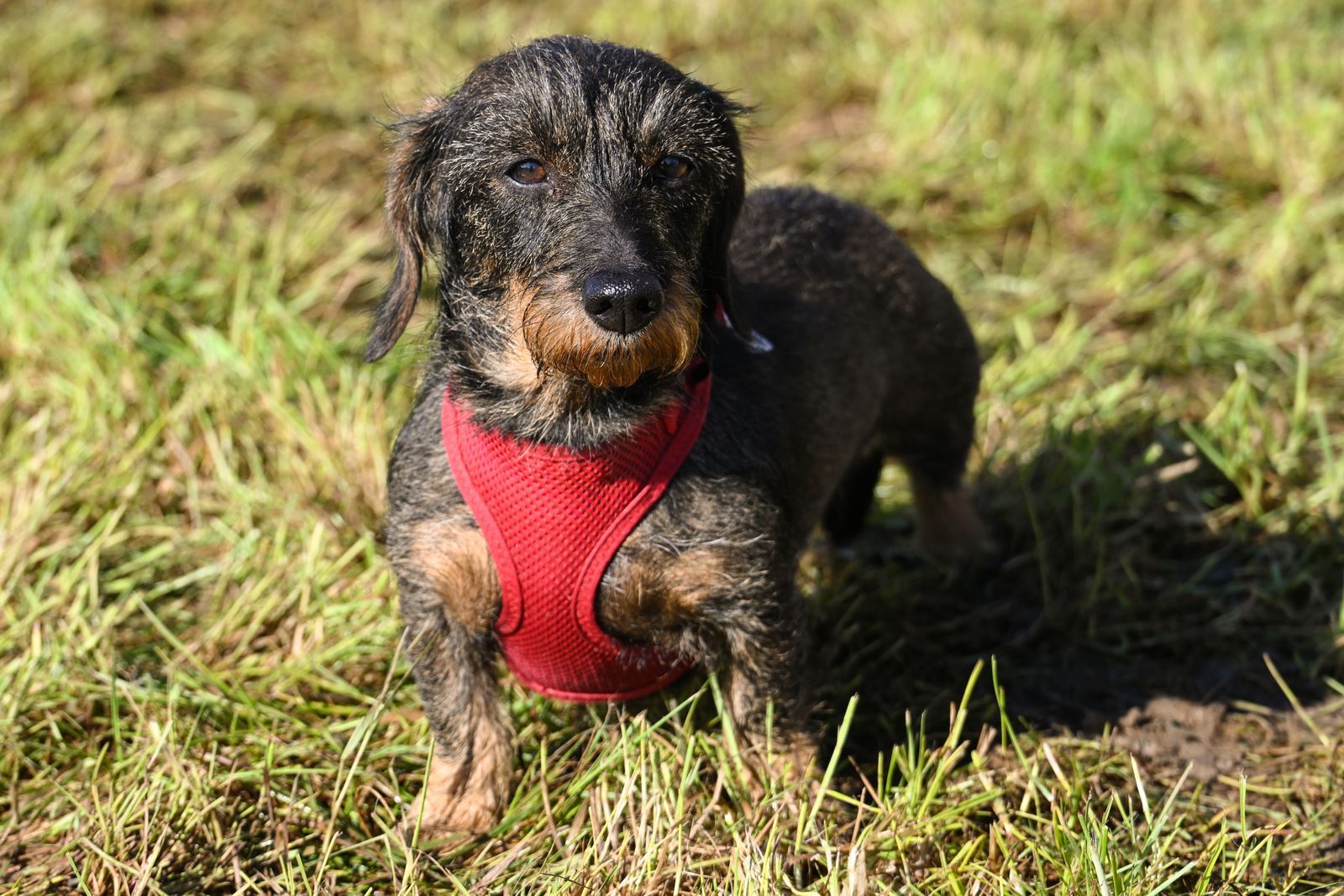
Breed snapshot
The Dachshund was bred in Germany to follow badgers into burrows, and the breed still carries that bold, persistent character in a pet home. The American Kennel Club recognises two sizes, standard and miniature, and three coat types, smooth, wirehaired, and longhaired. Dachshunds are friendly, curious, and spunky, with a watchdog voice that is much bigger than the dog. They need regular exercise to keep muscle supporting the spine, but jumping down from height and rough stair use are habits to manage from puppyhood. With a lifespan that is long even for a small dog, a Dachshund policy is a long relationship, which makes renewal wording and repeat episode rules unusually important.
| Height | Standard 8 to 9 inches. Miniature 5 to 6 inches |
|---|---|
| Weight | Standard 16 to 32 pounds. Miniature 11 pounds and under |
| Lifespan | 12 to 16 years |
| Coat | Three types: smooth, wirehaired, and longhaired, in a wide range of colours and patterns |
| Temperament | Friendly, curious, and spunky, with a bold and vivacious personality |
| Energy and exercise | Moderate. Regular walks and play to maintain muscle and weight, with ramps or steps to limit jumping down |
Health tendencies in Dachshunds
One condition dominates this section, and it gets the deepest card by design. The other conditions still matter. A long lived small dog can meet several of them, and each one maps to a different policy clause. All of them are tendencies, not predictions for an individual dog.
This section is general information only. It is not veterinary advice, and it is not a diagnosis for any specific dog. Signs described here can have many causes. Only a veterinarian who examines your dog can say what is going on and what care is needed. A Dachshund that suddenly cannot walk, drags its back legs, or loses bladder control needs emergency care the same day.
Intervertebral disc disease (IVDD)
What it is
Between each pair of spine bones sits a disc. Cornell describes a disc as a ring of cartilage around a gel like centre called the nucleus pulposus. The disc cushions the spine and lets the back bend and turn. Dachshunds are a chondrodystrophic breed. The same inherited trait that shortens the legs also causes the soft centre of the disc to harden early in life, often in the first year, long before any sign appears. Cornell calls this pattern Type I disc disease when the hardened centre ruptures through tears in the outer layer and pushes material toward the spinal cord. Pressure on the cord is what causes pain and neurological signs. Most disc problems occur in the mid and lower back, with a smaller share in the neck. The American College of Veterinary Surgeons estimate quoted by Cornell underlines why this breed is singled out in veterinary teaching. Dachshunds account for a very large share of all canine IVDD cases, and signs often first appear in young to middle aged adults rather than only in old dogs. A Dachshund can live with hardened discs for years and then have an episode after an ordinary movement. Another can have repeated episodes at different levels of the spine. That unpredictability is exactly what insurance is meant to address, and exactly why the wording deserves this much attention.
Signs owners may notice
- Back or neck pain shown as yelping, trembling, a stiff neck, an arched back, or unusual sensitivity or even snapping when touched or lifted
- Reluctance to jump, climb stairs, walk, turn the head, or lower the head to a bowl on the floor
- Wobbliness, loss of coordination, knuckling or dragging of the paws, or hind leg weakness described as partial paralysis
- A dog that walks to its food or water bowl and then just looks at it, but will eat if the bowl is raised
- In severe episodes, inability to stand or use the back legs, and loss of bladder or bowel control
Signs can begin suddenly or build gradually, and mild pain can be the only sign at first. Those signs are not a diagnosis. Other spine and nerve problems can look similar, which is why imaging and a neurological exam matter.
When it can be urgent
How vets usually evaluate and treat it
The first step is a thorough physical and neurological exam that grades pain, coordination, leg strength, and reflexes. Cornell notes that a mild case may need only an exam at first, with plain imaging as an added step. Dogs with more than mild pain are often referred to a veterinary neurologist. At that stage MRI or CT is commonly used to show the disc material, the level involved, and the degree of cord compression, and to rule out other causes such as a growth. Treatment then follows severity. Mild cases may be managed medically at first with strict restricted activity and crate rest, pain medicines, and possibly muscle relaxants. Cornell and its rehabilitation team also describe added pain control approaches in some cases. Surgery is an intensive operation. Bone is removed so the extruded disc material can be taken out and pressure lifted from the cord. Timing matters when surgery is chosen. After surgery a dog needs crate rest at first, help going to the bathroom in some cases, monitoring for pressure sores, and then strictly controlled, gradually increasing exercise. Recovery can take months. Rehabilitation as recovery progresses can include laser therapy, underwater treadmill work, and prescribed home exercises. Medically managed dogs also need genuine rest, not just fewer walks, and a recheck plan because a mild episode can progress.
Obesity and weight pressure on the back
What it is
Obesity is not a cosmetic issue in a Dachshund. Extra weight is mechanical load carried by a long spine and short legs on every step, every stair, and every jump down. Cornell advises keeping a dog with disc risk trim and fit as a core way to reduce the odds of a spine problem, and weight also loads the knees and other joints. Dachshunds are enthusiastic eaters in a small frame, they are skilled at soliciting food, and their exercise can quietly drop after a back scare, which creates a cycle. Weight gain after an IVDD episode, when activity is restricted, is a particular trap that needs a feeding plan rather than good intentions.
Signs owners may notice
- Ribs that are hard to feel under a layer of fat, or no visible waist from above or from the side
- Reluctance to exercise, tiring quickly, or worsening stiffness
- A belly that hangs lower and puts the back in a more swayed position
- Weight creeping up between vet visits even though meals look unchanged
When it can be urgent
Weight gain itself is gradual, but rapid gain with a swollen belly, breathing difficulty, collapse, or a sudden drop in exercise tolerance needs prompt veterinary assessment, because those signs can point to a problem beyond simple overfeeding.
How vets usually evaluate and treat it
A vet will usually weigh the dog, score body condition by feel and by sight, review the exact food, treats, chews, and table scraps, and rule out medical contributors where the picture suggests them. The plan is usually a measured feeding amount, treat accounting, safe regular activity suited to the spine, and scheduled weigh ins. After a disc episode, the vet can set activity and calorie targets together so rest does not quietly become weight gain.
Progressive retinal atrophy (PRA)
What it is
Progressive retinal atrophy is an inherited eye disease. Cornell describes it as degeneration of the light sensitive cells, called rods and cones, in the retina at the back of the eye. Rods help with night vision and motion detection, and in the common form they fail first. Cones help with day vision. There is no cure at present. The disease is not painful, it tends to progress slowly, and most dogs adapt well as vision fades, especially in a familiar home. Dachshunds appear on breed health lists for PRA, with particular attention in miniature varieties, and DNA testing exists for known variants, although Cornell notes that not every variant has been discovered yet.
Signs owners may notice
- Hesitance in dim light, reluctance to go outside at night or enter a dark room
- Bumping into door frames or clumsiness in new surroundings, or hesitance on stairs
- Pupils that look dilated, or eyes that reflect light in an unusually bright way
- Cataracts developing in both eyes in later stages
When it can be urgent
PRA itself is slow and painless, so it is not an emergency. Sudden blindness, a painful or red eye, or a cloudy eye that changes quickly is a different picture and needs prompt care, because other eye diseases that cause rapid signs can be treatable if caught early.
How vets usually evaluate and treat it
Diagnosis is by an eye exam focused on the retina. A veterinarian may refer the dog to a veterinary eye specialist, who can confirm the picture with testing such as electroretinography, which measures how the retina responds to light, especially when cataracts block the view. Care is management rather than cure. Cornell lists practical steps such as keeping furniture in the same arrangement, adding lighting in early stages, using gates at stairs, guiding the dog on a leash in new places, and teaching verbal cues while vision remains.
Patellar luxation (slipping kneecap)
What it is
The patella, or kneecap, normally glides in a groove at the front of the knee. In patellar luxation the kneecap slips out of that groove, most often toward the inside of the leg. The Merck Veterinary Manual describes it as a developmental orthopedic disorder linked to alignment of the hip, thigh bone, and shin bone, and notes that it is common in small and miniature breed dogs. Severity is graded. A mild kneecap slips occasionally and returns on its own. A severe one stays out of place and deforms how the leg is used.
Signs owners may notice
- A brief skipping or hopping step in a back leg that resolves within a few steps
- Intermittent limping where the dog holds a back leg up, then walks normally again
- Stretching a back leg out behind to pop the knee back into place
- In severe cases, a crouched stance in the back legs and ongoing lameness
When it can be urgent
A chronic skip is a routine appointment. A dog that suddenly cannot bear weight, cries in pain, or has a swollen knee after a jump or fall should be seen promptly, because an acute injury can look similar and needs different care.
How vets usually evaluate and treat it
A vet diagnoses luxation mainly by feeling the kneecap while moving the knee through its range, and imaging of the knee, shin, and pelvis is often used to assess alignment. Merck describes conservative care for milder cases, built on weight management, controlled exercise, physical therapy, and anti-inflammatory pain relief, with the understanding that conservative care does not correct the anatomy. Surgery is typically recommended for moderate to severe grades, for marked lameness, or when signs worsen, and can involve deepening the groove and realigning the attachment of the tendon.
Epilepsy (idiopathic epilepsy)
What it is
Idiopathic epilepsy is a neurological disorder of repeated seizures where no underlying structural or metabolic cause is found. Cornell describes a seizure as abnormal, excessive activity of brain cells, and notes that idiopathic epilepsy is diagnosed when testing finds no tumour, inflammation, or body wide disturbance to explain the events. A genetic component is known or suspected in a number of breeds, and Dachshunds appear on breed health lists for epilepsy. A specific inherited form called Lafora disease is discussed in miniature wirehaired Dachshunds in breed literature. Seizures most often begin in young to middle aged adult dogs.
Signs owners may notice
- A whole body event with collapse, stiffening or paddling, drooling, and loss of awareness
- Involuntary urination or defecation during an event
- A quiet, confused, clingy, or sleepy period after an event
- Restlessness, whining, or staring spells before an event in some dogs
When it can be urgent
How vets usually evaluate and treat it
Because idiopathic epilepsy is a diagnosis of exclusion, a vet will usually start with bloodwork and a urine test to rule out body wide causes, take a detailed history and any video of an event, and may recommend MRI of the brain and spinal fluid sampling to rule out structural problems. If at least two seizures occur more than a day apart and no cause is found, a tentative diagnosis of idiopathic epilepsy is made. Long term care is built on anti-seizure medicines, regular blood monitoring, a seizure log, and a plan for cluster events agreed in advance with the vet.
Dental disease
What it is
Dental, or periodontal, disease starts with plaque on the teeth. Cornell describes periodontal disease as one of the most common health issues in dogs, able to begin in very young dogs, and able to progress to inflamed gums, pain, and tooth loss if it is left unchecked. A Dachshund has a long, narrow jaw with teeth crowded into a small space, which makes plaque and tartar traps easy to form and hard to clean by chewing alone. Home brushing slows tartar and delays disease, but it does not replace professional cleaning and a full oral exam under anaesthesia when a vet recommends them.
Signs owners may notice
- Bad breath that is stronger than normal dog breath, or bleeding or red gums
- Visible tartar, loose or discoloured teeth, or reluctance to chew hard food
- Pawing at the mouth, drooling, dropping food, or chewing on one side
- No signs at all, which is common, because much of the disease sits below the gumline
When it can be urgent
A broken tooth with a visible pulp, a swollen face or jaw, refusal to eat, or bleeding from the mouth that does not stop needs prompt care. Mouth pain that stops a dog eating is never a wait and see problem in a small dog.
How vets usually evaluate and treat it
A vet will examine the mouth at routine visits and, when disease is suspected, recommend a dental procedure under anaesthesia. That allows cleaning above and below the gumline, probing around each tooth, dental imaging, and extraction of teeth that cannot be saved. Home care after that point is daily brushing where the dog tolerates it, plus dental products a vet recommends. In a Dachshund, anaesthesia planning also takes the spine into account for positioning and handling.
Policy decision table for a Dachshund
Read this table from the top. For a Dachshund the first three rows matter more than everything that follows, because they decide the disc disease question from three different angles.
| Policy feature | Why it matters for a Dachshund | Stronger wording looks like | Watch out for |
|---|---|---|---|
| IVDD coverage itself | Disc disease is the breed defining risk and the most likely major claim in the dog life. | IVDD is covered as an illness for Dachshunds with no breed based restriction. | Breed restrictions, disc exclusions, or coverage that exists in marketing but is limited in definitions. |
| Hereditary condition rules | Dachshund disc disease is tied to an inherited body shape and early disc hardening. | Hereditary conditions are covered on the same terms as other illnesses. | A hereditary exclusion that quietly removes the main Dachshund risk. |
| Spinal and orthopedic waiting periods | A waiting period that overlaps the first back pain note can make the condition pre-existing. | Waiting periods are short, listed in one place, and clear about what counts as a sign. | Long special waiting periods for spine or orthopedic care buried in a definitions section. |
| Repeat episode and renewal handling | A long lived Dachshund can have a second disc episode years after the first. | New episodes are handled under the annual terms while coverage stays in force. | Per condition limits that never refresh, or renewal wording that reclassifies a prior episode. |
| Imaging, specialist, and surgery coverage | A serious episode can combine neurology referral, MRI or CT, surgery, and hospital days. | Specialist care, advanced imaging, surgery, and hospital care are covered services. | Imaging sublimits, or specialist care covered only with advance approval you did not know to get. |
| Rehabilitation coverage | Recovery from disc disease is measured in months and often includes structured rehab. | Rehabilitation after a covered episode is a covered service. | Rehab excluded, or covered only for a very short window after surgery. |
| Bilateral rules | Patellar luxation can affect both knees over a lifetime. | Each knee is judged on its own record, or the bilateral rule is narrow. | A rule that treats the second knee as pre-existing because the first was noted early. |
| Dental wording | Crowded teeth make dental disease likely across a long life. | The dental section separates routine cleaning from treatment of diseased teeth, plainly. | Assuming cleanings and extractions are both covered when the policy limits one or both. |
Life stages: puppy, adult, and senior
Puppy
Enroll a Dachshund puppy early, ideally before the first back related note can exist. Discs begin hardening in the first year even though signs usually come later, so the medical record in puppyhood is about other things. A sore day after rough play, a yelp at the vet, or a comment about reluctance to jump can be quoted back years later. Ask the breeder or rescue what screening and history they have, including eye testing and any family history of disc episodes or seizures, and keep it. At home, start the habits that protect the policy and the dog at the same time. Ramps for the sofa and bed, support under both chest and rear when lifting, and lean feeding from the start.
Adult
Adulthood, and especially the young to middle adult years, is when disc episodes most often first appear in this breed, according to Cornell. That timing is the practical argument against delaying enrollment until a dog looks less healthy. Keep weight records at every visit, because a documented lean dog supports both spine health and any later claim conversation. If an episode does occur, keep every record together, including the first emergency visit, imaging reports, and rehab notes. If you consider changing insurers in adulthood, assume the new carrier will treat an episode already in the record as pre-existing, and weigh any saving against losing disc coverage you already have.
Senior
A senior Dachshund may carry an old disc history alongside newer problems such as dental disease, vision loss from PRA, knee stiffness, or seizure management if epilepsy was diagnosed earlier. Check that chronic medicines and monitoring stay covered at renewal, that dental treatment wording is clear before a procedure is booked, and whether there is an upper age limit for continued enrollment in your plan. A simple home log helps here too. Note mobility, stair confidence, night vision behaviour, appetite, and any seizure events with dates. That log supports good veterinary decisions, and it gives a claim review the clear timeline it will ask for.
A hypothetical claim, step by step: an IVDD episode that needs imaging and surgery
The walkthrough below is a hypothetical example for learning how a claim moves. It is not a promise that any real claim will be covered. Coverage always depends on the policy, the dates, the medical record, and the facts of the case.
Signs and records before the visit
Imagine a five year old Dachshund that yelps on a Saturday morning, refuses the stairs, and by afternoon is wobbly in the back legs and dragging one paw. The owner keeps the dog still in a crate, writes down when each sign appeared, and notes that the policy began in puppyhood with no back problems in the record. That clean early record and that same day timeline are the two facts the rest of the claim will rest on.
The emergency visit and the diagnosis record
At the emergency hospital the veterinarian performs a neurological exam and grades the weakness. Because the signs are more than mild pain, the dog is referred for specialist assessment. The written exam, the grading, and the referral reasoning are collected by the owner before transfer. These pages explain why imaging and surgery were medically needed, in the language a claim review looks for.
Checking the waiting period status
While the dog is being assessed, the owner confirms the policy dates. The policy started years earlier, the spinal waiting period passed long before any sign, and no back pain appears in earlier records. If the timeline had been different, for example a policy bought a few weeks earlier, the same episode could have fallen inside a waiting period and been treated as pre-existing. Timing, not the size of the bill, is what decides this step.
Imaging, surgery, and paying the vets
MRI shows the level of disc rupture and the degree of cord compression. The surgeon removes bone to reach the disc material, takes the pressure off the cord, and the dog stays in hospital for monitoring, bladder care, and pain control. Most pet insurance works on reimbursement, so the owner pays the emergency hospital and the surgical centre, and collects itemised invoices, imaging reports, surgery and anaesthesia reports, and discharge instructions from both.
Submitting the claim
The owner submits one organised file. Claim form, itemised invoices, the emergency exam, the neurology report, the imaging report, the surgery report, and the discharge and rehabilitation plan. A copy of everything is kept with the submission date. If the insurer requests the full prior history to confirm there were no earlier back signs, the owner sends the complete record rather than selected pages.
How reimbursement works in general
Once a claim is accepted, the mechanics follow the pattern explained in what pet insurance costs and why. The deductible is met as the policy defines it. The plan then reimburses a portion of the covered charges as its terms state, up to the annual or per condition limit that applies. Rehabilitation visits in the following weeks are submitted the same way, with their own invoices and progress notes, if rehab is a covered service in the plan.
Common denial points for this condition
Dachshund disc claims are most often challenged on history and wording. A prior note of back pain, yelping, or reluctance to jump dated before coverage or during a waiting period. IVDD classed as hereditary under a plan that limits hereditary conditions. A breed restriction the owner never saw. A per condition limit already used by an earlier episode. Or missing imaging and neurology reports that leave the need for surgery undocumented. Enrolling in puppyhood, reading the disc clause directly, and keeping the full record are the practical defences against each one.
What shapes the premium for a Dachshund
No prices appear in this guide, because a premium only means anything for a specific dog, place, and plan. The drivers are still worth understanding. Breed risk pulls the price up. Insurers know the disc risk in this breed, and spine imaging and surgery are major procedures even on a small dog. Size pulls the other way. Medicines, anaesthesia time, and most routine procedures are lower for a small dog than for a giant breed. Lifespan stretches the picture. A dog that commonly lives well into its teens will be insured across many renewals, and premiums generally rise with age as illness becomes more likely. Location matters because veterinary fees vary by area. Plan settings are your lever. Annual limit, deductible structure, and which services are covered move the quote, and for a Dachshund a cheap plan that limits disc care is not a saving in any useful sense. The wide spread between insurers for this breed usually reflects how differently they treat IVDD, which is why comparing the disc terms matters more than comparing the monthly figure alone. See what pet insurance costs and why for the general mechanics.
Pre-purchase checklist for a Dachshund
- Get a direct, written answer on whether intervertebral disc disease is covered for a Dachshund in the exact plan you are considering.
- Confirm hereditary conditions are covered, since Dachshund disc disease is tied to an inherited trait.
- List the spinal and orthopedic waiting periods, and what prior signs would count as a pre-existing back problem.
- Ask how a second disc episode in a later year is treated, and whether any per condition limit would already be used up.
- Check that MRI and CT, specialist neurology, surgery, hospital care, and rehabilitation are covered services.
- Read the bilateral rule with patellar luxation in mind, in case both knees need care over a lifetime.
- Read the dental section separately for routine cleanings and for treatment of diseased teeth and extractions.
- Choose an annual limit by picturing imaging plus surgery plus rehabilitation in one policy year, alongside ordinary illness care.
- Enroll in puppyhood, keep breeder or rescue history, and store your written insurer answers with the policy.
Questions to ask an insurer, in writing
- Is intervertebral disc disease covered for a Dachshund, and is it treated as a hereditary condition under this plan?
- What waiting period applies to spinal conditions, and what counts as a pre-existing sign of a back problem?
- If my dog has a disc episode this year and another in a later year, how is the second episode treated?
- Are MRI, CT, specialist neurology, spinal surgery, and post surgical rehabilitation covered, and are there sublimits?
- How does your bilateral rule apply if both knees develop patellar luxation at different times?
- What dental care is covered, for routine cleaning and for treatment of dental disease, stated separately?
Frequently asked questions
Is intervertebral disc disease covered for Dachshunds?
It depends on the exact policy. Some plans cover IVDD as a standard illness. Others class it as hereditary and apply hereditary rules, attach a longer spinal or orthopedic waiting period, or restrict it for breeds prone to disc disease. Ask the question word for word for a Dachshund, in writing, and read the answer in the policy document rather than on a summary page.
If my Dachshund once yelped and was sore, is disc disease now pre-existing?
It can be. Insurers read the medical record for signs such as back pain, reluctance to jump, or a sore spine, even without a formal IVDD diagnosis. A note like that before the policy started or during a waiting period can be used to treat later disc care as pre-existing. That is the main reason to enroll a young Dachshund while the record is still clean.
Is a second disc episode in a later year a new claim?
Policies handle this differently. Some treat each new episode under the annual terms while you stay insured. Others link repeat episodes to the first condition, apply a per condition limit, or treat a returning problem differently at renewal. Ask how repeat IVDD episodes are handled before you buy, because a Dachshund can have more than one episode in a long life.
Does pet insurance pay for rehabilitation after back surgery?
Only if rehabilitation is a covered service in that plan. Some policies include rehab after surgery. Others limit it, require it to follow a covered procedure, or leave it out. Check the covered services list for rehabilitation, physical therapy, laser therapy, and underwater treadmill work if your vet recommends them.
Are dental cleanings covered for a Dachshund?
Routine cleanings are usually preventive care rather than illness care, and many accident and illness plans do not cover them unless a wellness add on is included. Treatment for dental disease itself is a separate question, and policies differ on extractions and oral surgery. Read the dental section carefully and do not assume a cleaning is included.
My Dachshund is already a senior. Is it too late to insure?
It is not automatically too late, but the limits are real. Some plans have an upper enrollment age, and any condition already in the record will usually be treated as pre-existing. A senior policy can still help with new illnesses and accidents. Read the enrollment age, waiting periods, and pre-existing definitions with your dog's current record in mind.
Sources and further reading
- American Kennel Club, Dachshund breed page
- Cornell Riney Canine Health Center, Intervertebral disc disease
- Cornell Riney Canine Health Center, Chondrodystrophy and intervertebral disc disease (CDDY/IVDD)
- Cornell Riney Canine Health Center, Progressive retinal atrophy
- Cornell Riney Canine Health Center, Idiopathic epilepsy in dogs
- Merck Veterinary Manual, Patellar Luxation in Dogs and Cats