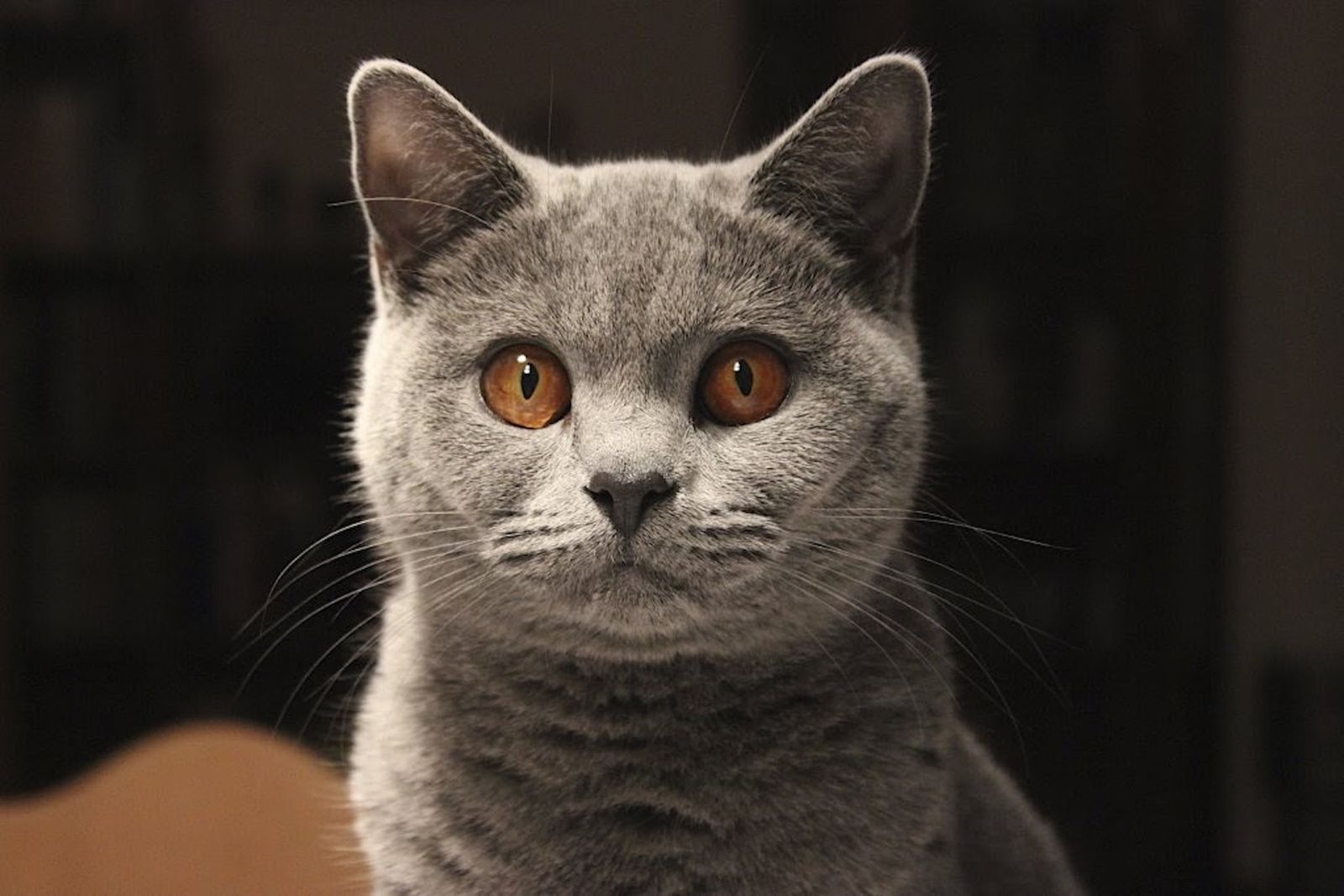
British Shorthair snapshot
The Cat Fanciers Association, known as the CFA, describes the British Shorthair as probably the oldest English breed of cat, a medium to large cat of compact build that is powerful and well balanced. The International Cat Association, known as TICA, describes a friendly and affectionate cat that enjoys attention in an undemanding way, is not really a lap cat, and prefers to sit beside its people with all four feet on the floor. Both registries describe the same physical signature: a round head with full cheeks, a broad chest, short strong legs, and a short coat so dense that the CFA compares it to deep pile carpet.
| Size | Medium to large, compact and powerful, with a broad chest and short, strong legs. |
|---|---|
| Weight | About 9 to 18 pounds as listed by TICA, with the weight meant to come from a solid, muscular body rather than from extra food. |
| Maturity | Slow to mature. The CFA notes that British Shorthairs often do not reach full size and development until the age of three. |
| Coat | Short and very dense, with a plush, crisp feel. The classic blue coat is the best known, and the breed is recognized in many colors and patterns. |
| Temperament | Calm, quiet, and undemanding. Affectionate beside its people rather than on them, tolerant, and content with its own company for stretches of the day. |
| Energy and exercise | Not an overly active cat. The CFA notes the breed is comfortable in apartments as well as houses, and TICA describes a cat that looks before it leaps and does not go in for high flying acrobatics. |
Two snapshot facts shape the insurance picture. The first is that calm, indoor, ground level temperament. A cat that expends little energy each day, in the CFA and Cornell sense of an indoor life, can gain weight gradually without any single moment that looks like a problem, and weight is the thread that runs from this breed's temperament to diabetes and to sore joints later. The second fact is slow maturity combined with a solid build. A young British Shorthair can look finished long before it is, and its most important conditions tend to belong to the middle and later years, which is exactly when a policy bought late may already have notes in the record to argue about.
It also helps to read the breed honestly on ancestry. British Shorthairs were crossed with Persians in the breed's history, and that Persian connection is not a piece of trivia. It is the reason a kidney condition strongly associated with Persians, and a DNA test developed for Persian related cats, appears in a guide about a shorthaired British breed. The health section below separates that ancestry linked risk from the risks this breed carries in its own right, and from the risks any quiet indoor cat can develop.
Health tendencies in British Shorthairs
Not every risk in this guide sits at the same level, and treating them as if they did would mislead a buyer. One condition on this list is linked to the breed itself in veterinary sources. One arrives through Persian ancestry and testing. The rest are general risks of indoor, aging, or male cats that fit this breed's life and build closely enough that a British Shorthair policy has to answer for them. The cards below label each one as they go.
Breed linked. Hypertrophic cardiomyopathy is named by Cornell among the conditions that are more prevalent in British Shorthairs, with genetics thought to play a role. Ancestry linked. Polycystic kidney disease is a Persian condition first, and British Shorthairs appear in Cornell and UC Davis material because of Persian ancestry in the breed. General indoor cat risks. Weight gain and diabetes, urinary stones and lower urinary tract disease, dental disease, and osteoarthritis can affect cats of any breed. They belong in this guide because a calm, solid, indoor cat that tends to gain weight and to hide discomfort is a cat in which those general risks are easy to miss until they are established.
This section is general information about conditions a breed or a type of cat can be prone to. It is not veterinary advice and it is not a diagnosis of any cat. Signs listed here are possible signs owners may notice, and many of them have several causes. Only a veterinarian who examines your cat can say what a sign means.
Hypertrophic cardiomyopathy (breed linked)
What it is
A disease of the heart muscle in which the walls of the left ventricle, the heart's main pumping chamber, become thickened. Cornell's Feline Health Center calls hypertrophic cardiomyopathy, often shortened to HCM, the most common heart disease of cats, and names the British Shorthair among the breeds in which the condition is more prevalent, with genetics thought to play a role. As the muscle thickens, the chamber holds less blood and relaxes less well, so the heart works harder to do the same job. Cornell describes HCM as generally progressive, meaning the thickening and its effects commonly worsen over time.
Signs owners may notice
- Often, nothing at all. Cornell notes that many cats with HCM do not appear to be ill, which is the central problem with this condition in a quiet breed.
- A heart murmur, an extra heart sound, or an irregular rhythm heard by a vet at a routine exam, in a cat that seems completely well at home.
- Working harder to breathe, breathing fast, open mouth breathing, or tiring and going quiet, which Cornell lists among the signs that can appear when fluid builds up in or around the lungs.
- Sudden pain or weakness in the back legs, which can signal a blood clot and needs emergency care.
How vets usually evaluate and treat it
HCM is diagnosed by echocardiography, which is an ultrasound examination of the heart, often shortened to an echo. Cornell is clear that the echo is what shows the thickened walls and the smaller chamber, and that high blood pressure and an overactive thyroid gland can cause similar thickening, so those conditions must be ruled out before HCM is named. A vet may also use chest X-rays, an electrocardiogram, which records the electrical activity of the heart, and blood pressure and thyroid testing as part of the same workup. TICA stresses that breeders should screen for this condition with an echocardiogram performed by a veterinary cardiologist, and that HCM does not always show up in the first years of life, so one early clear result is not a lifetime guarantee. There is no known cure, in Cornell's wording. Care aims to control heart rate, ease congestion if fluid builds up, and reduce the chance of blood clots, with repeat monitoring over time.
Polycystic kidney disease (ancestry linked, through Persian lines)
What it is
An inherited condition in which small, closed, fluid filled sacs, called cysts, develop in the tissue of the kidneys. Cornell explains that the cysts multiply and grow over time and can eventually overwhelm normal kidney tissue and lead to kidney failure. Cornell describes the condition as occurring most frequently in Persian cats, and occasionally in a few other breeds, including British Shorthairs. The UC Davis Veterinary Genetics Laboratory makes the connection precise for this breed: its PKD1 test page describes the heritable form as commonly seen in Persians and cats with Persian ancestry, and lists the British Shorthair among the Persian derived breeds the test is appropriate for. UC Davis describes the inheritance as autosomal dominant, which in plain language means a cat needs only one copy of the changed gene to be affected.
Signs owners may notice
- For years, often nothing. Cornell notes that cysts are present from birth but tiny, and that signs are most often recognized in middle aged or older cats.
- Drinking more and urinating more, which Cornell lists among the usual signs of kidney disease in general.
- Reduced appetite, weight loss, nausea or vomiting, and low energy, as kidney function declines.
- In an advanced case, kidneys that feel enlarged at a vet exam, because the cysts have grown large and numerous.
When it can be urgent
Polycystic kidney disease itself develops slowly, and early cysts are a monitoring question, not an emergency. A cat that stops eating, vomits repeatedly, becomes weak or dehydrated, or produces very little urine needs prompt care, because those signs can mean kidney function has fallen or that something else is wrong. Kidney failure in any form deserves a vet's attention the day it is suspected, not a wait and see approach at home.
How vets usually evaluate and treat it
Cornell is direct about the two testing routes, and about what each one can and cannot say. A genetic test, the UC Davis PKD1 test, can show whether a cat carries the known variant, which is valuable for breeding decisions and for knowing what to watch. It cannot show how seriously an individual cat is affected. Cornell states that ultrasound is the way to get a definitive diagnosis of cysts in the kidneys, because imaging shows the cysts themselves. Once kidney function is affected, vets follow the same measures used for kidney disease in general: blood and urine testing to track kidney values, diet management, fluid support when needed, and medication a vet prescribes for the problems kidney disease causes. Cornell puts the management goal plainly: to keep the kidneys working as well as possible for as long as possible.
Weight gain and diabetes mellitus (general risk, amplified by this breed's life)
What it is
Two linked problems share this card, because in this breed the first quietly prepares the ground for the second. A British Shorthair is built solid and lives calmly indoors, and Cornell's writing on obese cats explains the arithmetic of that life: cats that have their food delivered in a bowl use fewer calories than cats that hunt, and strictly indoor cats use fewer than cats that go outside, so food intake can exceed daily use and the remainder is stored as fat. Diabetes mellitus is a condition in which the body cannot properly produce or respond to insulin, the hormone that moves sugar from the blood into cells, so blood sugar stays high. Cornell notes that cats most commonly have the form in which cells do not respond appropriately to insulin, and names obesity, increasing age, physical inactivity, and male sex among the most important risk factors. That list is a fair description of a neutered male British Shorthair in middle age, which is why this general condition earns a deep card in a breed guide, without any claim that a British Shorthair gene causes it.
Signs owners may notice
- Weight that rises slowly across vet visits, ribs that become harder to feel, and a cat that plays less and sleeps more.
- For diabetes, the two signs Cornell says owners most commonly notice: weight loss despite a good appetite, and increased thirst and urination.
- A water bowl that empties faster, larger or more frequent clumps in the litter box, and a cat that seems hungry while getting thinner.
- In a longer standing case, walking or standing with the hocks, the back ankle joints, low to the ground, which Cornell describes as a nerve effect of uncontrolled diabetes.
How vets usually evaluate and treat it
Vets diagnose diabetes by showing persistently high sugar levels in both blood and urine, together with the clinical signs. Cornell adds a detail that matters for nervous indoor cats: a single high reading at the clinic can be a short term stress response, so a test called fructosamine, which gives a rough average of blood sugar over a recent period, can help confirm the picture. Other testing usually rules out conditions that overlap or contribute, such as urinary infection, kidney disease, or an overactive thyroid. Treatment traditionally combines insulin given by injection under the skin, usually on a regular daily schedule set by the vet, with dietary therapy that Cornell describes as lower in carbohydrate, and slow, controlled weight loss for a cat that is overweight. Cornell notes that a newer class of oral medication exists for some newly diagnosed cats, and that the choice belongs to the vet and the individual cat. Monitoring is part of the treatment, not an extra: blood glucose curves, fructosamine testing, and home records of weight, water intake, and appetite are how a vet judges whether control is real.
Urinary stones and lower urinary tract disease (general risk, emergency in males)
What it is
Lower urinary tract disease is an umbrella term for disorders of the bladder and the urethra, the tube that carries urine out of the body. Cornell lists inflammation of the bladder with no identified cause, urinary stones, and blockage of the urethra among its common causes. Urinary stones, also called uroliths, are hard collections of minerals that form in the urinary tract. Cornell names the two most common stone types in cats as struvite and calcium oxalate, and notes that they are handled differently, because struvite stones can sometimes be dissolved with a special diet while calcium oxalate stones cannot be dissolved that way and often need to be removed. This is a general cat risk, not a British Shorthair trait. It belongs here because Cornell describes lower urinary tract signs as most frequent in middle aged, overweight cats that get little exercise and live indoors, and because in a male cat the same problem can close the urethra completely.
Signs owners may notice
- Straining or seeming to have pain when urinating, and going to the litter box more often.
- Crying out while urinating, blood in the urine, or urinating outside the litter box.
- Licking the genital area frequently, and producing only small amounts of urine each time.
- Repeated trips that produce little or nothing, growing restlessness, and distress, which in a male cat suggest a blockage forming.
How vets usually evaluate and treat it
Because the same signs have several causes, Cornell describes an initial workup of a physical examination and a urinalysis, which is a laboratory examination of a urine sample, followed when needed by blood work, X-rays, abdominal ultrasound, or a urine culture to tell infection from inflammation from stones. An obstructed cat is treated as an emergency patient: the blockage is usually relieved by passing a narrow tube called a catheter into the urethra under sedation or anesthesia, and fluids are given by vein to correct dehydration and the chemical imbalances a blockage causes, with hospital care afterward. For stones without a blockage, treatment depends on the stone type, and can include a stone dissolving diet for struvite, flushing, or surgery. Cornell notes that cats that have formed stones are at increased risk of forming them again, so prevention advice from the vet, and a record of what the stone was made of, become part of the cat's long term file.
Dental disease (general risk, easy to miss in a quiet cat)
What it is
Disease of the teeth and gums. Cornell names the three most common dental diseases in cats as gingivitis, periodontitis, and tooth resorption. Gingivitis is inflammation of the gums where they meet the teeth, driven by plaque, the bacterial film that builds up on teeth and can harden into tartar. Periodontitis is what follows when gingivitis is not controlled: the tissues that attach the tooth to the gum and bone weaken, teeth loosen, and the damage cannot be reversed. Tooth resorption is a process in which the tooth structure breaks down, and Cornell calls it the most common cause of tooth loss in cats. None of this is specific to British Shorthairs. It earns its place because a stoic, quiet cat can be in real mouth pain while still eating, and because TICA reminds owners that untreated dental problems can lead to other health problems when they are left.
Signs owners may notice
- Bad breath, red or swollen gums, or bleeding where the gums meet the teeth.
- Eating hesitantly, turning the head to one side while chewing, dropping food, or newly preferring soft food, which Cornell lists among the signs of mouth discomfort.
- Drooling, pawing at the mouth, or becoming irritable when the face is touched.
- A pinkish defect in a tooth at the gum line, which Cornell describes as the usual first visible sign of tooth resorption, in a tooth that is already significantly damaged by then.
When it can be urgent
Dental disease is usually a prompt appointment rather than an emergency. A cat that stops eating altogether, drools heavily, has a swollen face, or bleeds from the mouth needs same day care, because a cat that does not eat can become seriously unwell, and facial swelling can mean infection. Cornell notes that dental disease can cause a cat to stop eating, which then leads to wider health problems.
How vets usually evaluate and treat it
A full dental evaluation involves examining and probing the teeth and gums and, for periodontitis and tooth resorption, dental X-rays, work that Cornell notes requires anesthesia because so much of the disease sits below the gum line where an awake cat cannot be examined properly. Treatment categories include professional cleaning with scaling and polishing under anesthesia, treatment of gum inflammation, and removal of teeth that are loose, badly damaged, or being resorbed and causing pain. Cornell describes home tooth brushing with a cat specific toothpaste as the best way to prevent gingivitis, introduced gradually and only on a mouth that is not already sore, with a vet's advice first when gums are inflamed.
Osteoarthritis (general risk of the senior, heavier cat)
What it is
A degenerative joint condition, also called degenerative joint disease, in which the cartilage in a joint breaks down over time, the joint becomes inflamed, and movement becomes stiff and painful. The Merck Veterinary Manual, in its MSD owner edition on joint disorders in cats, describes osteoarthritis as cartilage degeneration that leads to loss of joint movement and, in many cases, pain, and notes that the condition is common in cats but may not be noticed because cats often hide signs of pain. Weight is part of this story in this breed. Cornell's writing on obese cats notes that heavier cats suffer more from conditions like arthritis, and a solid cat carrying extra weight loads the same joints every time it jumps down from the sofa it was never very athletic about climbing.
Signs owners may notice
- Jumping up less, choosing lower resting places, hesitating before a jump the cat used to make without thinking, or using a step in between.
- Stiffness after rest, a less fluid way of walking, or lameness, which the manual lists among the signs of joint disease.
- Grooming less, especially over the back and hips, sleeping more, and seeming less interested in play or in being handled.
- Muscle loss over the back legs, joint swelling, or litter box misses in a cat that may find a high sided box harder to step into.
When it can be urgent
Osteoarthritis is a slow condition managed through routine care. A cat that suddenly cannot bear weight, cries out, has a swollen joint after a fall, or stops eating needs prompt care, because a sudden change suggests an injury, an infection in a joint, or another problem rather than the slow wear of arthritis. Treat the change, not the label, as the urgent part.
How vets usually evaluate and treat it
Evaluation is a hands on examination of the joints and how the cat moves, often with X-rays. The manual describes X-ray findings that can include fluid in the joint, soft tissue swelling, bony outgrowths, and a narrowed joint space. Treatment is usually medical rather than surgical, and the manual lists its categories plainly: weight loss when appropriate, controlled exercise, and appropriate medication to reduce pain and inflammation, with other treatments that may help protect cartilage. For a British Shorthair, the weight part of that plan is not a side note. Bringing a heavy cat slowly back toward a healthy weight, under a vet's direction, reduces the load on every sore joint at once and supports diabetes prevention at the same time.
Policy decisions that matter for a British Shorthair
For a breed whose problems arrive slowly, the policy table is about detection and duration. The expensive questions are whether a silent heart condition gets investigated while it is still silent, whether a condition diagnosed in one term is still covered in the next, and whether the monitoring that chronic care runs on is treated as care or as an extra. Read these rows with the middle and senior years in mind, because that is where this breed's claims tend to live.
| Policy feature | Why it matters for a British Shorthair | Stronger wording looks like | Watch out for |
|---|---|---|---|
| Heart screening and cardiology terms | HCM is diagnosed by echocardiogram, and a murmur at a routine exam may be the only prompt to arrange one. | Cardiology referral and echocardiogram testing are covered when a vet records a clinical reason, and repeat echoes for a covered condition are covered too. | Wording that classifies every echo in a healthy seeming cat as screening and excludes it, even after a murmur is found. |
| Hereditary condition coverage | HCM is breed linked and polycystic kidney disease is ancestry linked, so the hereditary clause carries both of the breed's named conditions. | Hereditary and congenital conditions are covered on the same terms as other illnesses, with no breed specific carve outs. | Hereditary exclusions, or a list of named breed conditions that quietly includes the two this breed is known for. |
| Chronic condition renewal terms | Diabetes, kidney disease, heart disease, and osteoarthritis are managed for years once they are diagnosed. | A condition covered in one policy term stays covered in later terms while enrollment continues. | Wording that caps a condition per term, ends its coverage at renewal, or treats it as pre-existing in a new term. |
| Monitoring coverage | Glucose curves, fructosamine tests, kidney panels, and repeat heart ultrasounds are how this breed's conditions are actually managed. | Monitoring tests and recheck visits for a covered chronic condition are reimbursable, not only the medication. | Policies that pay for a diagnosis and a drug but exclude the repeat testing that makes the treatment safe. |
| Genetic test treatment | A PKD1 result, a heart screening result, or a breeder test can sit in the record long before any sign appears. | A clear written rule for how test results without symptoms are classified, available before you enroll. | Silence on the point, which leaves a positive result to be argued about for the first time inside a kidney or heart claim. |
| Urinary emergency terms | A blocked male cat needs hospital care at once, and stones and blockages can recur. | Emergency hospitalization, catheterization, imaging, and stone treatment are covered, with a clear rule for repeat episodes. | Recurrence wording that treats every later litter box episode as the same pre-existing event, however far apart they are. |
| Dental illness terms | Tooth resorption and periodontitis need anesthesia, dental X-rays, and sometimes extractions, and they are common in adult cats. | Dental illness is covered, including anesthesia, imaging, and extractions a vet recommends for diseased teeth. | Dental cover limited to accidents, or a tartar or gingivitis note used to refuse later treatment of a different tooth. |
| Prescription food and medication | A vet may order a special diet for urinary stones, diabetes, weight, or kidney care, alongside long term medication. | The policy states plainly whether vet prescribed food for a covered condition is included, excluded, or partly included. | Assuming a prescribed diet is treatment. In many policies food is food, and the surprise arrives inside a claim. |
Life stages: kitten, adult, and senior
Kitten
The kitten stage is when the paperwork is worth the most. Ask the breeder for the screening behind the kitten, in records you can keep: echocardiogram results for the parents, because TICA stresses cardiologist performed heart screening, and PKD1 test results where the line has been tested, because a DNA result for a parent is simple information to file now and hard to reconstruct later. Expect slow growth rather than a finished cat, since the CFA notes the breed often does not reach full size until the age of three. Enrolling in this stage clears waiting periods while the record is cleanest, and it sets up the habit that protects this breed for life: a weight recorded at every visit, so that slow gain is visible on paper instead of being noticed years late.
Adult
Adulthood is when the quiet middle of this breed's risk profile arrives. Weight creeps. A vet hears a murmur, or does not, and the heart screening conversation becomes real either way. A male cat has a litter box episode that turns out to be inflammation, or a stone, and the urinary file opens. Teeth build tartar while the cat still eats happily. The insurance work of this stage is evidence and timing. Keep every screening result, normal or not. File claims as they happen rather than saving them up. Watch the water bowl and the litter box with the same attention you give the food bowl, because in this breed an increase in drinking and urination is an early sentence in several different stories, including diabetes and kidney disease.
Senior
A senior British Shorthair can have several of this guide's conditions at once, and they interact. Kidneys that are losing function, a heart that needs monitoring, joints that make the litter box harder to reach, teeth that make eating sore, and a weight that can now fall for the wrong reasons after years of rising. New drinking, new urination, appetite change, or weight loss in an older cat should never be filed under old age without a workup, because Cornell lists the same signs across diabetes, kidney disease, and thyroid disease. Review the policy at this stage for age based premium changes and any thinning of terms, and keep the home record described in the claim section below current, because a senior cat's vet visits go better, and its claims read better, when the history is written down rather than remembered.
A claim, step by step: a diabetes workup
The example below is hypothetical. It is not a real cat, a real claim, or a guarantee of how any insurer will decide. It follows a middle aged British Shorthair that starts drinking and urinating more, through the workup that names diabetes, the start of treatment, and the repeat monitoring claims that follow, because that full arc is what coverage for this breed has to handle. Pet insurance generally reimburses after you pay the vet, as explained in how pet insurance works.
The change at home, and the notes that start the file
Over several weeks the water bowl empties faster, the litter box holds larger clumps, and the cat, a heavy indoor male, seems hungrier while his weight slips at his checkup. The owner writes down when the change was first noticed and brings that date to the visit, together with a simple home record of water, litter, appetite, and weight. That timeline matters twice. It helps the vet judge how long the signs have run, and it helps the insurer place the first sign inside the policy period rather than before it.
The vet visit and the tests that name it
At the clinic the vet examines the cat, weighs him, and runs blood and urine testing. The results show sugar persistently high in both blood and urine, the pattern Cornell describes for diagnosing diabetes. Because a stressed cat can show a single high reading at a clinic, a fructosamine result supports the diagnosis by reflecting average blood sugar over a recent period. The vet also checks for overlapping problems Cornell names in this workup, such as a urinary infection, kidney disease, or an overactive thyroid, because treating diabetes well means knowing what else is in the room. The itemized invoice and the full visit record, with the lab values in it, are the core documents of the claim.
Checking the waiting period and the record
On paper, the insurer lines the first signs up against the policy dates. In this example the cat was enrolled as a young adult, the illness waiting period ended long before the drinking changed, and no earlier visit recorded increased thirst, increased urination, or a high blood sugar reading. The one difficult note is weight: earlier records describe a heavy cat, and weight is a risk factor for diabetes rather than a sign of diabetes itself. A claim can still be argued over that note, which is why the policy question about weight records, asked in the checklist below, is worth asking before enrollment rather than during this claim.
Treatment starts, and the owner pays as care happens
The vet sets the treatment plan, which traditionally combines insulin with dietary therapy, and teaches the owner how to give injections at home and what low blood sugar can look like. Cornell describes the goals plainly: restore normal blood sugar, stop or control weight loss, ease the thirst and urination, and avoid blood sugar falling too low because of treatment. The owner pays the clinic for the visit, the testing, the medication, and the supplies, and keeps the same two documents at every step: the itemized invoice and the complete record for that visit.
Submitting the first claim
The first claim is filed with the invoices and records from the workup visit, with the date the owner first noticed the change at home stated clearly and matching the vet record. The diagnosis recorded is diabetes mellitus. Filing promptly matters for a chronic condition, because the monitoring claims that follow will refer back to this diagnosis date, and a clean, early, well documented first claim makes every later claim simpler to read.
Monitoring, and how reimbursement works
Control is proven by monitoring, not assumed. The vet schedules rechecks that can include blood glucose curves, in which blood sugar is checked across a day, or fructosamine testing, and reviews the home record of weight, water intake, appetite, and litter output. Each eligible bill moves through the same mechanics described in what pet insurance costs and why. Charges count against the deductible first, the policy reimbursement rate applies to eligible charges after that, and totals are tracked against the annual limit. The practical point for this breed is frequency: a well managed diabetic cat generates a steady rhythm of modest claims, and a policy that excludes monitoring quietly removes the rhythm while keeping the label.
Renewal claims, remission, and where claims get denied
At renewal the decisive question is whether diabetes is still a covered condition or has been reclassified or capped. Under wording that keeps covered chronic conditions covered, refills, curves, fructosamine tests, and rechecks in the new term are filed the same way, referring back to the original diagnosis. Cornell notes that some diabetic cats enter remission, meaning they maintain normal blood sugar without insulin for a time, and that monitoring should continue because insulin can be needed again. Keep filing and recording through a remission rather than treating the file as closed. Denial pressure points in this story are an insurer reading the first sign as earlier than the owner reported, monitoring denied as routine care rather than treatment of a covered condition, and prescription food refused as food rather than therapy. Each is a clause question that can be asked in writing before you buy.
A home record worth keeping for a British Shorthair
The simplest useful tool in this guide is a one page home record, kept on paper or in a phone note, and brought to every recheck. It turns the quiet changes this breed is known for into dated evidence a vet can act on and an insurer can follow. Once a week, or as often as your vet suggests, write down five things. First, weight, taken the same way each time, so a trend is visible rather than a guess. Second, water intake, even in rough form, such as how often the bowl is filled. Third, litter output, meaning how many clumps and roughly how large, because urine volume is a sign in diabetes, kidney disease, and urinary disease alike. Fourth, appetite, including food left uneaten and any new preference for soft food that could point at sore teeth. Fifth, activity, such as jumps the cat no longer makes, play that ends sooner, or grooming that has slipped, which is often the first visible sentence of joint pain. Date every entry. A record like this does not diagnose anything. It makes the next vet visit start from facts, and it makes a claim file read as one continuous, honest story.
What drives a British Shorthair premium
No responsible guide will name a price for your cat, because the quote depends on the cat, the address, and the settings chosen. What can be explained is the shape of the pricing and the choices that move it. The full mechanics are in what pet insurance costs and why.
Breed risk profile. Insurers see a solid, long lived type of indoor cat whose named conditions lean chronic and investigative: a heart condition that takes an ultrasound and a specialist to find, a kidney condition that takes imaging and years of bloodwork to follow, and a strong tendency to gain the weight that feeds diabetes and joint strain. That profile prices steady, repeated care more than rare dramatic surgery, with a urinary emergency in a male cat as the sudden exception.
Build and weight. This is a medium to large cat, and medication, anesthesia, and imaging are sized to the cat in front of the vet. The more useful point for a buyer is that the breed's body makes the deductible and monitoring questions worth more than the headline limit. Many modest claims, arriving on schedule for years, are where a British Shorthair policy either earns its premium or quietly fails to.
Age curve. Premiums generally rise with age, and this breed's risks concentrate in the middle and later years: diabetes and kidney signs in middle age, heart monitoring across adulthood, and joints and teeth in the senior years. A slightly cheaper policy with weak chronic wording can cost more over that long middle than a stronger policy, because the weakness is charged again at every recheck, every curve, and every renewal.
Location and plan settings. Vet prices in your area set the size of the bills an insurer expects, and specialist care, such as a cardiology visit with an echocardiogram, is priced very differently from place to place. Your deductible, reimbursement rate, and annual limit choices then trade premium against what claims return. For this breed, read the annual limit against a bad year that stacks an emergency urinary stay on top of standing heart, kidney, or diabetes care, rather than against any one condition alone.
Pre-purchase checklist for a British Shorthair policy
- Confirm hereditary conditions are covered, including hypertrophic cardiomyopathy and polycystic kidney disease, with no breed specific exclusion.
- Ask where screening ends and diagnosis begins for an echocardiogram, in writing, for the case where a vet hears a murmur in a cat that seems well.
- Ask how a positive PKD1 genetic result, with no symptoms and normal kidney values, is classified under the policy.
- Confirm a condition covered in one term stays covered at renewal, since diabetes, kidney disease, heart disease, and arthritis are managed for years.
- Confirm monitoring is reimbursable: glucose curves and fructosamine tests, kidney blood panels, and repeat heart ultrasounds.
- Ask how emergency urinary obstruction care is handled, including hospitalization and catheterization, and how repeat episodes are counted.
- Read the dental wording line by line: dental illness, anesthesia, dental X-rays, extractions, and any effect of an earlier tartar note.
- Ask whether vet prescribed food for stones, diabetes, weight, or kidney care is covered, excluded, or partly covered.
- Enroll as a kitten or young cat, keep the breeder screening records, and start the weekly home record from the first year.
Questions to ask an insurer, in writing
- If my vet hears a heart murmur in my British Shorthair, is a cardiology visit with an echocardiogram covered, and are repeat echoes for monitoring covered?
- How do you treat a positive PKD1 DNA result in a cat with no symptoms and normal kidney test results?
- Once diabetes is diagnosed and covered, will its monitoring, including glucose curves and fructosamine testing, be reimbursed at every renewal?
- How is an emergency urinary blockage in a male cat handled, and how do you count a second blockage or a later stone?
- Is dental illness covered, including anesthesia, dental X-rays, and extraction of a resorbing tooth?
- Does a weight note or a tartar note in my cat's early record affect later diabetes, joint, or dental claims, and how?
Questions British Shorthair owners ask
Does a normal heart sound rule out heart disease in a British Shorthair?
No. Cornell notes that many cats with hypertrophic cardiomyopathy do not appear ill, and the condition is diagnosed by echocardiography, an ultrasound of the heart. A murmur heard at a routine exam is a common reason to arrange that test, but a quiet exam is not the same as a clear heart. Ask a policy how cardiology referral and echocardiogram testing for a covered heart condition are handled, and whether repeat heart ultrasounds for monitoring are covered as well.
Is an echocardiogram for a British Shorthair something insurance can cover?
It can be, when the echocardiogram is part of diagnosing or monitoring a covered condition and any waiting period has passed. Policies draw a line in different places between screening a healthy cat and investigating a murmur, a gallop rhythm, breathing changes, or a family history noted by a vet. TICA stresses breeder screening by echocardiogram performed by a veterinary cardiologist, so ask in writing where screening ends and diagnosis begins under the policy you are considering.
Is polycystic kidney disease covered for a British Shorthair?
It can be, as a hereditary condition, when hereditary conditions are included and the disease was not already diagnosed or noted before enrollment. A positive DNA result for the PKD1 variant is a record an insurer may treat as a known condition even before signs appear, so ask in writing how a positive genetic test, with no symptoms and normal kidney values, is classified. Also check that kidney monitoring bloodwork and ultrasound are covered categories.
Will diabetes stay covered after my policy renews?
It should, under a policy that keeps covered chronic conditions covered at renewal. Diabetes care is not one visit. It is treatment, repeat glucose monitoring such as blood glucose curves or fructosamine testing, recheck exams, and supplies, repeated for as long as the cat needs them. Check that monitoring for an ongoing covered condition is itself covered, and avoid wording that treats a chronic condition as new or capped at each renewal.
Is a blocked urinary tract in a male British Shorthair covered?
Emergency treatment for a urethral obstruction can be covered as an illness or emergency condition when the signs first appeared after enrollment and any waiting period. Cornell calls a urethral obstruction an absolute emergency that needs immediate treatment, so do not delay care to check coverage first. Ask in advance how hospitalization, catheterization, and repeat obstruction are handled, and how earlier litter box episodes in the record affect a later claim.
When is the best time to enroll a British Shorthair?
As a kitten or young cat, before a heart murmur, a kidney cyst, a weight note, a dental note, or a litter box episode is in the record. This breed matures slowly and its main risks tend to appear in the middle and later years, so a policy started early has time to clear its waiting periods while the cat is least likely to need care. Keep breeder screening records, including heart and PKD1 results for the parents when available.
Sources and further reading
- Cat Fanciers Association, Meet the British Shorthair for the breed's age and origin, medium to large compact build, slow maturity to the age of three, exceptionally dense coat, and calm apartment friendly temperament.
- The International Cat Association, British Shorthair breed page for the quiet, undemanding temperament, the four feet on the floor character, the listed weight range, breeder heart screening by echocardiogram performed by a veterinary cardiologist, and the reminder that untreated dental problems can lead to other health problems.
- Cornell Feline Health Center, Hypertrophic cardiomyopathy for the thickened heart muscle, British Shorthairs among the breeds where the condition is more prevalent, cats that do not appear ill, diagnosis by echocardiography, ruling out high blood pressure and hyperthyroidism, and treatment goals including clot prevention.
- Cornell Feline Health Center, Polycystic kidney disease for kidney cysts that grow over time, the condition in Persians and occasionally in British Shorthairs, its kidney disease signs, ultrasound as the definitive diagnosis, and what a genetic test can and cannot show.
- UC Davis Veterinary Genetics Laboratory, Polycystic kidney disease (PKD1) for the heritable form in Persians and cats with Persian ancestry, the British Shorthair listed among the Persian derived breeds appropriate for testing, and the dominant pattern of inheritance.
- Cornell Feline Health Center, Feline diabetes for insulin and blood sugar in plain terms, obesity and inactivity among the main risk factors, increased thirst and urination and weight loss despite a good appetite, persistent blood and urine sugar and fructosamine testing, insulin and dietary treatment, glucose curve monitoring, remission, and ketoacidosis as an emergency.
- Cornell Feline Health Center, Ask Elizabeth: Care of obese cats for indoor cats using fewer calories than cats that hunt or go outside, food intake stored as fat when it exceeds daily use, and heavier cats having more diabetes and arthritis.
- Cornell Feline Health Center, Feline lower urinary tract disease for lower urinary tract signs, bladder inflammation, struvite and calcium oxalate stones and how their treatment differs, urethral obstruction as an absolute emergency, and catheterization and fluid treatment for a blocked cat.
- Cornell Feline Health Center, Feline dental disease for gingivitis, periodontitis, and tooth resorption as the three most common dental diseases in cats, their signs at the gum line and at mealtimes, and evaluation and treatment under anesthesia with X-rays.
- MSD Veterinary Manual, Joint disorders in cats for osteoarthritis as cartilage degeneration that leads to loss of joint movement and pain, cats hiding signs of pain, X-ray findings, and medical treatment categories including weight loss when appropriate.