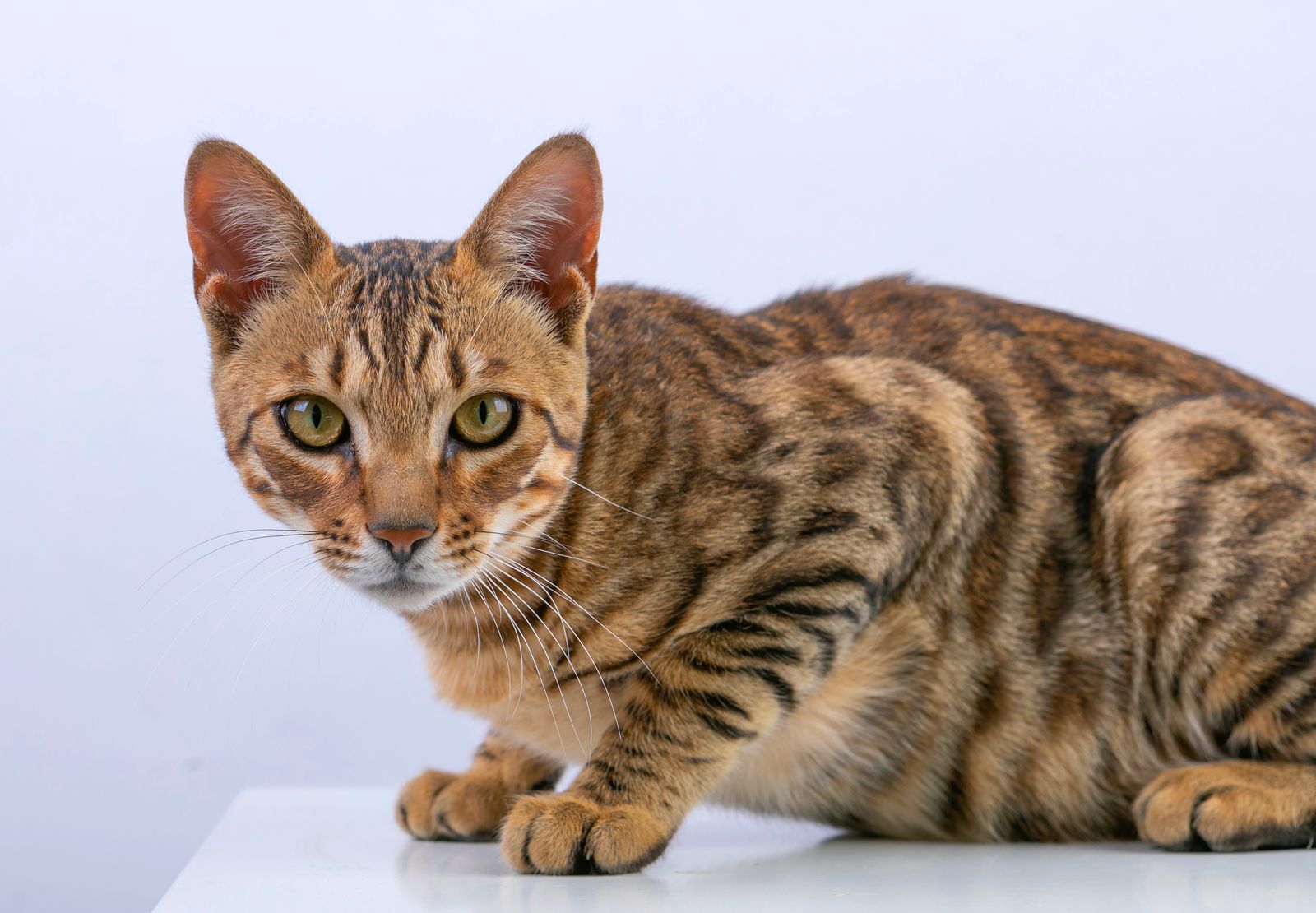
Bengal snapshot
The Cat Fanciers' Association, or CFA, describes the Bengal as a medium to large cat with a sleek, muscular build and substantial boning. The CFA standard calls the breed alert and active, with an inquisitive and dependable disposition, and it gives the Bengal its wild appearance through a broad head, a nocturnal expression, and markings unlike any other breed. The breed was developed from crosses between Asian leopard cats and domestic cats in earlier generations. Modern pet Bengals are domestic cats several generations removed from that origin, and the CFA requires registered Bengals to be well removed from any Asian leopard cat in the pedigree.
The International Cat Association, or TICA, adds the everyday picture. TICA describes Bengals as generally confident, curious, and devoted companions that enjoy being part of a family. That combination, a strong and athletic body with a busy and social mind, explains a lot of the breed's health and insurance profile. This is a cat that plays hard, climbs high, and notices everything, which is wonderful at home and relevant when you are reading accident and joint wording.
| Size | Medium to large, well muscled and athletic, with males generally larger than females. |
|---|---|
| Weight | From 6 to 15 pounds, as listed by TICA. |
| Coat | Short, soft, and luxurious in the shorthaired variety, either spotted or marbled. Some coats show glitter, an iridescent sheen on each hair. The CFA also recognizes a longhaired variety. |
| Pattern | Rosettes, which are two toned spots like those of jaguars and leopards, or a dramatic marbled pattern with a flowing, swirling look. |
| Temperament | Confident, curious, and devoted, and also alert, active, and inquisitive. Each Bengal is an individual. |
| Energy and exercise | High. A healthy Bengal looks athletic because it is athletic, and it needs daily play, climbing, and company to match. |
The snapshot fact that matters most for insurance is not the coat. It is the combination of bloodline and energy. The bloodline carries a small set of inherited conditions that breeders and vets know by name, and two of them can be tested with DNA, which means paperwork often exists for a Bengal before it ever sees your vet. The energy means the accident side of a policy is not filler for this breed. Falls, bad landings, and objects swallowed during intense play are part of the real risk picture, alongside the inherited list.
A note on words used in this guide. A hereditary condition is one passed through the genes. A congenital condition is one present at birth, whether or not it was inherited. A pre-existing condition is a condition, or a sign of one, that was present before a policy started or during its waiting period, which is the set number of days at the start of a policy when new conditions are not yet covered. Those three definitions decide most Bengal claims, so they are worth keeping in mind as you read.
Health tendencies in Bengals
The conditions below are the ones Bengal breeders, registries, and veterinary sources return to most often. Two have validated genetic tests through the UC Davis Veterinary Genetics Laboratory. One is found with heart imaging. The rest are conditions a Bengal owner may meet through the eyes, the knees, or the nerves. These are tendencies, not predictions about an individual cat, and a well bred, well tested Bengal may never develop any of them.
This section is general information about conditions a breed can be prone to. It is not veterinary advice and it is not a diagnosis of any cat. Signs listed here are possible signs owners may notice, and many of them have several causes. Only a veterinarian who examines your cat can say what a sign means.
Bengal progressive retinal atrophy (PRA-b)
What it is
An inherited disease of the retina, the light sensitive layer at the back of the eye. The UC Davis Veterinary Genetics Laboratory explains that Bengal progressive retinal atrophy destroys the cells in the back of the eye that register light, called photoreceptors, and that it causes an autosomal recessive blindness in Bengal cats. Autosomal recessive means a cat needs two copies of the variant, one from each parent, to be affected. A cat with one copy is a carrier. Carriers have normal vision and can only be found with the DNA test. UC Davis reports that the loss of cells begins early in life and progresses slowly, until vision is very compromised at around two years of age in many affected cats, although the rate varies from cat to cat.
Signs owners may notice
- More difficulty at night or in dim light than in bright light, including hesitating, misjudging jumps, or bumping into objects that were moved.
- Pupils that look more dilated than those of other cats in the same light, as UC Davis describes in affected cats.
- Whiskers carried in a more forward position, and a cat that becomes more vocal or stays closer to its owner, both noted by UC Davis in blind cats.
- In a familiar room, often nothing at all. UC Davis notes that once affected cats know their surroundings, they can be very mobile and active, which is why early signs are easy to miss.
When it can be urgent
Progressive retinal atrophy itself develops slowly and is not a same day emergency. A sudden vision change is different. A cat that goes blind quickly, has a painful or red eye, or shows a cloudy eye needs prompt care, because sudden blindness has other causes, including high blood pressure and retinal detachment, and some of those are treatable if they are caught fast. Never assume a sudden change is the inherited condition.
How vets usually evaluate and treat it
Evaluation usually starts with a full eye examination and a history of when the changes began. A veterinary ophthalmologist, a vet with advanced training in eye disease, can examine the retina directly and may use additional eye testing to judge how the retina is responding. The DNA test for the Bengal variant can confirm whether this specific inherited form explains the signs, and it is also the tool breeders use before mating. The Merck Veterinary Manual notes for progressive retinal atrophy in cats that no effective therapy is available for the retinal degeneration itself. Care is therefore about confirming the diagnosis, ruling out treatable causes of vision loss, watching the eyes for later problems such as cataracts, and adapting the home, which the claim section of this guide covers in detail.
Pyruvate kinase deficiency (PK deficiency)
What it is
An inherited disorder of red blood cells. Pyruvate kinase is an enzyme, a protein that helps cells make energy, that red blood cells need to survive. UC Davis describes erythrocyte pyruvate kinase deficiency as an inherited hemolytic anemia caused by too little activity of that enzyme. Hemolytic anemia means red blood cells break down faster than the body can replace them, so the cat has too few of them. The condition is autosomal recessive, like PRA-b, and Bengal is one of the breeds UC Davis lists as appropriate for testing and at higher risk. A DNA test identifies normal cats, carriers, and affected cats.
Signs owners may notice
- Severe tiredness and weakness that comes and goes, because UC Davis describes the anemia in this condition as intermittent, with a variable age of onset.
- Weight loss and a reduced interest in food or play during an anemic episode.
- Jaundice, a yellowing of the skin, gums, or whites of the eyes, and an enlarged abdomen, both listed by UC Davis among the signs of this anemia.
- Pale gums, which owners sometimes notice when a cat yawns or during tooth checks at home.
When it can be urgent
A cat that is weak, breathing fast, reluctant to move, or has very pale or yellow gums needs same day care. Anemia can also have many other causes, including blood loss and immune disease, and a vet needs bloodwork to sort out which one this is. Do not wait for a routine appointment to find out whether a tired Bengal is anemic.
How vets usually evaluate and treat it
Vets usually start with an examination and a complete blood count, the standard blood test that measures red blood cells, to confirm anemia and judge its severity. Further blood tests help rule out other causes, and the DNA test confirms whether the inherited Bengal relevant variant is present. UC Davis notes that the severity in an affected cat cannot be predicted from the test result alone and may be variable. Treatment categories are supportive. They can include monitoring blood counts over time, care during anemic episodes, and, in severe episodes, hospital care that a vet judges necessary at the time. There is no treatment in this list that changes the enzyme itself, which is why breeder testing before mating matters so much for this condition.
Hypertrophic cardiomyopathy (HCM)
What it is
A disease of the heart muscle. The Cornell Feline Health Center calls hypertrophic cardiomyopathy the most common heart disease of cats, and it lists Bengal among the breeds in which the condition is more prevalent, which suggests that genetics plays a role. In HCM, the muscular walls of the heart thicken, most importantly the left ventricle, the main pumping chamber. A thicker wall leaves less room for blood and makes the heart relax less well, so the heart works less efficiently even while the cat may look completely normal.
Signs owners may notice
- Often, no signs at all for a long time. Cornell notes that many cats with HCM do not appear ill, and the first clue may be a heart murmur or an irregular rhythm heard at a routine visit.
- Fast or labored breathing, open mouth breathing, and low energy, which Cornell lists as signs of congestive heart failure, a state where fluid builds up in or around the lungs.
- Loss of appetite, hiding, and tiring faster in play in a breed that is normally intense and busy.
- Sudden hind leg weakness or paralysis with pain, which can signal a blood clot, a complication Cornell describes in connection with heart disease.
How vets usually evaluate and treat it
A vet who hears a murmur or an abnormal rhythm will usually recommend an echocardiogram, an ultrasound examination of the heart that shows wall thickness and chamber size. Cornell states that HCM is diagnosed by echocardiography. The workup may also include blood pressure measurement, thyroid testing, chest images, an electrocardiogram, which records the heart's electrical activity, and a blood test that rises when the heart muscle is stretched. Those extra tests matter because high blood pressure and an overactive thyroid can also thicken the heart, and the treatment differs. Cornell notes that HCM has no known cure, and that a specialized care plan can help manage its signs, with goals that include controlling heart rate, easing lung congestion, and lowering the chance of clots. Screening matters for breeders, because a single normal ultrasound is a snapshot. A cat can develop thickening later, so responsible screening is repeated over time.
Cataracts and other lens problems
What it is
A cataract is a clouding of the lens, the clear structure behind the colored part of the eye that helps focus light onto the retina. The Merck Veterinary Manual's owner guide for lens disorders in cats explains that a cataract blocks light from reaching the retina and can cause vision loss that ranges from mild problems to partial blindness. The same guide adds an important honesty check for cat owners. In cats, most cataracts do not appear on their own. They often follow inflammation inside the front of the eye, called anterior uveitis. Cataracts can also be inherited, and those inherited forms are seen most often in young cats. In a Bengal, a cloudy lens therefore deserves a full eye workup rather than an assumption about which kind it is. Cataracts can also develop later in the course of retinal disease, which is one reason the eye conditions in this guide belong in the same conversation.
Signs owners may notice
- A cloudy, white, or bluish area in the center of one or both eyes, most visible in bright light or in photographs.
- Hesitating at jumps, missing a landing, or being startled when approached from one side.
- Signs of eye inflammation alongside the clouding, such as redness, squinting, tearing, or a pupil that looks a different size or shape.
When it can be urgent
A painful, red, or suddenly cloudy eye needs prompt care. The Merck guide warns that when cataract surgery is not done, continued monitoring matters because cataracts can lead to inflammation inside the eye, glaucoma, which is raised pressure inside the eye, and further vision loss. A lens that shifts out of place, called lens displacement, can cause sudden severe signs when it moves into the front chamber, and that is an urgent problem.
How vets usually evaluate and treat it
Eye evaluation usually includes a complete eye examination, measurement of pressure inside the eye, and an assessment of whether the retina behind the cloudy lens is still working, because removing a lens only helps if the retina can still receive light. That last point matters in a breed with an inherited retinal disease. A veterinary ophthalmologist usually makes the call on surgery. In general, treatment for cataracts involves surgery to remove the affected lens, as the Merck guide states, alongside treatment of any underlying inflammation. Not every cataract is a surgical case, and timing is a specialist decision.
Luxating patella (slipping kneecap)
What it is
A developmental condition in which the kneecap, called the patella, slips out of the groove it should ride in at the front of the thigh bone. The Merck Veterinary Manual describes patellar luxation in dogs and cats as displacement of the patella from that groove, caused by abnormal development of the surrounding structures of the hind leg, and it notes that displacement toward the inside of the leg is more common in cats. Vets grade the condition by how easily the kneecap slips and whether it stays out. In an athletic cat that launches off furniture and lands hard, a loose kneecap is worth knowing about early, even when the cat hides lameness well, as cats often do.
Signs owners may notice
- A skipping gait, a short hop or a few steps where a back leg is held up, then normal walking again. Merck calls intermittent lameness that resolves within a few steps the characteristic sign.
- Reluctance to jump up to a favorite high place, or a change in how the cat lands.
- In more severe cases, lameness that does not come and go, or a crouched way of walking on the back legs.
When it can be urgent
A skipping gait is a book an appointment sign, not an emergency. A leg that will not bear weight at all after a fall, a cry of pain, swelling, or a knee that looks deformed could be a fracture or another injury, and that combination needs prompt care. In a Bengal, always separate a chronic knee tendency from an acute accident, because a policy may treat the two very differently.
How vets usually evaluate and treat it
Vets usually diagnose and grade the kneecap by hand during an examination, feeling whether it slips and whether it returns on its own. X-rays can show leg alignment and joint changes. Merck notes that conservative care, meaning weight management, controlled exercise, physical therapy, and pain relief medication, suits mild cases, while surgery is typically considered for more severe grades, persistent lameness, or worsening signs. Surgical correction in cats can involve realigning how the leg muscles pull and deepening the groove, and it is less common in cats than in dogs.
Bengal polyneuropathy (a relapsing nerve condition)
What it is
A condition of the peripheral nerves, the nerves outside the brain and spinal cord, that is described specifically in young Bengal cats. The Merck Veterinary Manual lists polyneuropathy of Bengal cats as a chronic, relapsing polyneuropathy that causes weakness from demyelination. Demyelination means damage to the insulating coating around nerve fibers, which slows or blocks the signals that tell muscles to move. Merck gives the age of onset as young, ranging across kittenhood into early adulthood, and notes that recovery through remyelination, the rebuilding of that coating, can occur, that relapses are possible, and that some weakness can remain.
Signs owners may notice
- Weakness in the back legs first, including a plantigrade stance, where the hocks drop and the cat walks flatter on its back feet than normal.
- A stiff or stilted gait, tiring quickly in play, and trouble jumping to heights the cat used to reach easily, all listed by Merck for this condition.
- Muscle loss over the hindquarters, weight loss, and, in a young cat, slower growth, which Merck notes can occur.
- In more advanced episodes, weakness that spreads to all four legs.
When it can be urgent
Weakness that is progressing, weakness in all four legs, or a cat that cannot stand or walk needs prompt care, even though this particular condition often improves over time. Several other diseases can look like nerve weakness in a young cat, including low potassium, diabetes related nerve problems, and spinal disease, and those need their own workups and timelines.
How vets usually evaluate and treat it
Evaluation usually starts with a full neurological examination, which tests reflexes, posture reactions, and muscle strength, plus bloodwork to rule out metabolic causes. Referral to a neurologist may follow, with electrodiagnostic testing, which measures how nerves and muscles carry electrical signals, and in some cases muscle or nerve biopsy, a small tissue sample examined in a laboratory. Merck's key points for inherited nerve disorders name biopsy and electrodiagnostic testing as part of how these diagnoses are made. Merck states there is no specific treatment for Bengal polyneuropathy. Care categories are supportive and practical: nursing care while the cat is weak, safe flooring and litter access, controlled activity during recovery, physical rehabilitation where a vet recommends it, and recheck examinations to document recovery or relapse.
Policy decisions that matter for a Bengal
For many cats, the policy table is about one large accident. For a Bengal it is about paperwork that exists before you buy, and about words that decide whether testing helps or hurts a later claim. Breeder genetic results, a murmur note, an eye note, and a loose kneecap note can all be in a young Bengal's file in its first year. Read these rows as a Bengal owner, not as a general shopper, and get answers in writing where the table says to.
| Policy feature | Why it matters for a Bengal | Stronger wording looks like | Watch out for |
|---|---|---|---|
| Hereditary condition coverage | Progressive retinal atrophy, pyruvate kinase deficiency, and a tendency toward heart thickening all run through bloodlines. | Hereditary and congenital conditions are covered on the same terms as other illnesses. | Hereditary exclusions, or breed specific exclusions aimed at conditions like these. |
| Genetic test results and pre-existing rules | Breeder DNA results for two conditions may be in the file before enrollment, and a carrier is not a sick cat. | A clear written rule that separates a carrier result from a diagnosis, and states how an affected result without signs is treated. | Vague wording where any test result, sign, or note before enrollment can be used to treat a condition as pre-existing. |
| Eye condition terms | The breed list is eye heavy: an inherited retinal disease, cataracts, and the monitoring both require. | Eye disorders, including hereditary ones, are covered, with specialist examinations and surgery where a vet recommends it. | Eye exclusions, or wording that separates a cataract from the retinal disease or inflammation behind it so neither is fully covered. |
| Diagnostics and specialist referral | Bengal diagnoses are test driven: eye examinations, DNA tests, blood counts, heart ultrasound, and nerve testing. | Lab work, imaging, specialist examinations, and tests ordered to diagnose a covered condition are covered categories. | Policies that cover treatment but exclude or separately cap the tests that establish the diagnosis. |
| Heart screening rules | A murmur workup and a routine screening scan look identical on an invoice and are treated very differently. | Diagnostic heart ultrasound for a murmur or signs is covered as illness care, and the preventive rules are stated plainly. | All heart ultrasound classified as screening and excluded, even when a vet ordered it for a new murmur. |
| Chronic condition and renewal terms | Anemia monitoring, heart management, and eye monitoring continue across renewals for years. | A condition covered in one policy term stays covered in later terms while enrollment continues. | Wording that caps a condition each year, ends coverage at renewal, or reclassifies it as pre-existing. |
| Bilateral condition rule | Kneecaps come in pairs, and eyes come in pairs. A problem on one side raises the question of the other side. | Each side is judged on its own record, with clear terms for the second side. | Wording that treats the second knee or eye as pre-existing after the first is diagnosed. |
| Accident coverage and waiting period | This is a climbing, leaping cat. Falls, fractures, and swallowed objects are realistic claims, not edge cases. | Accident coverage that starts quickly, with clear terms for fractures, wounds, and foreign object removal. | A long accident waiting period, or activity wording that questions claims from a cat that was allowed to climb at home. |
Life stages: kitten, adult, and senior
Kitten
The kitten stage is when the Bengal file is built. Breeder paperwork should include the DNA results of the parent cats for progressive retinal atrophy and pyruvate kinase deficiency, and a record of heart screening for the parents, ideally repeated echocardiograms rather than a single scan done long ago. Keep every page of it. Your own kitten's first examinations add the baseline notes an insurer will later read: heart sounds, eye appearance, kneecaps, weight, and gait. Enrolling in this window, before any of those notes describes a problem, is the single most valuable move a Bengal owner makes. Kitten energy also needs channeling from the start, with sturdy climbing routes and play that ends on the floor rather than on top of a bookcase, because accident claims start young in this breed.
Adult
Adulthood is when the inherited list and the active lifestyle meet. A young adult Bengal is the cat in which retinal changes, an anemic episode, an episode of hind leg weakness, or a new murmur is most likely to be investigated. The insurance work of this stage is documentation. File claims as they happen, keep specialist reports with the general vet records, and keep a simple home log of appetite, breathing at rest, jumping ability, and any dim light behavior that changes. That log sounds modest and becomes genuinely useful evidence, because Bengal conditions often declare themselves as a pattern over weeks rather than as one dramatic day.
Senior
A senior Bengal is still a Bengal, often busy and opinionated well into old age, and that spirit can hide decline. Eye changes in an older cat have a wider list of causes, including high blood pressure, so new vision signs in a senior should never be assumed to be the inherited condition arriving late. Heart monitoring, blood pressure checks, and kidney and thyroid bloodwork become part of the same picture, because those conditions interact with both the heart and the eyes. Review the policy at this stage for age based premium changes and any reduction in coverage at advanced ages, and confirm that conditions diagnosed earlier in life remain described as covered.
A claim, step by step: a vision change and a retinal diagnosis
The example below is hypothetical. It is not a real cat, a real claim, or a guarantee of how any insurer will decide. It follows a young Bengal through the first signs of trouble seeing in dim light, an ophthalmology workup, a genetic test discussion, and the part many guides skip: living well with a condition that has management and safety changes but no cure. Pet insurance generally reimburses after you pay the vet, as explained in how pet insurance works.
Dim light trouble, and the notes that start the file
Over a few weeks, the owner notices the cat hesitating at a dark hallway, misjudging a jump it used to make easily, and bumping a chair that was moved that day. In bright light the cat still plays and chases. The owner writes down the dates, notes the difference between dim and bright light, and takes a short video of the cat navigating the hallway in the evening. Because the change is gradual and the eyes look comfortable, the vet books a prompt eye examination rather than an emergency visit. If the vision loss had been sudden, or the eye painful or red, it would have been a same day emergency instead, and the file would have started there.
The first eye examination
At the clinic, the vet takes the history, checks how the cat responds to light and to objects in its visual field, examines the front of the eye, and measures pressure inside the eye. The lens looks clear and the pressure is normal, which makes cataract and glaucoma less likely explanations and points attention toward the retina at the back of the eye. The vet refers the cat to a veterinary ophthalmologist for a complete retinal examination. The records from this first visit, with the owner's dated observations attached, are the starting documents of the claim.
Checking the waiting period and the record
On paper, the insurer lines the first noted sign up against the policy dates. In this example the policy started when the cat was a kitten, the illness waiting period ended long ago, and there is no earlier note of bumping, night hesitation, dilated pupils, or any eye abnormality. The breeder file includes the parent cats' genetic results, which the owner kept. That clean timeline is what makes this a straightforward diagnostic claim. A single vague note from before enrollment, such as an owner comment about clumsiness at a vaccine visit that was never worked up, is the kind of record that can turn the same claim into an argument about pre-existing signs.
The specialist workup and the genetic test discussion
The ophthalmologist examines the retina directly and finds changes consistent with progressive retinal degeneration. The specialist explains the Bengal specific form, progressive retinal atrophy type b, and discusses the DNA test for that variant, which can confirm whether this inherited form explains what the examination shows. The discussion also covers what the test cannot do. It cannot restore vision, it cannot predict the exact speed of change in this individual cat, and a negative result would not erase the examination findings, because other retinal diseases exist. The owner pays the specialist directly and keeps the itemized invoice, the full specialist report, and the test result together.
Submitting the claim, and what it can and cannot do
The claim is filed with the invoices and records from both clinics and the stated date of the first noticed sign. The eligible charges move through the same mechanics described in what pet insurance costs and why. Charges count against the deductible first, the reimbursement rate applies to eligible charges after that, and totals are tracked against the annual limit. Here is the honest part, stated plainly. The claim helps with the cost of finding out what is wrong and with covered follow up care. It does not bring back photoreceptor cells, and no covered treatment will restore this cat's sight. A guide or a salesperson who implies otherwise is not telling the truth about this condition.
Follow up care and the record going forward
Ongoing care settles into monitoring. Recheck eye examinations watch for later cataract formation and pressure changes. The general vet keeps a vision note in the record at regular visits, which documents progression in a way memory cannot. If a cataract later forms, its claim will be read against this history, which is why the policy question about eye conditions that develop from an earlier covered condition was worth asking in writing before enrollment. Each follow up bill is filed the same way, referencing the original diagnosis date.
Living with vision loss: a home safety and monitoring plan
This is the part of the claim story that is not about money, and for this condition it may be the part that matters most. Keep routes consistent. A blind or low vision cat maps the home by memory, so keep furniture, litter boxes, food, and water in fixed places, and move one thing at a time when a change is unavoidable. Add night lighting along the cat's main routes, especially at stairs and at the litter box, because low light is where this condition bites first. Use stair gates or closed doors for any drop the cat can no longer judge, and block access to balconies and high perches with a fall risk, while keeping safe, low climbing options in place so the cat can still be a Bengal. Announce yourself before touching the cat, use sound cues and scent markers at key spots, and keep a short weekly note of navigation, appetite, and confidence. Bring that note, plus the dates of any new bumping or startling, to every recheck. It turns a vague worry into a timeline a vet can act on, and it keeps the insurance record honest at the same time.
What drives a Bengal premium
No responsible guide will name a price for your cat, because the quote depends on the cat, the address, and the settings chosen. What can be explained is the shape of Bengal pricing and the choices that move it. The full mechanics are in what pet insurance costs and why.
Breed risk profile. Insurers see a medium to large, long lived breed with a named inherited list, an eye heavy claim pattern, and a heart condition that is diagnosed with specialist imaging. That profile prices the diagnostic side of care into the breed. Policies for this breed should be compared on diagnostic and specialist wording first, and on headline price second.
Activity and accident risk. A Bengal climbs, leaps, and investigates at an intensity many cats never reach. Insurers price accident risk at the breed level, and owners feel it in the details: fracture care, wound care, and surgery to remove a swallowed object are the realistic accident claims in this breed. Secure storage of small objects and sturdy, wall anchored climbing furniture are genuine risk reduction here, not decorating advice.
Age and the timing of the inherited list. Premiums generally rise with age. In this breed, several inherited conditions tend to be investigated in young adult life, which is earlier than the senior conditions that dominate many other breeds. That timing strengthens the case for enrolling as a kitten. The expensive diagnostic years can arrive while an owner is still thinking of the cat as young and invincible.
Location and plan settings. Vet prices in your area set the bill sizes the insurer expects, and specialist care in particular varies widely by region. Your deductible, which is the amount you pay before reimbursement begins, your reimbursement rate, which is the share of eligible charges the policy pays after the deductible, and your annual limit trade premium against claim returns. For a breed whose claims often involve specialists, check whether specialist visit fees sit inside those settings or outside them.
Pre-purchase checklist for a Bengal policy
- Ask the breeder for the parent cats' DNA results for progressive retinal atrophy and pyruvate kinase deficiency, and for the dates of their most recent heart screening scans. Keep the paperwork with your policy.
- Confirm hereditary conditions are covered, including the eye, blood, and heart conditions named in this guide.
- Ask in writing how a carrier genetic result, and an affected result with no signs, are treated under the pre-existing condition definition.
- Confirm ophthalmology referral, retinal examination, and genetic testing ordered as part of a diagnosis are covered categories.
- Ask how an echocardiogram is classified when it is ordered for a murmur, for breathing signs, and as routine screening.
- Confirm monitoring stays reimbursable: repeat blood counts, heart scans, and eye rechecks for a covered condition, not only the first visit.
- Read the bilateral clause for knees and eyes, and any orthopedic waiting period that applies to kneecaps.
- Check accident terms for a high energy cat: when accident coverage starts, and how fractures and swallowed objects are handled.
- Enroll as a kitten, before a murmur, an eye note, a blood result, a kneecap note, or an episode of hind leg weakness enters the medical record.
Questions to ask an insurer, in writing
- How do you treat a breeder DNA result showing my kitten is a carrier for PRA-b or PK deficiency? Is a carrier result a pre-existing condition?
- If my cat is later diagnosed with progressive retinal atrophy, are the ophthalmology examinations and the genetic test covered?
- Is an echocardiogram ordered for a new heart murmur covered as diagnostic care? How is a routine screening scan treated?
- Are repeat blood counts for pyruvate kinase deficiency monitoring reimbursable year after year?
- If one kneecap needs surgery, how is the other kneecap treated under your bilateral rule?
- If weakness from Bengal polyneuropathy returns after recovery, is the second episode the same condition or a new one for deductible purposes?
Questions Bengal owners ask
Does pet insurance cover Bengal progressive retinal atrophy?
An accident and illness policy can cover the eye examinations and specialist workup for progressive retinal atrophy when hereditary conditions are included, the illness waiting period has passed, and no vision sign or eye note was recorded before enrollment. There is no treatment that restores sight in this condition, so the honest value is in diagnosis, monitoring, and care for related eye problems. Check in writing whether ophthalmology visits and genetic testing done as part of a diagnostic workup are covered categories.
Will a genetic test result make my Bengal's condition pre-existing?
Policies define pre-existing conditions in their own wording, and they do not all treat a genetic test result the same way. A carrier result is not the same as a diagnosis, because a carrier has one copy of a variant and is not expected to develop that recessive condition. An affected result, or a vet record noting signs, is more likely to be treated as known before enrollment. Ask the insurer in writing how it treats breeder genetic test results for progressive retinal atrophy and pyruvate kinase deficiency before you enroll.
Does pet insurance cover heart screening for a Bengal?
It depends on why the screening is done. An echocardiogram, which is an ultrasound of the heart, ordered because a vet heard a murmur or the cat shows breathing changes is a diagnostic test for a possible illness, and many accident and illness policies treat it that way. A routine screening ultrasound for a cat with no signs is often treated as preventive care, which standard policies usually exclude unless a wellness add-on covers it. Ask which of those two situations your policy covers before you book the scan.
Are cataracts covered for Bengals?
They can be, as an illness condition, when eye disorders are not excluded and the cataract was not noted before enrollment or during the waiting period. In cats, many cataracts follow inflammation inside the eye, and inherited cataracts are seen most often in young cats, so the insurer will look closely at the eye history. Ask in writing how cataract surgery is handled, and whether treatment for inflammation linked to a cataract is covered as part of the same condition.
My Bengal has started bumping into things in dim light. What should I save for a claim?
Save the dates when you first noticed the change, short notes on what happens in dim light and in bright light, and a video if you can take one safely at home. Keep the itemized invoice and the full record from every eye visit, including any specialist report and any genetic test result. Write down when the policy started and when its waiting periods ended. That timeline helps the vet work out the cause, and it helps the insurer place the first sign inside or outside the policy period.
When is the best time to enroll a Bengal?
As a kitten, before an eye note, a heart murmur, a blood result, a kneecap note, or an episode of hind leg weakness is in the record. Two of the breed's inherited conditions can be tested before breeding, so ask the breeder for those results, and enroll before any sign gives an insurer a reason to call a condition pre-existing. Enrolling early also clears the waiting periods while the cat is least likely to need care.
Sources and further reading
- Cat Fanciers' Association, Bengal breed standard for size, build, coat, pattern, and the alert, active, inquisitive disposition of the breed.
- The International Cat Association, Bengal breed page for weight, the spotted and marbled patterns, glitter, and the confident, curious, devoted temperament.
- UC Davis Veterinary Genetics Laboratory, Progressive Retinal Atrophy (PRA-b) in Bengals for the autosomal recessive inheritance, the loss of light registering cells, the early onset and slow progression, and how carriers and affected cats are identified.
- UC Davis Veterinary Genetics Laboratory, Erythrocyte Pyruvate Kinase Deficiency for the inherited hemolytic anemia, its intermittent course and variable signs, and Bengal among the breeds at higher risk.
- Cornell Feline Health Center, Hypertrophic Cardiomyopathy for thickening of the heart muscle, Bengal among the more prevalent breeds, diagnosis by echocardiography, and management without a known cure.
- Merck Veterinary Manual, Disorders of the Lens in Cats for cataracts blocking light, inflammation as a common cause in cats, inherited cataracts in young cats, lens displacement, and monitoring.
- Merck Veterinary Manual, Disorders of the Retina, Choroid, and Optic Disk in Cats for progressive retinal atrophy as a group of retinal diseases, night blindness progressing over time, and the absence of effective therapy.
- Merck Veterinary Manual, Patellar luxation in dogs and cats for the slipping kneecap, its skipping gait sign, grading, and conservative versus surgical care in cats.
- Merck Veterinary Manual, Congenital and Inherited Neuromuscular Disorders in Dogs and Cats for polyneuropathy of Bengal cats, its weakness from demyelination, its signs and age of onset, and recovery with possible relapse.